The sample copy of this report is available for access.
The North America Computational Photography Market size was valued at USD 5.53 billion in 2026 and is expected to reach USD 11.63 billion by 2032, rising at a market growth of 13.4% CAGR during the forecast period.
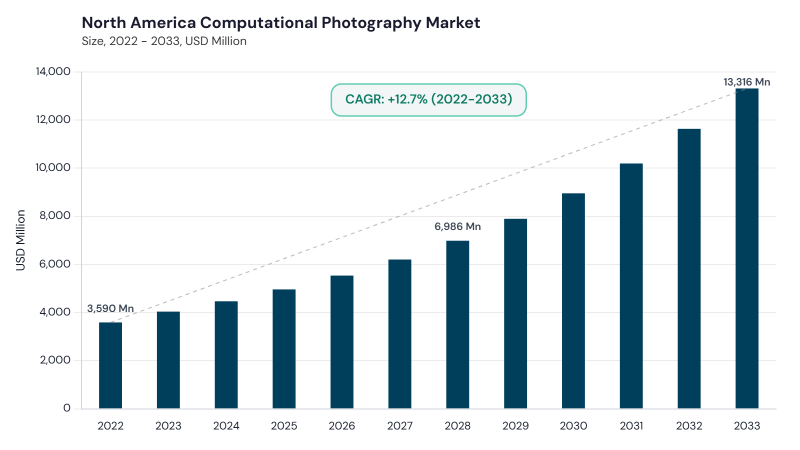
The U.S. market dominated the North America Computational Photography Market by Country in 2025 and would continue to be a dominant market till 2033; thereby, achieving a market value of USD 9.62 billion by 2033. The Canada market is expected to witness a CAGR of 13.6% during (2025 - 2033). Additionally, The Mexico market is expected to witness a CAGR of 15.1% during (2025 - 2033). The U.S. and Canada led the North America Computational Photography Market by Country with a market share of 74.8% and 15.9% respectively in 2025. The Mexico market is expected to witness significant growth throughout the forecast period.
The computational photography market in North America has developed rapidly because of strong advancements in artificial intelligence, smartphone imaging technologies, and semiconductor innovation. The region has become a major hub for AI-powered imaging systems due to the presence of leading technology companies, smartphone manufacturers, semiconductor developers, and imaging software providers. Initially focused on digital image enhancement and software processing, the market has evolved into a sophisticated ecosystem integrating machine learning, neural image processing, HDR imaging, semantic scene recognition, and depth sensing technologies.
The growing demand for high-quality mobile photography and immersive digital experiences continues to accelerate market expansion across North America. Smartphone manufacturers are increasingly integrating computational imaging technologies to improve low-light photography, portrait enhancement, computational zoom, and real-time image optimization capabilities. Social media growth, content creation trends, and increasing digital communication activities are also strengthening demand for AI-enabled imaging systems throughout the region.
Based on Architecture, the market is segmented into Single & Dual-Lens Camera, 16-Lens Camera, and Other Architecture. The Single & Dual-Lens Camera segment dominated the North America Computational Photography Market by Architecture in 2025 and would continue to be a dominant market till 2033 owing to increasing integration across smartphones and consumer electronics devices. The 16-Lens Camera segment is expected to witness notable growth during the forecast period due to rising deployment in advanced imaging applications requiring enhanced depth sensing and ultra-high-resolution photography.
Based on Product, the market is segmented into Smartphone Cameras, Machine Vision, AR/VR/Immersive Devices, and Digital Cameras. The Smartphone Cameras segment dominated the North America Computational Photography Market by Product in 2025 and would continue to maintain its dominance till 2033 due to increasing consumer demand for AI-enhanced mobile photography and rapid integration of computational imaging technologies in premium smartphones. The AR/VR/Immersive Devices segment is expected to witness strong growth throughout the forecast period owing to increasing adoption of immersive technologies across gaming, healthcare, media, and enterprise applications.
Based on Application, the market is segmented into Standard Digital Imaging, 3D Imaging, Augmented Reality, Virtual Reality, Mixed Reality, and Other Application. The Standard Digital Imaging segment dominated the North America Computational Photography Market by Application in 2025 owing to widespread deployment across smartphones, digital cameras, and consumer imaging devices. The Augmented Reality and Mixed Reality segments are expected to witness substantial growth due to increasing investments in immersive media technologies, AI-powered visualization systems, and interactive digital experiences.
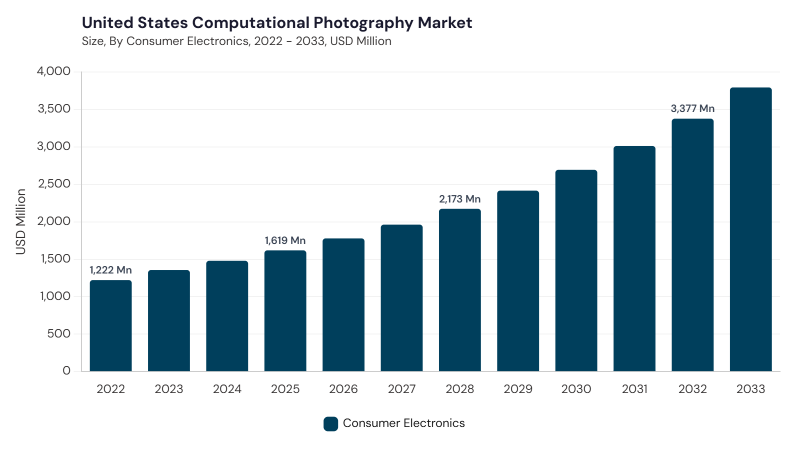
Based on Vertical, the market is segmented into Consumer Electronics, Automotive, Security & Surveillance, Media, Entertainment & Content Creation, Industrial, Healthcare, and Other Vertical. The Consumer Electronics segment dominated the North America Computational Photography Market by Vertical in 2025 due to rising adoption of AI-enabled imaging technologies in smartphones, tablets, and wearable devices. The Automotive segment is expected to witness significant growth during the forecast period owing to increasing deployment of computational imaging systems in autonomous vehicles, advanced driver assistance systems (ADAS), and intelligent transportation technologies.
Free Valuable Insights: The Global Computational Photography Market will hit USD 40.69 Billion billion by 2033, at a CAGR of 14.2%
The U.S. computational photography market is one of the most advanced globally because of strong investments in artificial intelligence, semiconductor innovation, and smartphone ecosystem development. Major technology companies continuously invest in computational imaging software, neural processing systems, and advanced camera architectures to enhance imaging performance across smartphones, AR/VR platforms, industrial systems, and automotive applications. Increasing adoption of immersive technologies and content creation platforms continues to strengthen market demand across the country.
The Canada computational photography market is witnessing steady growth due to increasing investments in AI research, advanced imaging technologies, and immersive media applications. Growing adoption of machine vision systems, healthcare imaging technologies, and industrial automation solutions is also contributing to market expansion.

By Architecture
By Product
By Application
By Vertical
By Country
Market valued at $5.53 billion in 2026, expected to reach $11.63 billion by 2032. Growth rate of 13.4% CAGR during 2025-2033.
The U.S. dominates with 74.8% market share in 2025. Canada follows with 15.9% share in the same year.
Canada market will grow at 13.6% CAGR during 2025-2033. Mexico shows faster growth at 15.1% CAGR during the same period.
Yes, the U.S. market will continue dominating through 2033. American market leadership expected to persist throughout the forecast period.
Our team of dedicated experts can provide you with attractive expansion opportunities for your business.




 Unique Offerings