The sample copy of this report is available for access.
The North America Artificial General Intelligence Market is expected to reach USD 499.0 Million by 2032, growing at a CAGR of 29.4% during 2026 - 2033.
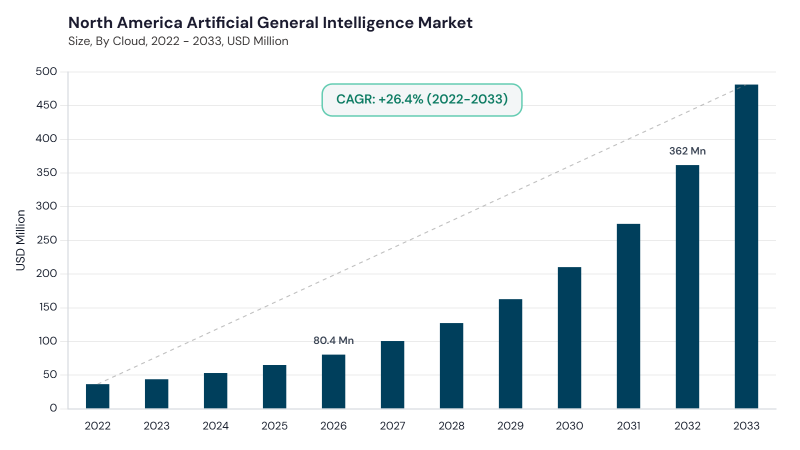
The North America Artificial General Intelligence Market is witnessing strong growth, supported by rapid AI model innovation, enterprise automation programs, cloud-based AI infrastructure, rising use of intelligent agents, multimodal data processing, advanced analytics, healthcare AI adoption, financial risk intelligence, defense modernization, and growing investment in systems capable of reasoning, learning, planning, and adapting across complex business functions.
The US holds a major position in the North America Artificial General Intelligence Market, supported by strong private and public sector AI investments, advanced research institutions, technology giants, cloud infrastructure, defense modernization, enterprise AI adoption, and rapid progress in foundation models, autonomous agents, and multimodal systems. Canada is also witnessing strong momentum through academic AI leadership, generative AI adoption, policy-backed AI governance, enterprise digital transformation, and growing research-commercial collaboration, while Mexico is emerging through industrial digitization, public-private AI initiatives, manufacturing automation, cloud-based AI platforms, and localized AGI-focused innovation.
Based on type, the market is segmented into Foundation Model-Based AGI, Autonomous Agent-Based AGI, Multi-Modal AGI Systems, and Hybrid Cognitive AGI. The Foundation Model-Based AGI market dominated the North America Artificial General Intelligence Market by Type in 2025, and would continue to be a dominant market till 2033; thereby, achieving a market value of USD 185.5 Million by 2032, growing at a CAGR of 28.6% during the forecast period. The Autonomous Agent-Based AGI market is expected to witness a CAGR of 29.8% during (2026 - 2033). Additionally, The Multi-Modal AGI Systems market is expected to witness highest CAGR of 30% during (2026 - 2033).
Foundation Model-Based AGI represents the leading category, supported by large-scale model development, broad language and reasoning capabilities, enterprise workflow automation, code generation, knowledge management, and strong adoption across software, customer support, finance, healthcare, and business intelligence use cases. Autonomous Agent-Based AGI forms a major category, driven by demand for systems that can plan tasks, execute workflows, interact with digital tools, and support decision-making with limited human intervention. Multi-Modal AGI Systems hold a strong position, supported by the ability to process text, images, audio, video, sensor inputs, and enterprise documents in integrated environments. Hybrid Cognitive AGI serves a specialized role by combining symbolic reasoning, machine learning, knowledge graphs, and domain rules for applications requiring explainability, structured decision logic, and higher reliability.
Based on deployment, the market is segmented into Cloud and On-Premises. The Cloud market dominated the North America Artificial General Intelligence Market by Deployment in 2025, and would continue to be a dominant market till 2033; thereby, achieving a market value of USD 361.8 Million by 2032, growing at a CAGR of 29.1 % during the forecast period. The On-Premises market is expected to witness a CAGR of 30.1% during (2026 - 2033).
Cloud represents the dominant deployment category, supported by scalable computing capacity, easier model access, lower infrastructure burden, faster experimentation, API-based integration, and strong adoption among enterprises developing AI-enabled applications. Cloud deployment is especially preferred for foundation models, agentic systems, multimodal platforms, and analytics workloads that require flexible processing power and frequent model updates. On-Premises deployment holds a relevant position, supported by data security needs, regulatory control, low-latency processing, sensitive workloads, and enterprise preference for direct infrastructure management. This model is more common in defense, government, banking, healthcare, and industrial environments where privacy, compliance, and operational control are central priorities.
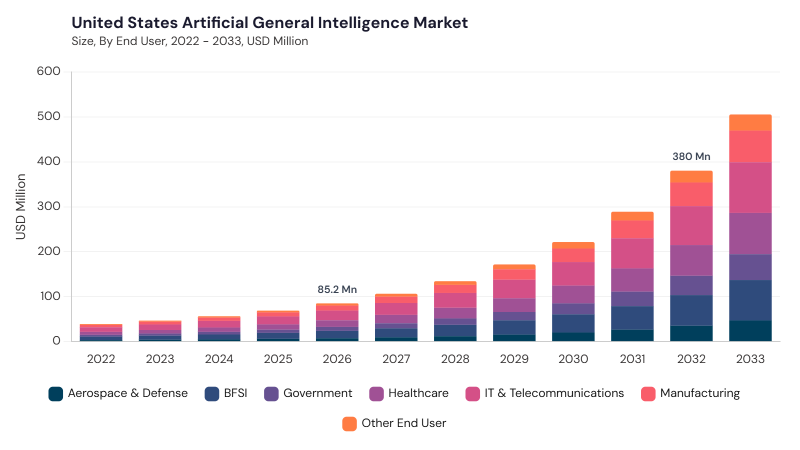
Based on end user, the market is classified into IT & Telecommunications, BFSI, Healthcare, Manufacturing, Government, Aerospace & Defense, and Other End User. IT & Telecommunications represents the leading end-user category, supported by software development automation, network optimization, customer service intelligence, cybersecurity analytics, cloud operations, and AI platform development. BFSI forms a strong demand area, driven by fraud detection, risk modeling, compliance automation, credit analysis, customer personalization, trading intelligence, and financial advisory tools. Healthcare contributes significant adoption through clinical decision support, medical imaging analysis, drug discovery, patient engagement, hospital operations, and administrative automation. Manufacturing uses AGI-oriented systems for predictive maintenance, quality inspection, production planning, digital twins, robotics coordination, and supply chain optimization. Government adoption is supported by public service automation, policy analysis, citizen support, security intelligence, and data-driven administration. Aerospace & Defense applies advanced AI to mission planning, simulation, autonomous systems, threat analysis, logistics, and operational intelligence, while Other End User includes education, energy, retail, media, legal services, and research organizations using AGI-related tools for productivity, analytics, and decision support.
Free Valuable Insights: The Global Artificial General Intelligence Market will hit USD 1,783.6 Million billion by 2033, at a CAGR of 30.2%
Based on country, the market is segmented into US, Canada, Mexico, and Rest of North America. The US is a major market for Artificial General Intelligence in North America, supported by foundational AI research, large-scale technology investments, cloud computing strength, advanced model development, defense modernization, enterprise AI integration, and strong activity across foundation models, multimodal reasoning, and hybrid human-AGI collaboration. Canada is witnessing growing adoption through academic AI leadership, generative AI integration, domestic AI sovereignty initiatives, regulatory governance, public-private partnerships, and localized AGI development across finance, healthcare, public services, and enterprise automation. Mexico is emerging through manufacturing digitization, AI policy development, research centers, cloud-based AI platforms, industrial automation, public-private collaborations, and localized AGI applications for supply chain, finance, and government services. Rest of North America is supported by generative AI adoption, regional policy alignment, localized AI solutions, enterprise automation, healthcare innovation, financial analytics, and growing collaboration among academic, commercial, and regulatory stakeholders.

By Type
By Deployment
By End User
By Country
Set to reach $499.0 Million by 2032, growing at 29.4% CAGR during 2026-2033.
Foundation Model-Based AGI will achieve $185.5 Million by 2032, growing at 28.6% CAGR during the forecast period.
Cloud deployment will reach $361.8 Million by 2032, growing at 29.1% CAGR during the forecast period.
Multi-Modal AGI Systems will witness the highest CAGR of 30% during 2026-2033.
On-Premises AGI deployment is expected to grow at a CAGR of 30.1% during 2026-2033.
Our team of dedicated experts can provide you with attractive expansion opportunities for your business.




 Unique Offerings