“Global Mobile Gaming Market to reach a market value of 263.33 Billion by 2032 growing at a CAGR of 9.9%”
The Global Mobile Gaming Market size is estimated at $136.08 billion in 2025 and is expected to reach $263.33 billion by 2032, rising at a market growth of 9.9% CAGR during the forecast period (2025-2032). This market is growing because more people are getting smartphones, internet access is getting cheaper, and 5G infrastructure is getting bigger. More people are using in-app purchases, cloud gaming, and immersive technologies like AR/VR, which increases engagement and revenue.
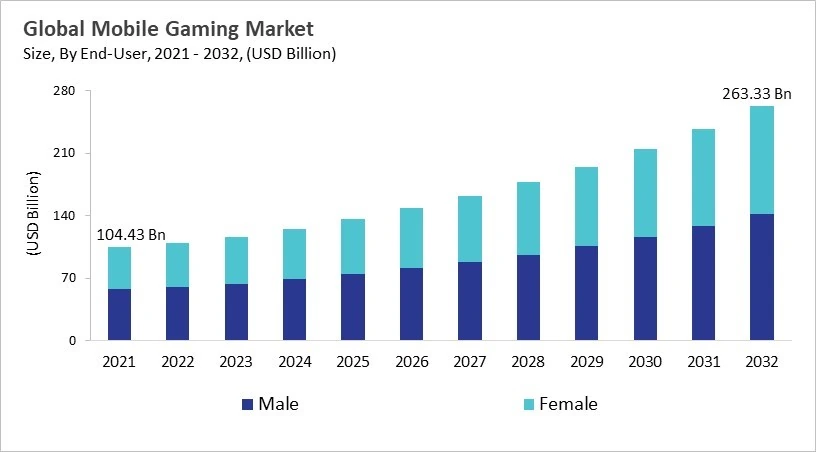
The mobile gaming market has developed from simple feature phone games into a global industry propelled by the widespread adoption of app distribution platforms and smartphones. Advances in mobile technology, like high-resolution displays, enhanced processing power, and faster connectivity, such as 5G, have allowed rich and more immersive gaming experiences. The mobile gaming market is further fuelled by rising smartphone penetration, especially in developing nations, and a diverse ecosystem of publishers and developers continuously innovating in monetization and game design. Monetization strategies like in-app purchases, freemium models, advertising, and subscription have played a crucial role in driving revenue, while digital infrastructure and supportive government policies have resulted in market expansion.
The mobile gaming market is shaped by key elements, including the growth of cloud gaming, which enables high-quality games to be streamed, and the rising use of artificial intelligence to improve personalization, gameplay, and user engagement. Advanced advertising formats and subscription-based models are also transforming revenue generation, offering more sustainable income streams. Enterprises in the mobile gaming market focus largely on partnerships, innovation, and content diversification to remain competitive. Also, the mobile gaming market seems to be competitive, with large enterprises and independent developers looking for user attention. The market growth depends on continuous innovation, retention strategies, effective user acquisition, and the ability to adapt to developing technologies, regional market dynamics, and consumer preferences.

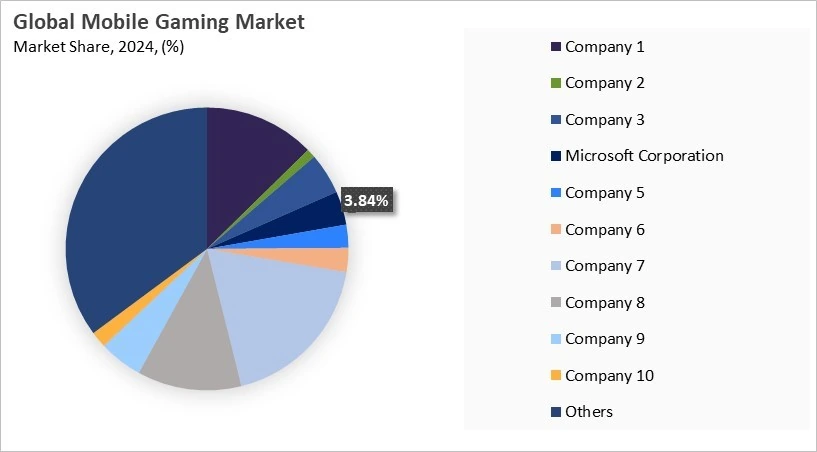
The leading players in the market are competing with diverse innovative offerings to remain competitive in the market. The above illustration shows the percentage of revenue shared by some of the leading companies in the market. The leading players of the market are adopting various strategies in order to cater demand coming from the different industries. The key developmental strategies in the market are Acquisitions, and Partnerships & Collaborations.
The COVID-19 pandemic mostly had favorable effects on the mobile gaming market. People played games more and got more into them during lockdowns and when they had to stay away from other people. People wanted to have fun with things that were easy to get to and use, so mobile gaming became a popular digital activity because it is portable and easy to access. The industry's digital transformation sped up because more people wanted it. To reach more people and make more money, developers had to improve the content, add social interaction features, and use omnichannel strategies. Also, the rise of remote work and online socializing made mobile devices even more important for entertainment. This meant that more money was spent on making them work better and handle more users. But the market also had problems, like more competition and the need for new ideas all the time to keep users interested after the pandemic's growth phase. Thus, the COVID-19 pandemic had a positive impact on the mobile gaming market.
Based on End-User, the market is segmented into Male, and Female. The female segment attained 45% revenue share in the mobile gaming market in 2024. The female segment continues to expand within the global mobile gaming market as mobile devices provide accessible and convenient digital entertainment options. Female gamers engage with a diverse range of genres, including puzzle, simulation, casual, and narrative-driven games that offer interactive and engaging gameplay experiences.
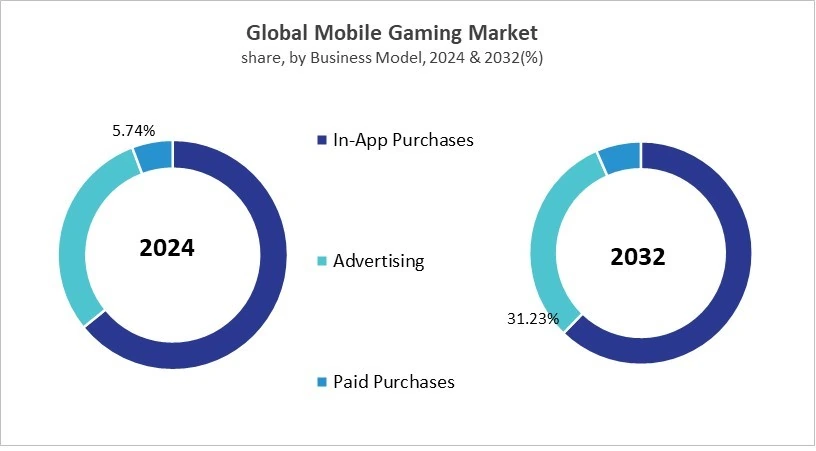
Based on Business Model, the market is segmented into In-App Purchases, Advertising, and Paid Purchases. The advertising segment recorded 30% revenue share in the mobile gaming market in 2024. The advertising segment plays an essential role in supporting revenue generation across the global mobile gaming ecosystem. Many mobile games incorporate advertising formats such as banner ads, interstitial advertisements, and rewarded video ads that allow players to gain bonuses, additional lives, or in-game currency after viewing promotional content.
Free Valuable Insights: Mobile Gaming Market Size to reach $263.33 by 2032
Region-wise, the Mobile Gaming Market is analyzed across North America, Europe, Asia Pacific, and LAMEA. The Asia Pacific segment gained 51% revenue share in the Mobile Gaming Market in 2024. In North America and Europe, the mobile gaming market is expected to expand at a significant rate. The market is driven by advanced digital infrastructure, high smartphone penetration, and strong consumer spending on entertainment. The North America market remains innovation-driven with widespread adoption of subscription services, premium games, and cloud gaming platforms. The region further benefits from the presence of major technology companies and game developers, propelling continuous advancements in AI integration, graphics, and cross-platform gaming experiences. Additionally, Europe mobile gaming market is projected to capture prominent growth during the forecast period. This is because of a diverse gaming audience, rising adoption of mobile-first gaming, especially in nations like Germany, France, and the UK. Regulatory frameworks related to digital content and data privacy shape monetization strategies, while regional content and multilingual offerings are necessary to capture regional audiences. Both regions focus on user engagement through esports integration, high-quality content, and advanced monetization models, which include subscriptions and in-app purchases.
The mobile gaming market is anticipated to grow at a substantial rate in the Asia Pacific and LAMEA regions. The market is driven by affordable internet access, rapid smartphone adoption, and a strong culture of gaming. The region is further known for its popularity of competitive and multiplayer games, and innovative monetization approaches like live-streaming integrations and microtransactions. Moreover, the LAMEA mobile gaming market is experiencing noticeable expansion, driven by rising mobile internet penetration and a digitally engaged population. The mobile gaming market showcases strong potential because of the increasing adoption of affordable smartphones and the enhanced infrastructure. Ad-supported models and lightweight game design are especially prevalent in LAMEA, as enterprises aim to cater to price-sensitive users while expanding their footprints in these regions.
| Report Attribute | Details |
|---|---|
| Market size value in 2025 | USD 136.08 Billion |
| Market size forecast in 2032 | USD 263.33 Billion |
| Base Year | 2024 |
| Historical period | 2021 to 2023 |
| Forecast Period | 2025 to 2032 |
| Revenue Growth Rate | CAGR of 9.9% from 2025 to 2032 |
| Number of Pages | 580 |
| Tables | 475 |
| Report Coverage | Market Trends, Revenue Estimation and Forecast, Segmentation Analysis, Regional and Country Breakdown, Market Share Analysis, Porter’s 5 Forces Analysis, Company Profiling, Companies Strategic Developments, SWOT Analysis, Winning Imperatives |
| Segments Covered | End-User, Business Model, Platform, Game Type, Region |
| Country Scope |
|
| Companies Included | Apple, Inc., Hulu, LLC (The Walt Disney Company), Electronic Arts, Inc., Microsoft Corporation, Nintendo Co., Ltd., Sony Corporation, Tencent Holdings Ltd., Google LLC (Alphabet Inc.), Take-Two Interactive Software, Inc., and Rovio Entertainment Corporation |
By End-User
By Business Model
By Platform
By Game Type
By Geography
Valued at USD 136.08 billion in 2025, reaching USD 263.33 billion by 2032 at 9.9% CAGR during 2025-2032.
Android dominates with a projected market value of $155.1 billion by 2032.
Apple, Inc., Hulu, LLC (The Walt Disney Company), and Electronic Arts hold dominant positions.
Asia Pacific leads at $136.06 billion by 2032; North America grows at 9.1% CAGR during 2025-2032.
In-App Purchases segment grows at 9.5% CAGR during the forecast period.
Male segment achieves $141.3 billion market value by 2032, representing the major gaming audience portion.
Our team of dedicated experts can provide you with attractive expansion opportunities for your business.








 Unique Offerings