“Global Mobile Enterprise Application Market to reach a market value of 289.32 Billion by 2032 growing at a CAGR of 12.6%”
The Global Mobile Enterprise Application Market size is estimated at $126.23 billion in 2025 and is expected to reach $289.32 billion by 2032, rising at a market growth of 12.6% CAGR during the forecast period (2025-2032). The anticipated rise is due to more businesses using mobile devices, more businesses relying on cloud-based solutions, and the need for businesses to run in real time. The strong market is supported by the growth of remote work, digital transformation projects, and the use of AI-powered apps. These things all help to speed up adoption and boost revenue growth.
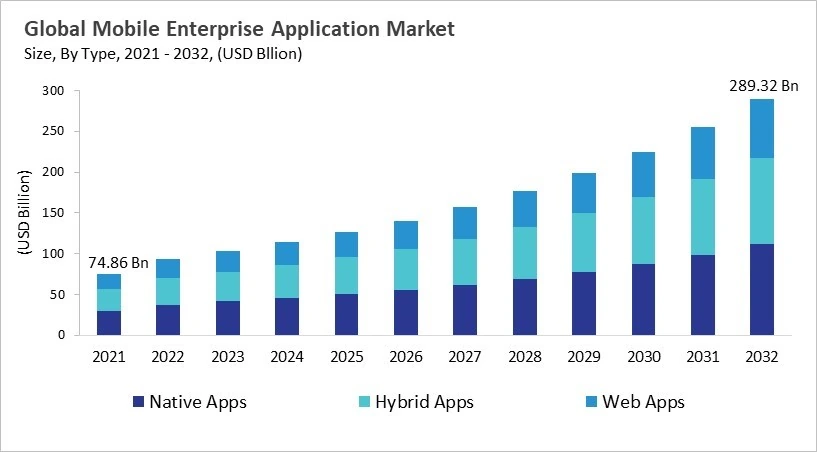
The mobile enterprise application market has developed with enterprises expanding business operations, supported by improved workforce mobility, and the need for real-time data access. The rapid adoption of tablets and smartphones shifted the market, allowing broader use of mobile devices for crucial functions. Advancements in cloud integration, mobile operating systems, and security frameworks substantially enhanced application adoption and performance. Key milestones like the development of cross-platform tools and the rise of Bring Your Own Device (BYOD) policies further surged growth, resulting in a shift from standalone apps to integrated enterprise mobility solutions emphasizing seamless integration, scalability, and robust security.
The mobile enterprise application market is driven by elements like the adoption of edge computing, which improves application responsiveness by processing data closer to users, and the rising usage of cross-platform frameworks that reduce costs and streamline development. Also, the integration of machine learning and AI is allowing automation, predictive analytics, and a more personalized user experience. Market players are focusing on strategic partnerships, innovation, and regional customization to stay competitive, alongside investing largely in security architectures and advanced technologies. The competitive landscape includes both regional and global players, positioning themselves ahead by security features, integration capabilities, and innovation, thereby creating a dynamic environment that emphasizes efficiency, agility, and user-centric design.
The major strategies followed by the market participants are Partnership as the key developmental strategy to keep pace with the changing demands of end users. For instance, In February, 2025, IBM Corporation and Juniper Networks are expanding their collaboration to integrate Mist AI and IBM watsonx, enhancing AI-driven enterprise network management. This partnership aims to improve IT operations, optimize mobile connectivity, and explore AI-powered insights for industries like healthcare and retail. Moreover, In February, 2025, IBM Corporation and Qualcomm expanded their collaboration to enhance enterprise AI across edge and cloud devices. By integrating IBM watsonx.governance with Qualcomm AI Inference Suite and optimizing Granite models, they enable secure, efficient AI-driven enterprise applications, supporting the Mobile Enterprise Application Market.
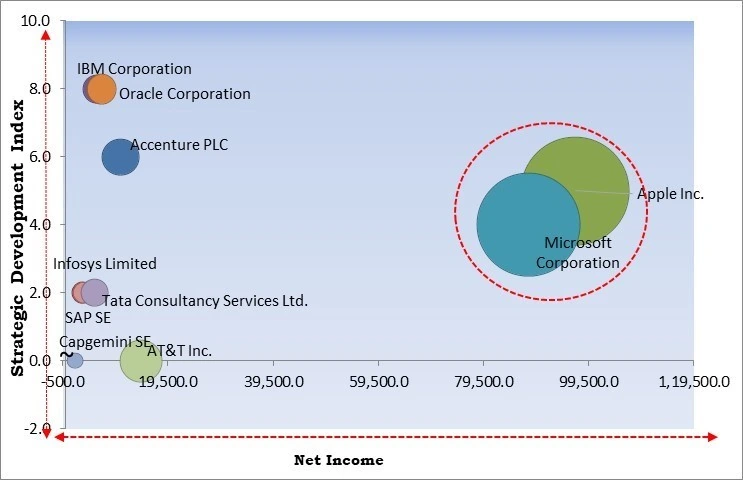
Based on the Analysis presented in the KBV Cardinal matrix; Apple, Inc. and Microsoft Corporation are the forerunners in the Mobile Enterprise Application Market. In January, 2024, Microsoft Corporation and Vodafone signed a 10-year strategic partnership to enhance generative AI, IoT, and cloud services for over 300 million businesses and consumers. The collaboration focuses on digital transformation, financial inclusion, enterprise growth, and modernizing Vodafone’s cloud infrastructure with Microsoft Azure. Companies such as AT&T Inc., IBM Corporation and Oracle Corporation are some of the key innovators in Mobile Enterprise Application Market.
Before the COVID-19 pandemic, the Mobile Enterprise Application Market was growing steadily. This was due to slow but steady improvements in business mobility and digital transformation efforts. The pandemic, on the other hand, stopped this progress by causing problems with the supply chain, delaying deployments, and making it harder to manage IT remotely. This made integration slower and made security risks higher. Some industries cut back on or put off investments because of uncertainty in the economy. However, the sudden switch to remote work greatly increased the need for mobile enterprise apps to keep businesses running. This time also led to new ideas, such as real-time workforce management, contactless operations, and better mobile security solutions. After the pandemic, the market bounced back with stronger demand. This was because more people realized how important mobile apps are in distributed work environments. As a result, the market has changed to focus on hybrid work models, AI integration, and a better user experience, which makes it even more important in the long term. Thus, the COVID-19 pandemic had negative impact on the Mobile Enterprise Application Market.

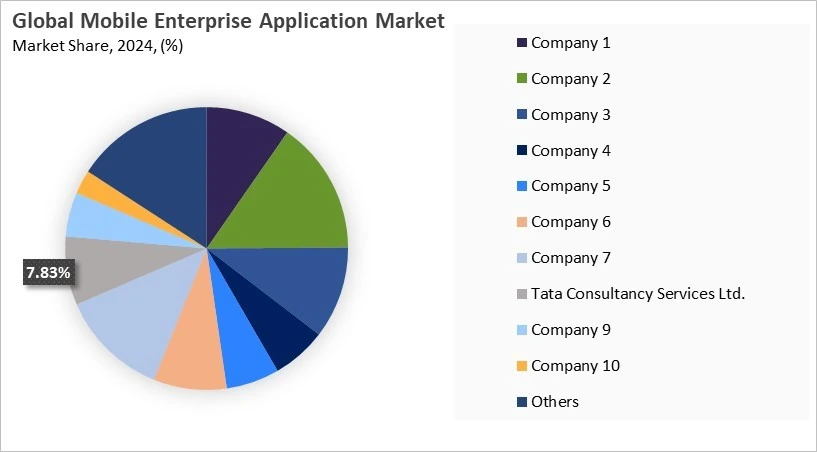
The leading players in the market are competing with diverse innovative offerings to remain competitive in the market. The above illustration shows the percentage of revenue shared by some of the leading companies in the market. The leading players of the market are adopting various strategies in order to cater demand coming from the different industries. The key developmental strategies in the market are Acquisitions, and Partnerships & Collaborations.
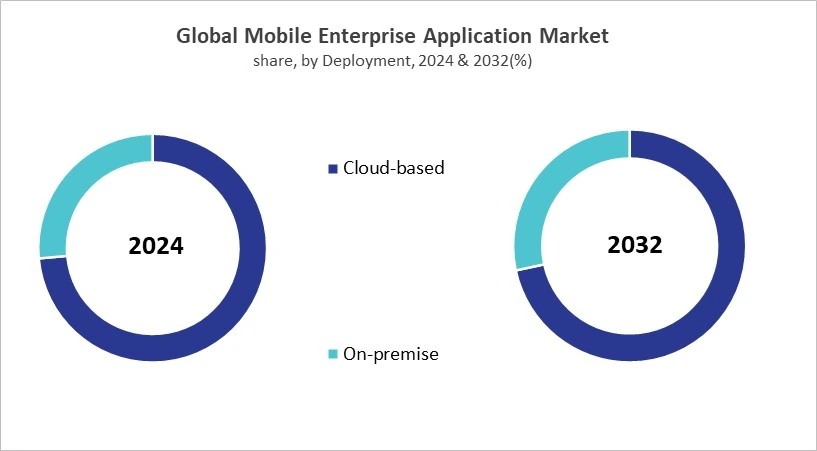
Based on Deployment, the market is segmented into Cloud-based, and On-premise. The On-premise segment garnered 26.43% revenue share in the Mobile Enterprise Application market in 2024. This segment holds a smaller share due to higher operational costs and limited scalability. However, it remains essential for organizations with strict data governance and regulatory requirements. Certain industries continue to prioritize on-premise deployments for enhanced control over sensitive data.
Based on Industry, the market is segmented into IT & Telecom, BFSI, Retail & E-commerce, Healthcare, Manufacturing, and Other Industry. The BFSI segment garnered 19.22% revenue share in the Mobile Enterprise Application market in 2024. This segment is witnessing strong demand due to the increasing need for secure mobile banking and financial services. Regulatory compliance and cybersecurity requirements drive enterprise application deployment. Growth in fintech solutions further contributes to expansion.
Free Valuable Insights: Mobile Enterprise Application Market Size to reach $289.32 by 2032
Region-wise, the Mobile Enterprise Application Market is analyzed across North America, Europe, Asia Pacific, and LAMEA. The North America segment holds 37.90% share in the Mobile Enterprise Application Market. The mobile enterprise application market is projected to capture prominent growth in North America and Europe. The market growth is supported by strong digital infrastructure and high adoption of enterprise mobility solutions. In North America, enterprises are early adopters of advanced technology like artificial intelligence and cloud computing, which substantially raises demand for sophisticated mobile applications. The widespread implementation of BYOD policies, the presence of major technology providers, and a strong focus on cybersecurity further propel market expansion.
Moreover, Europe mobile enterprise application market is growing rapidly, fueled by digital transformation initiatives across various industry verticals like healthcare, manufacturing, and finance, along with stringent data protection regulations such as GDPR that push for compliant and secure mobile solutions. Also, European companies prioritize operational efficiency and sustainability, resulting in growing adoption of mobile applications that enhance productivity and streamline workflows.
In the Asia Pacific and LAMEA regions, the mobile enterprise application market is anticipated to grow at a rapid rate. The market is growing because of expanding internet connectivity, rising smartphone penetration, and rapid enterprise digitalization. Asia Pacific is experiencing strong demand propelled by a large workforce, rising startup ecosystems, and government-supported digital initiatives. Organizations in the region are largely adopting scalable mobile solutions, often leveraging cross-platform frameworks.
Furthermore, LAMEA’s mobile enterprise application market is estimated to experience a substantial growth rate. The market is propelled by increasing awareness of enterprise mobility benefits, advancements in IT infrastructure, especially in industries such as retail, banking, and telecommunications. Rising investment in mobile-first strategies and cloud technologies is expected to surge adoption in the market.
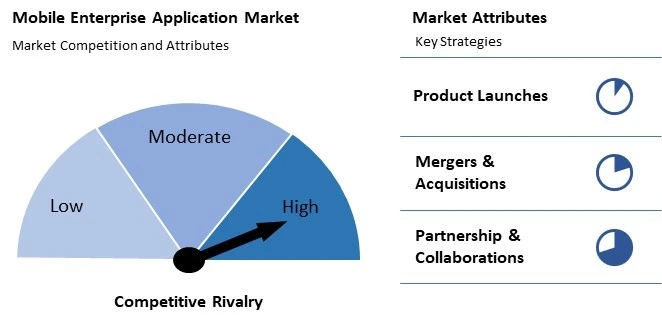
The Mobile Enterprise Application Market is very competitive and not well structured. Many vendors compete by offering new features, customization, and integration options. Companies use cloud and low-code platforms to improve the user experience, security, and scalability. To grow their capabilities and reach more customers, companies often form strategic partnerships and buy other companies. Strong competition and low switching costs make it necessary for companies to constantly change their products. New companies and niche players also make competition even stronger in a wide range of industry applications and deployment models.
| Report Attribute | Details |
|---|---|
| Market size value in 2025 | USD 126.23 Billion |
| Market size forecast in 2032 | USD 289.32 Billion |
| Base Year | 2024 |
| Historical period | 2021 to 2023 |
| Forecast Period | 2025 to 2032 |
| Revenue Growth Rate | CAGR of 12.6% from 2025 to 2032 |
| Number of Pages | 598 |
| Tables | 488 |
| Report Coverage | Market Trends, Revenue Estimation and Forecast, Segmentation Analysis, Regional and Country Breakdown, Competitive Landscape, Market Share Analysis, Porter’s 5 Forces Analysis, Company Profiling, Companies Strategic Developments, SWOT Analysis, Winning Imperatives |
| Segments Covered | Type, Application, Deployment, Industry, Region |
| Country Scope |
|
| Companies Included | IBM Corporation, Microsoft Corporation, Oracle Corporation, Infosys Limited, Capgemini SE, Accenture PLC, SAP SE, Tata Consultancy Services Ltd., Apple Inc., and AT&T Inc. |
By Type
By Application
By Deployment
By Industry
By Geography
Valued at USD 126.23 billion in 2025, it will reach USD 289.32 billion by 2032, growing at 12.6% CAGR during 2025-2032.
Native Apps captured maximum revenue in 2024, projected to achieve USD 111.4 billion by 2032.
IBM Corporation, Microsoft Corporation, Oracle Corporation, Infosys Limited, and Capgemini SE hold dominant positions.
North America dominated in 2024, reaching USD 105.5 billion by 2032. Asia Pacific grows at 13.2% CAGR during 2025-2032.
Cloud-based segment led maximum revenue in 2024, achieving USD 207.3 billion by 2032.
CRM segment grows at 11.5% CAGR during the forecast period.
Our team of dedicated experts can provide you with attractive expansion opportunities for your business.







 Unique Offerings