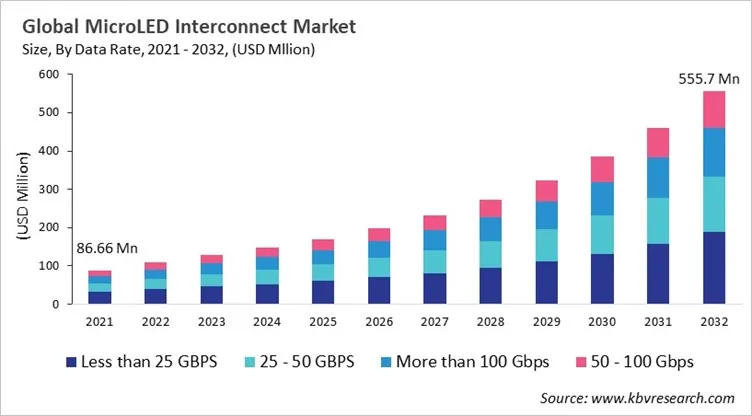
“Global MicroLED Interconnect Market to reach a market value of USD 555.7 Million by 2032 growing at a CAGR of 18.4%”
The Global MicroLED Interconnect Market size is expected to reach $555.7 Million by 2032, rising at a market growth of 18.4% CAGR during the forecast period.
The 25–50 GBPS segment serves more advanced applications that need moderate to high bandwidth. This includes mid-range TVs, industrial monitors, and entry-level augmented reality systems that require smoother rendering and faster data transfer than what lower-tier solutions can offer. Manufacturers who wish to improve the usability of their products without incurring the high costs associated with ultra-high-speed interconnects might consider this type of interconnect. Performance and energy efficiency are balanced. For products that are aiming for high definition and real-time responsiveness, this is a crucial step.
The COVID-19 pandemic drastically created a lot of problems across all the sectors, and Micro LED interconnect was no exception. In the initial stages of the pandemic, manufacturing plants were closed for a temporary period due lockdown in the leading production hubs such as, China, Taiwan, and South Korea. Hence, the inventory of important parts such as semiconductors, complex substrates and specialized bonding tools needed for MicroLED interconnect was very small. Due to the delay in the supply chain, production was affected which eventually reduce production and sales. Thus, the COVID-19 pandemic had a negative impact on the market.

One of the primary factors driving the growth of the MicroLED interconnect market is the increasing demand for ultra-high-resolution and energy-efficient display solutions globally. Due to their numerous advantages over more traditional OLED and LCD technologies, microLEDs represent a revolutionary advancement in display technology. These consist of improved contrast ratios, brightness, lifespans, and reaction times. From TVs and smartphones to AR/VR systems and automobile screens, businesses and individuals are searching for high-end visual experiences. Manufacturers are investing more in MicroLED technology as a result. Furthermore, the reising media and entertainment is rising, for instance, according to the THEME report 2021, published by the Motion Picture Association, the global box office collection for all films released in each country around the world was $21.3 billion in 2021, up 81% over 2020’s total because of theater re-openings following COVID-19 pandemic lockdowns. As a result, the MicroLED industry needs to develop new concepts at the interconnected level because more people are looking for displays that are brighter, sharper, and consume less energy.
Furthermore, the market for MicroLED interconnects is increasing swiftly because of the growing virtual reality, augmented reality (AR), and wearable electronics sectors. Small screens with lots of pixels, low latency, high brightness, and low power consumption are required for these applications. These characteristics are unique to microLED technology. Smart glasses, fitness trackers, and head-mounted displays are examples of wearable technology that can significantly reduce power consumption. Longer battery life and improved usability result from every milliwatt saved. Small, high-performing MicroLED screens and the interconnect solutions that enable them are in high demand as wearable electronics and immersive technologies continue to expand.
But the high cost of making them and the very complicated process of making them are the main things that are holding back the market for MicroLED interconnects. MicroLED displays have a lot of performance benefits over regular OLED and LCD technologies, but they haven't been widely used in business yet because of technical and financial problems. This is especially true for the interconnect layer, which is the most important link between the driving electronics and the MicroLED emitters. In conclusion, the market for MicroLED interconnects is still very limited because of the high costs and complicated manufacturing process. This makes it hard to sell them in large quantities and limits their use to high-end niches.
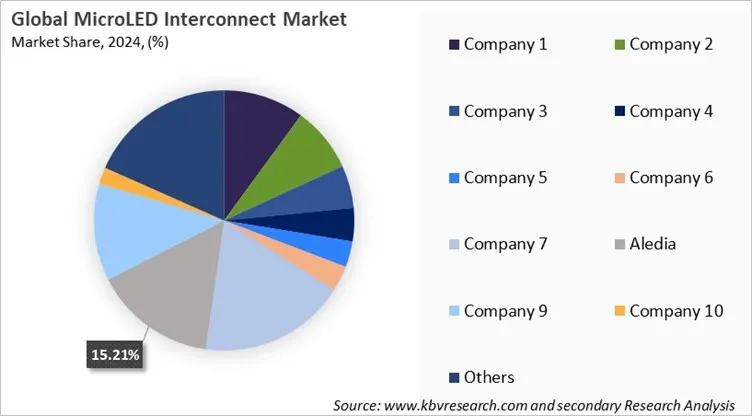
The leading players in the market are competing with diverse innovative offerings to remain competitive in the market. The above illustration shows the percentage of revenue shared by some of the leading companies in the market. The leading players of the market are adopting various strategies to cater to demand coming from the different industries. The key developmental strategies in the market are Acquisitions, and Partnerships & Collaborations.
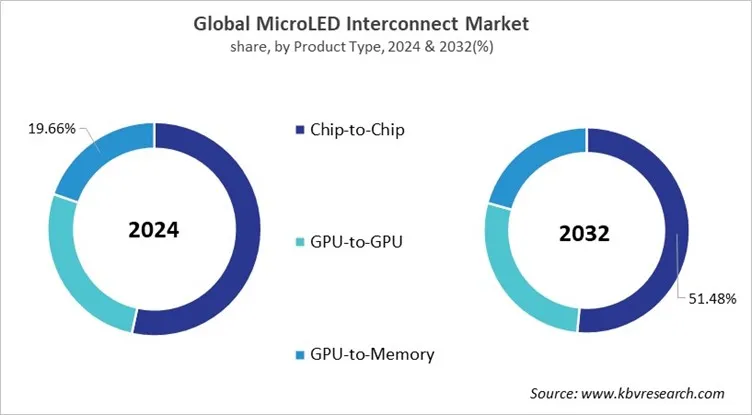
Based on product type, the MicroLED interconnect market is characterized into chip-to-chip, GPU-to-GPU, and GPU-to-memory.The chip-to-chip segment garnered 53% revenue share in the MicroLED interconnect market in 2024. Due to its necessity for seamless data transfer between various microelectronic components, the chip-to-chip segment accounts for a significant portion of the MicroLED interconnect market. MicroLED systems can swiftly collaborate and communicate between processing and driving circuits thanks to this kind of interconnect. It is especially useful for applications that demand high performance and low power consumption, like wearable technology, AR/VR headsets, and advanced display technologies. Its popularity is a result of the need for accurate, low-latency connections in compact architectures.
On the basis of data rate, the MicroLED interconnect market is classified into less than 25 GBPS, 25 - 50 GBPS, more than 100 Gbps, and 50 - 100 Gbps.The less than 25 GBPS segment acquired 36% the largest revenue share in the MicroLED interconnect market in 2024. Because it is compatible with many low-power display systems, the less than 25 GBPS data rate segment is the most widely used in the MicroLED interconnect market. Smartwatches, consumer-grade displays, and IoT-enabled screens that require dependable and consistent performance but do not require fast data transfer are all excellent candidates for this range.
By distance, the MicroLED interconnect market is divided into less than 1 meter, 1 - 5 meter, and more than 5 meter. The 1 – 5 meter segment garnered 36% revenue share in the MicroLED interconnect market in 2024. For medium-range applications, such as desktop monitors, automobile display clusters, and broadcasting equipment, where components are somewhat dispersed but still manage to fit in a small space, the 1 to 5 m range works well. These applications frequently need to strike a balance between speed and adaptability to transmit data and video without sacrificing signal quality.
| Category | Details |
|---|---|
| Use Case Title | Confidential |
| Date | 2025 |
| Entities Involved | Confidential |
| Objective | Enable robust and EMI-resistant data links between central processors and MicroLED instrument clusters and infotainment units across vehicle interiors. |
| Context and Background | Interconnects in the 1–5-meter range are suited for automotive applications where display modules are physically distant from ECUs or GPUs but within the vehicle cabin. |
| Description | Hyundai implemented Molex's automotive-grade interconnects with up to 5-meter reach for its MicroLED cockpit displays in luxury sedans. Samsung supplied high-luminance panels optimized for daylight readability. |
| Key Capabilities Deployed |
|
| Regions Covered |
|
| Benefits |
|
| Source | Confidential |
Free Valuable Insights: Global MicroLED Interconnect Market size to reach USD 555.7 Million by 2032
Region-wise, the MicroLED interconnect market is analyzed across North America, Europe, Asia Pacific, and LAMEA. The North America segment recorded 40% revenue share in the MicroLED interconnect market in 2024. North America is the leader in the MicroLED interconnect market because it has a strong presence in advanced display technologies and a lot of people want cutting-edge electronic devices. There are a lot of big tech companies and startups in the area that are working on MicroLED innovation, and the semiconductor ecosystem is well-established. Applications include high-end consumer electronics, automotive displays, defense systems, and professional-grade visual equipment.
| Report Attribute | Details |
|---|---|
| Market size value in 2024 | USD 147.2 Million |
| Market size forecast in 2032 | USD 555.7 Million |
| Base Year | 2024 |
| Historical Period | 2021 to 2023 |
| Forecast Period | 2025 to 2032 |
| Revenue Growth Rate | CAGR of 18.4% from 2025 to 2032 |
| Number of Pages | 333 |
| Number of Tables | 372 |
| Report coverage | Market Trends, Revenue Estimation and Forecast, Segmentation Analysis, Regional and Country Breakdown, Market Share Analysis, Porter’s 5 Forces Analysis, Company Profiling, Companies Strategic Developments, SWOT Analysis, Winning Imperatives |
| Segments covered | Product Type, Data Rate, Distance, Region |
| Country scope |
|
| Companies Included | Samsung Electronics Co., Ltd. (Samsung Group), Apple, Inc., Sony Corporation, LG Electronics, Inc. (LG Corporation), AU Optronics Corporation, BOE Technology Group Co., Ltd., AvicenaTech, Corp., Aledia, Ayar Labs, Inc. and EPISTAR Corporation |
By Product Type
By Data Rate
By Distance
By Geography
This Market size is expected to reach $555.7 Million by 2032.
Surging Demand for High-Resolution and Power-Efficient Displays are driving the Market in coming years, however, High Manufacturing Costs and Complex Fabrication Processes restraints the growth of the Market.
Samsung Electronics Co., Ltd. (Samsung Group), Apple, Inc., Sony Corporation, LG Electronics, Inc. (LG Corporation), AU Optronics Corporation, BOE Technology Group Co., Ltd., AvicenaTech, Corp., Aledia, Ayar Labs, Inc. and EPISTAR Corporation
The expected CAGR of this Market is 18.4% from 2023 to 2032.
The Less than 1 meter segment is leading the Market by Distance in 2024; thereby, achieving a market value of $205.5 Million by 2032.
The North America region dominated the Market by Region in 2024, and would continue to be a dominant market till 2032; thereby, achieving a market value of $210.5 Million by 2032.
Our team of dedicated experts can provide you with attractive expansion opportunities for your business.







 Unique Offerings