The sample copy of this report is available for access.
“Global Medical AI Apps Market to reach a market value of USD 4.37 Billion by 2033 growing at a CAGR of 18.8%”
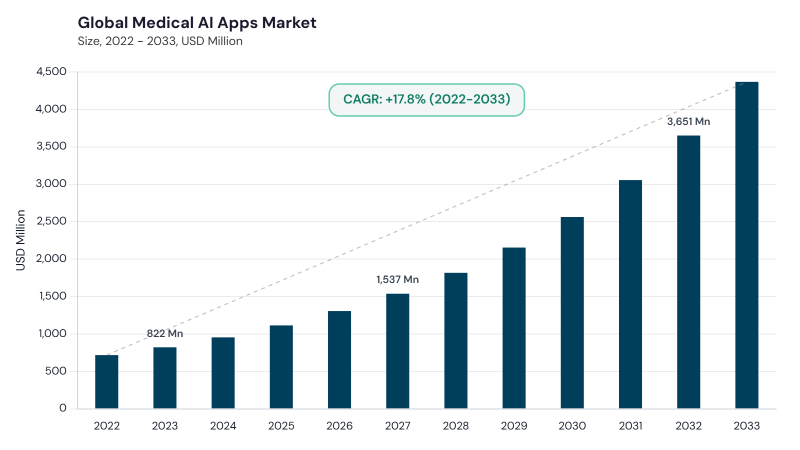
The Global Medical AI Apps Market size is expected to reach USD 4.37 billion by 2033, rising at a market growth of 18.8% CAGR during the forecast period.
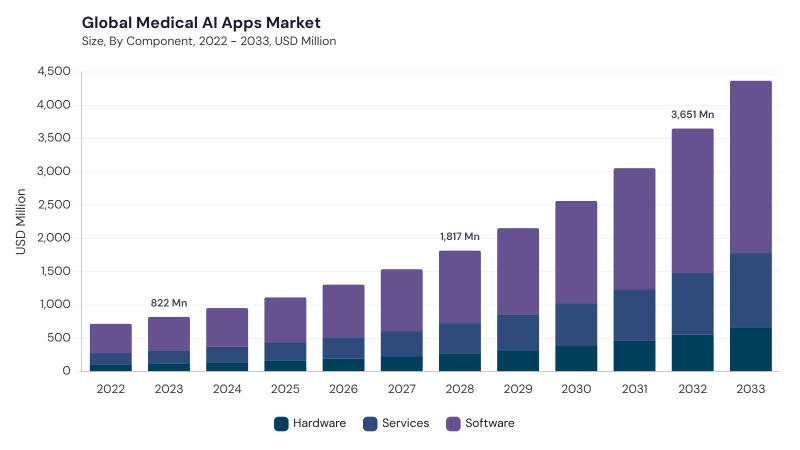
Growth in the Medical AI Apps Market is driven by the increasing integration of artificial intelligence across healthcare ecosystems to improve diagnostics, patient management, clinical decision-making, and operational efficiency. The growing prevalence of chronic diseases, rising demand for precision medicine, and rapid expansion of telehealth infrastructure are accelerating the adoption of AI-powered healthcare applications worldwide. Advancements in machine learning, natural language processing, predictive analytics, and cloud-based healthcare platforms are further strengthening market expansion from 2025-2033.
The Global Medical AI Apps Market has evolved from limited experimental healthcare applications into a large-scale data-driven ecosystem that is transforming diagnostics, treatment planning, patient monitoring, and hospital operations. Initially, AI applications in healthcare were primarily focused on diagnostic support and imaging interpretation. However, advancements in machine learning algorithms, cloud computing, natural language processing, and predictive analytics have significantly broadened the scope of AI-driven healthcare solutions. Today, medical AI applications are increasingly integrated into hospital workflows, telemedicine platforms, clinical decision support systems, and personalized medicine initiatives.
Healthcare providers globally are leveraging AI applications to improve operational efficiency, reduce diagnostic errors, and optimize patient outcomes. AI-powered imaging tools, predictive analytics solutions, and intelligent workflow automation platforms are enabling healthcare institutions to streamline clinical processes while improving decision-making accuracy. Furthermore, growing investments in healthcare IT infrastructure and digital transformation initiatives are accelerating AI deployment across hospitals, diagnostic centers, and clinics.
The market is also witnessing rising adoption of AI-driven remote patient monitoring solutions and automated administrative applications that reduce healthcare workload and improve resource allocation. Governments and regulatory bodies across major regions are increasingly focusing on AI governance, transparency, and compliance frameworks, creating a more structured environment for AI deployment in healthcare. As a result, Medical AI Apps are rapidly transitioning from pilot-stage technologies into scalable and commercially viable healthcare solutions.
The major strategies followed by market participants are Partnerships, Collaborations & Agreements as the key developmental strategy to keep pace with the changing demands of healthcare providers and patients. For instance, healthcare technology companies are increasingly collaborating with hospitals, diagnostic centers, and cloud service providers to improve AI integration into clinical workflows. In addition, strategic investments in AI-enabled diagnostic platforms, predictive healthcare analytics, and remote patient monitoring solutions are strengthening competitive positioning in the market.
The COVID-19 pandemic positively accelerated the adoption of Medical AI Apps globally as healthcare systems faced unprecedented pressure to improve diagnostics, remote monitoring, and operational efficiency. During the pandemic, hospitals and healthcare providers increasingly adopted AI-powered imaging applications, predictive analytics, and telemedicine solutions to support patient management and disease detection. AI-driven healthcare tools were extensively used to analyze medical imaging scans, optimize hospital resource allocation, and improve remote patient monitoring capabilities.
The rapid digital transformation across healthcare systems further boosted investments in healthcare IT infrastructure and cloud-based AI solutions. Telehealth expansion and the increasing demand for contactless healthcare delivery accelerated the deployment of AI-powered applications in clinical workflows. However, challenges related to data privacy, interoperability, and regulatory compliance remained critical concerns during large-scale implementation. Overall, the pandemic significantly strengthened long-term adoption trends in the Medical AI Apps Market.

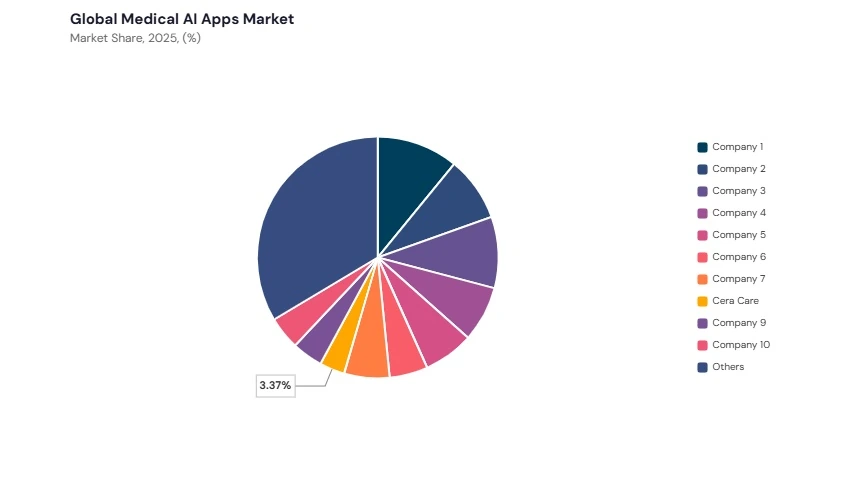
The leading players in the market are competing with diverse AI-powered healthcare offerings to remain competitive in the market. Companies are focusing on advanced machine learning algorithms, predictive healthcare analytics, cloud-based deployment models, and real-time imaging analysis tools to strengthen their market presence. Strategic collaborations with healthcare providers, hospitals, and cloud infrastructure companies are further accelerating competitive differentiation. The key developmental strategies in the market are Partnerships & Collaborations, Product Innovations, and AI Platform Expansion.
Based on component, the Medical AI Apps market is segmented into Software, Hardware, and Services. The Software segment accounted for the largest revenue share of 60.71% in 2025. This segment is driven by increasing adoption of AI-powered platforms for diagnostics, workflow automation, predictive analytics, and clinical decision support systems. Healthcare providers are increasingly prioritizing scalable and interoperable AI software solutions to improve efficiency and patient outcomes. Continuous advancements in machine learning and cloud-based deployment technologies are further accelerating segment growth.
Based on application, the Medical AI Apps market is categorized into Medical Imaging & Diagnostics, Clinical Decision Support Systems (CDSS), Remote Patient Monitoring, Hospital Workflow & Administrative AI, and Other Application. The Medical Imaging & Diagnostics segment dominated the market with a 33.94% revenue share in 2025 due to growing utilization of AI-powered radiology and imaging tools. AI algorithms are improving diagnostic accuracy, reducing interpretation time, and supporting early disease detection across healthcare institutions globally.
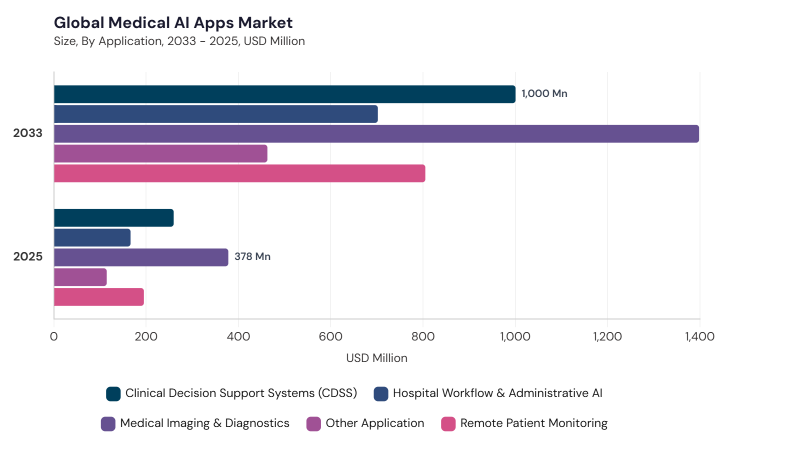
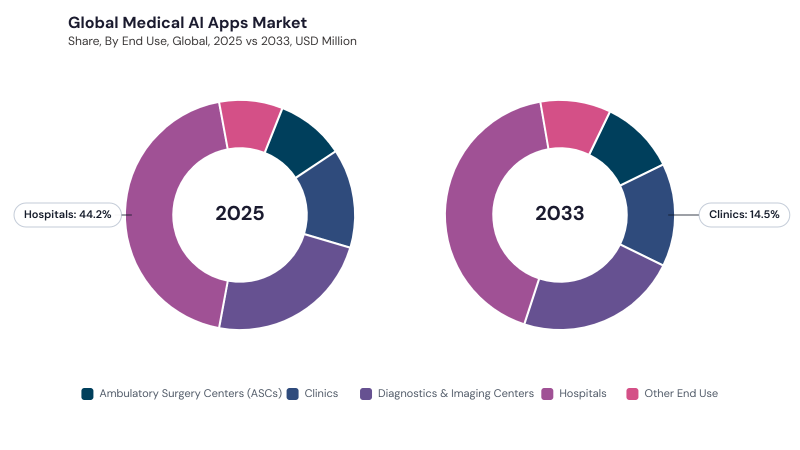
By end use, the Medical AI Apps market is divided into Hospitals, Diagnostics & Imaging Centers, Clinics, Ambulatory Surgery Centers (ASCs), and Other End Use. The Hospitals segment dominated the market with a 44.16% revenue share in 2025 due to increasing AI integration across hospital workflows, diagnostics, treatment planning, and resource management. Hospitals are leveraging AI applications to enhance operational efficiency, reduce administrative burden, and improve patient care outcomes.
Free Valuable Insights: Medical AI Apps Market Size to reach $4.37 Billion by 2033
Region-wise, the Medical AI Apps Market is analyzed across North America, Europe, Asia Pacific, and LAMEA. North America dominated the market in 2025 due to the presence of advanced healthcare infrastructure, high healthcare IT investments, and strong adoption of AI technologies across hospitals and diagnostic centers. The United States and Canada are witnessing increasing deployment of AI-powered healthcare applications for diagnostics, predictive analytics, and workflow automation.
Europe is emerging as a strong growth region due to increasing healthcare digitization, supportive AI governance frameworks, and expansion of telemedicine services. Regulatory initiatives such as the EU AI Act are encouraging responsible and transparent AI deployment across healthcare systems.
Asia Pacific and LAMEA are witnessing rising adoption of cloud-based AI healthcare solutions as governments and healthcare providers invest in digital healthcare infrastructure. Increasing awareness regarding AI-enabled diagnostics, telemedicine expansion, and growing healthcare modernization initiatives are accelerating market penetration across developing economies.
The Medical AI Apps Market is highly competitive and characterized by rapid technological innovation, growing healthcare digitization, and increasing AI integration across healthcare systems. Competition centers on the ability to deliver scalable AI-powered healthcare platforms that improve diagnostics, operational efficiency, and patient outcomes. Vendors are differentiating themselves through predictive analytics, AI-enabled imaging solutions, workflow automation tools, and cloud-based healthcare applications.
Strategic partnerships with hospitals, healthcare providers, cloud infrastructure companies, and research institutions are playing a crucial role in strengthening competitive positioning. In addition, explainability, interoperability, regulatory compliance, and data security are becoming critical competitive differentiators across the global healthcare AI ecosystem.
Medical AI Apps Market Coverage:
| Report Attribute | Details |
|---|---|
| Market size value in 2026 | USD 1.31 Billion |
| Market size forecast in 2033 | USD 4.37 Billion |
| Base Year | 2025 |
| Historical period | 2022 to 2024 |
| Forecast Period | 2026 to 2033 |
| Revenue Growth Rate | CAGR of 18.8% from 2026 to 2033 |
| Number of Pages | 591 |
| Number of Tables | XX |
| Report Coverage | Market Trends, Revenue Estimation and Forecast, Segmentation Analysis, Regional and Country Breakdown, Competitive Landscape, Market Share Analysis, Porter’s 5 Forces Analysis, Company Profiling, Companies Strategic Developments, SWOT Analysis, Winning Imperatives |
| Segments Covered | Component, Application, End Use, Region |
| Country Scope | North America (US, Canada, Mexico, and Rest of North America), Europe (Germany, UK, France, Russia, Spain, Italy, and Rest of Europe), Asia Pacific (Japan, China, India, South Korea, Singapore, Malaysia, and Rest of Asia Pacific), LAMEA (Brazil, Argentina, UAE, Saudi Arabia, South Africa, Nigeria, and Rest of LAMEA) |
| Companies Included | Tempus AI, Inc., Viz.ai, Inc., Aidoc Medical Ltd., NVIDIA Corporation, Microsoft Corporation, Google LLC, Amazon Web Services, Inc., Siemens Healthineers AG, GE HealthCare Technologies, Inc., Philips Healthcare |
By Component
By Application
By End Use
By Geography
Valued at USD 1.31 billion in 2026, reaching USD 4.37 billion by 2033 at 18.8% CAGR during 2026-2033.
Software leads the market, projected to achieve $2.59 billion by 2033.
Tempus AI Inc., Viz.ai Inc., and Aidoc Medical Ltd. hold dominant positions in this space.
North America dominates, achieving $1.73 billion by 2033. Europe grows at 18.3% CAGR during 2026-2033.
Growing adoption of AI-powered diagnostic imaging and rising demand for predictive analytics are pushing market expansion.
Medical Imaging & Diagnostics generates maximum revenue share, growing at 18.0% CAGR during the forecast period.
Our team of dedicated experts can provide you with attractive expansion opportunities for your business.








 Unique Offerings