The sample copy of this report is available for access.
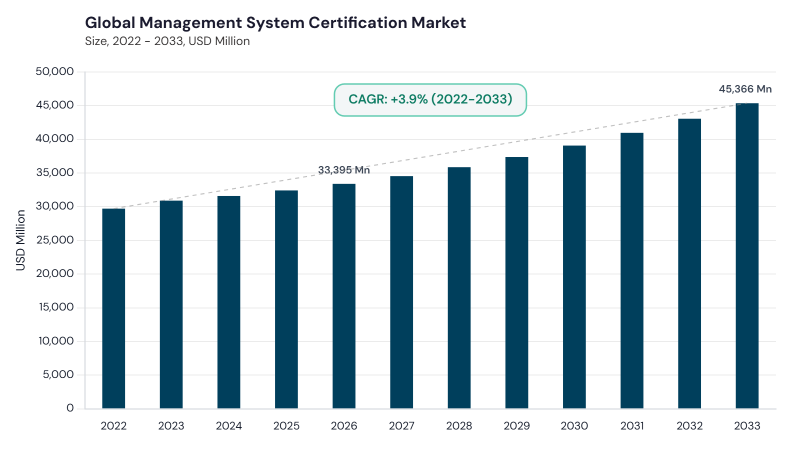
“Global Management System Certification Market to reach a market value of USD 45,365.76 Million by 2033 growing at a CAGR of 4.5%”
The Global Management System Certification Market expected to reach $45365.8 million by 2033, growing at a CAGR of 4.5% during 2026 - 2033.
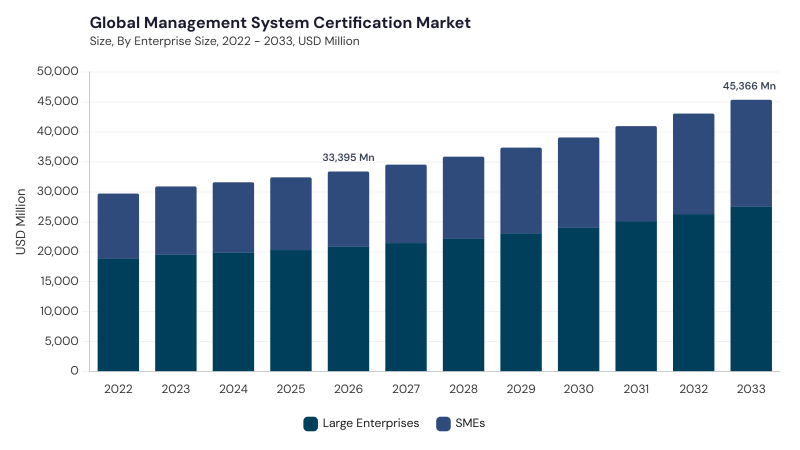
The Global Management System Certification Market is expected to witness significant growth during the forecast period, driven by increasing regulatory compliance requirements, rising focus on operational excellence, growing sustainability initiatives, and expanding adoption of internationally recognized management standards. Organizations across industries are increasingly implementing management system certifications to improve quality assurance, strengthen governance frameworks, enhance risk management capabilities, and support global business competitiveness.
The market continues to evolve through advancements in digital compliance platforms, AI-enabled audit solutions, blockchain-based verification systems, and integrated management frameworks. Growing regulatory complexity, expansion of global supply chains, and increasing focus on corporate sustainability are creating significant growth opportunities. Furthermore, certification providers are investing in digital infrastructure, remote auditing capabilities, and industry-specific certification solutions to improve operational efficiency and enhance client value.
The Management System Certification Market is characterized by moderate consolidation and strong compliance-driven competition. Market participants compete through accreditation strength, audit quality, technological capabilities, sector expertise, and global certification networks. Strategic partnerships, geographic expansion, digital transformation initiatives, and sustainability-focused certification programs remain key growth strategies adopted by industry participants.
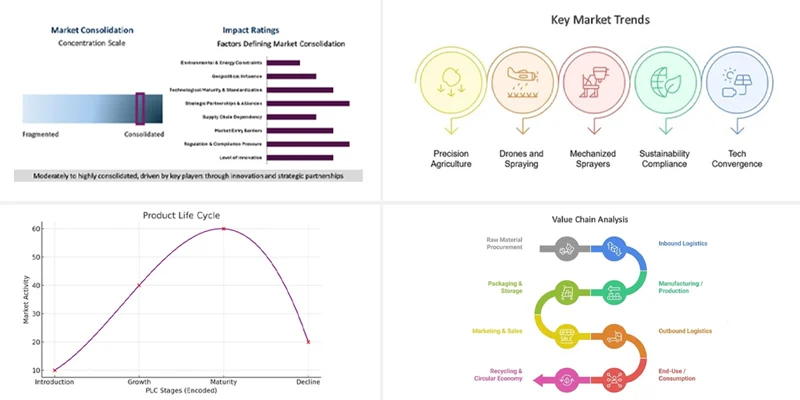


The Management System Certification Market demonstrates a moderately consolidated competitive structure supported by global certification bodies, accreditation organizations, compliance service providers, and digital compliance solution vendors. Market leaders continue strengthening their positions through investments in AI-enabled auditing, sustainability certification programs, cybersecurity certifications, and digital compliance platforms. The market remains highly compliance-oriented, with competition increasingly focused on accreditation coverage, audit quality, digital transformation, industry specialization, and regulatory expertise. Strategic partnerships, technology development, service expansion, and geographic penetration continue to shape competitive dynamics across the industry.
Based on Enterprise Size, the market is segmented into Large Enterprises and SMEs.
The Large Enterprises market dominated the Global Management System Certification Market by Enterprise Size in 2025, and would continue to be a dominant market till 2033; thereby, achieving a market value of $27511.8 million by 2033, growing at a CAGR of 4.1 % during the forecast period. The SMEs market is expected to witness a CAGR of 5.1% during (2026 - 2033).
The Large Enterprises market dominated the Global Management System Certification Market by Enterprise Size in 2025 and would continue to be a dominant market till 2033. The SMEs market is expected to witness significant growth during the forecast period.
Large enterprises continue to account for a substantial share of certification adoption owing to increasing regulatory compliance requirements, multinational business operations, and greater emphasis on integrated governance frameworks. SMEs are increasingly adopting management system certifications to improve operational efficiency, strengthen customer confidence, enhance competitiveness, and gain access to international supply chains, while the growing availability of digital compliance tools and remote auditing services continues to support certification adoption across smaller organizations.
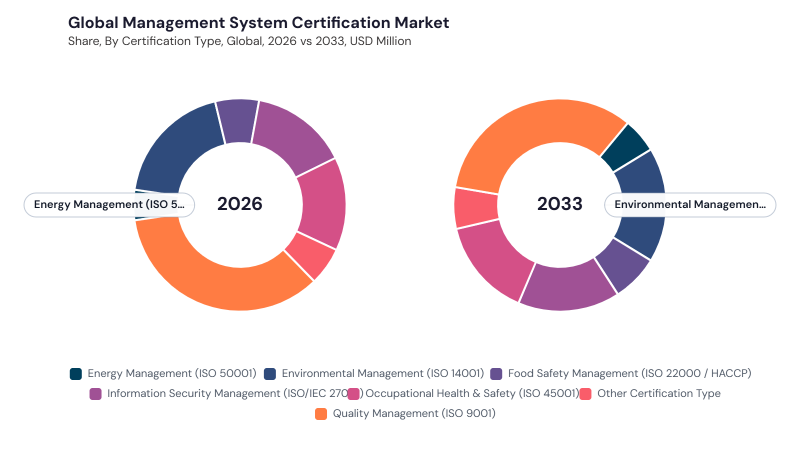
Based on Certification Type, the market is segmented into Quality Management (ISO 9001), Environmental Management (ISO 14001), Information Security Management (ISO/IEC 27001), Occupational Health & Safety (ISO 45001), Food Safety Management (ISO 22000/HACCP), Energy Management (ISO 50001), and Other Certification Types.
The Quality Management (ISO 9001) market dominated the Global Management System Certification Market by Certification Type in 2025, and would continue to be a dominant market till 2033; thereby, achieving a market value of $15099.7 million by 2033, growing at a CAGR of 3.7 % during the forecast period. The Environmental Management (ISO 14001) market is expected to witness a CAGR of 3.3% during (2026 - 2033).
The Quality Management (ISO 9001) market dominated the Global Management System Certification Market by Certification Type in 2025 and would continue to be a dominant market till 2033. The Information Security Management (ISO/IEC 27001) market is expected to witness significant growth during the forecast period.
Quality Management certifications continue to witness widespread adoption across industries owing to their role in improving operational consistency and customer satisfaction. Environmental Management certifications are gaining traction due to increasing sustainability initiatives and regulatory requirements, while Information Security Management certifications are benefiting from growing cybersecurity concerns and digital transformation activities. Occupational Health & Safety certifications remain essential for workplace safety and compliance management, whereas Food Safety Management certifications support quality assurance across food supply chains.
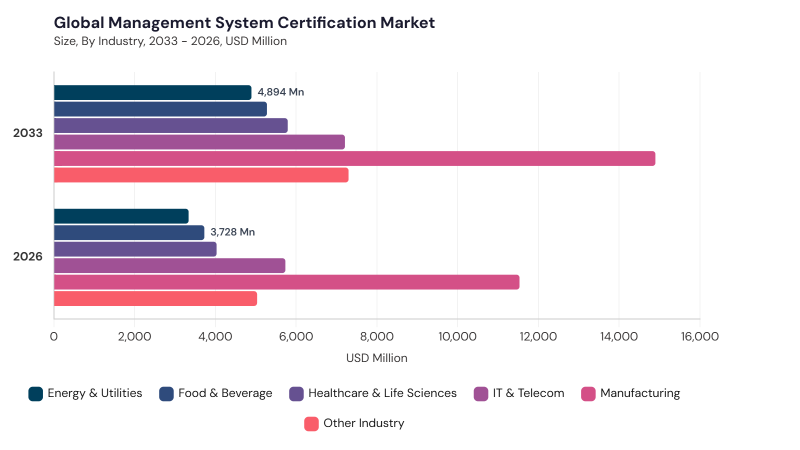
Based on Industry, the market is segmented into Manufacturing, IT & Telecom, Healthcare & Life Sciences, Food & Beverage, Energy & Utilities, and Other Industries.
The Manufacturing market dominated the Global Management System Certification Market by Industry in 2025, and would continue to be a dominant market till 2033; thereby, achieving a market value of $14895.6 million by 2033, growing at a CAGR of 3.7 % during the forecast period. The IT & Telecom market is expected to witness a CAGR of 3.3% during (2026 - 2033). Additionally, The Healthcare & Life Sciences market is expected to witness highest CAGR of 5.3% during (2026 - 2033).
The Manufacturing market dominated the Global Management System Certification Market by Industry in 2025 and would continue to be a dominant market till 2033. The IT & Telecom market is expected to witness significant growth during the forecast period.
Manufacturing remains the leading industry segment due to strong demand for quality assurance, operational standardization, and regulatory compliance frameworks. IT & Telecom organizations are increasingly implementing certifications to strengthen cybersecurity and information governance, while Healthcare & Life Sciences companies focus on quality management and patient safety standards. Food & Beverage organizations continue adopting certifications to improve food safety and supply chain transparency, whereas Energy & Utilities companies utilize certification frameworks to support sustainability and operational efficiency objectives.
Free Valuable Insights: Management System Certification Market Size to reach $45,365.76 Million by 2033
Region-wise, the Management System Certification Market is analyzed across North America, Europe, Asia Pacific, and LAMEA.
The Europe market dominated the Global Management System Certification Market by Region in 2025, and would continue to be a dominant market till 2033; thereby, achieving a market value of $12376.7 million by 2033, growing at a CAGR of 4.1 % during the forecast period. The Asia Pacific market is expected to witness a CAGR of 5% during (2026 - 2033). Additionally, The Europe market is expected to witness a CAGR of 3.9% during (2026 - 2033).
The Europe market dominated the Global Management System Certification Market by Region in 2025 and would continue to be a dominant market till 2033. The Asia Pacific market is expected to witness the highest growth during the forecast period.
Europe continues to lead the market due to stringent regulatory frameworks, strong sustainability initiatives, and widespread adoption of international management standards. Asia Pacific is witnessing rapid growth supported by industrialization, export-oriented manufacturing, and increasing awareness regarding quality and compliance standards. North America continues to benefit from strong corporate governance practices, cybersecurity requirements, and digital transformation initiatives, while LAMEA is experiencing steady growth driven by infrastructure development, industrial modernization, and expanding participation in international trade activities.
| Report Attribute | Details |
|---|---|
| Market size value in 2026 | USD 33,394.70 Million |
| Market size forecast in 2033 | USD 45,365.76 Million |
| Base Year | 2025 |
| Historical Period | 2022 to 2024 |
| Forecast Period | 2026 to 2033 |
| Revenue Growth Rate | CAGR of 4.5% from 2026 to 2033 |
| Number of Pages | 709 |
| Tables | 780 |
| Report Coverage | Market Trends, Revenue Estimation and Forecast, Segmentation Analysis, Regional and Country Breakdown, Competitive Landscape, Market Share Analysis, Company Profiling, Strategic Developments, SWOT Analysis, and Winning Imperatives |
| Segments Covered | Enterprise Size, Certification Type, Industry, Region |
| Country Scope |
|
| Companies Included | SGS S.A., Bureau Veritas SA, Intertek Group PLC, TÜV SÜD AG, TÜV Rheinland AG, DNV AS, DEKRA SE, British Standards Institution (BSI), TÜV NORD AG, and Applus+ |
By Enterprise Size
By Certification Type
By Industry
By Geography
Expected to reach USD 45,365.8 million by 2033, growing at 4.5% CAGR during 2026-2033.
Quality Management (ISO 9001) leads, growing at a 3.7% CAGR during 2026-2033.
SGS S.A., Bureau Veritas SA, Intertek Group PLC, TÜV SÜD AG, TÜV Rheinland AG are key players.
Europe dominates with a market value of USD 12,376.7 million by 2033.
Enhanced regulatory compliance and risk mitigation imperatives drive market growth.
Asia Pacific is expected to witness a 5.0% CAGR during 2026-2033.
Our team of dedicated experts can provide you with attractive expansion opportunities for your business.







 Unique Offerings