The sample copy of this report is available for access.
“Global Magnesium Battery Market to reach a market value of USD 8.12 billion by 2033 growing at a CAGR of 22.8%”
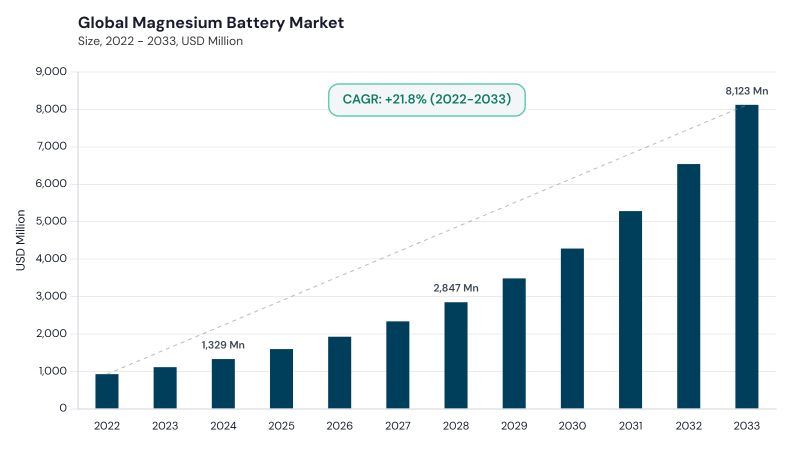
The Global Magnesium Battery Market size is expected to reach USD 8.12 billion by 2033, rising at a market growth of 22.8% CAGR during the forecast period.
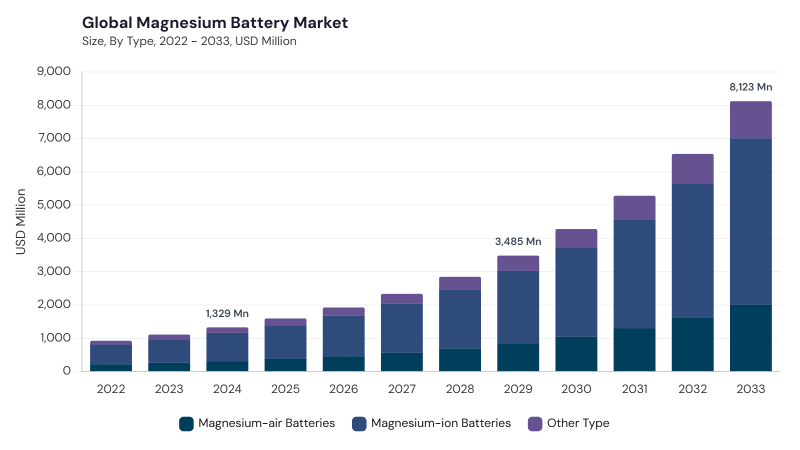
The market is witnessing strong growth driven by rising demand for next-generation energy storage technologies, increasing focus on battery safety, and growing investments in sustainable battery chemistries. Magnesium batteries are gaining traction across electric vehicles, renewable energy storage, and consumer electronics due to their high volumetric energy density and abundant raw material availability.
Growing investments in renewable energy infrastructure, electric mobility, and industrial energy storage are supporting market adoption. Increasing emphasis on sustainable battery materials, improved thermal stability, and long-cycle energy storage systems is further strengthening demand for magnesium battery technologies globally.
Leading companies in the magnesium battery market are focusing on advanced electrolyte development, solid-state battery innovation, and expansion of high-performance energy storage solutions. Market participants are strengthening partnerships with automotive manufacturers, renewable energy providers, and material science firms to accelerate commercialization and improve battery efficiency. Companies are also investing in pilot-scale manufacturing facilities, localized supply chains, and advanced production technologies to support large-scale deployment across electric mobility and grid storage applications.
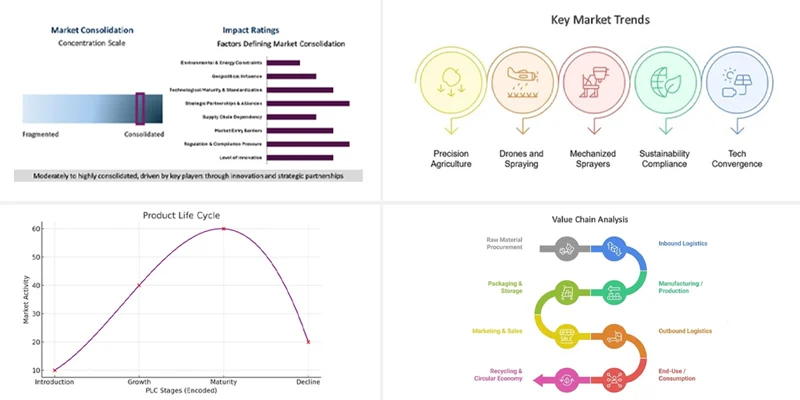
The magnesium battery market is moderately fragmented with the presence of battery technology developers, advanced material suppliers, and global energy storage companies. Competition is primarily centered on innovation in magnesium-ion chemistry, electrolyte stability, and high-energy-density battery architectures.
Companies are increasingly integrating AI-driven battery management systems, smart energy monitoring platforms, and advanced automation technologies to improve battery lifecycle performance and operational efficiency. Interoperability with electric vehicle platforms, renewable energy systems, and industrial storage infrastructure has become a major competitive factor.
Strategic collaborations among battery manufacturers, automotive OEMs, chemical companies, and research institutions are accelerating product development and commercialization efforts. Regional expansion strategies and investments in sustainable raw material sourcing are further strengthening competitive positioning across North America, Europe, and Asia Pacific.

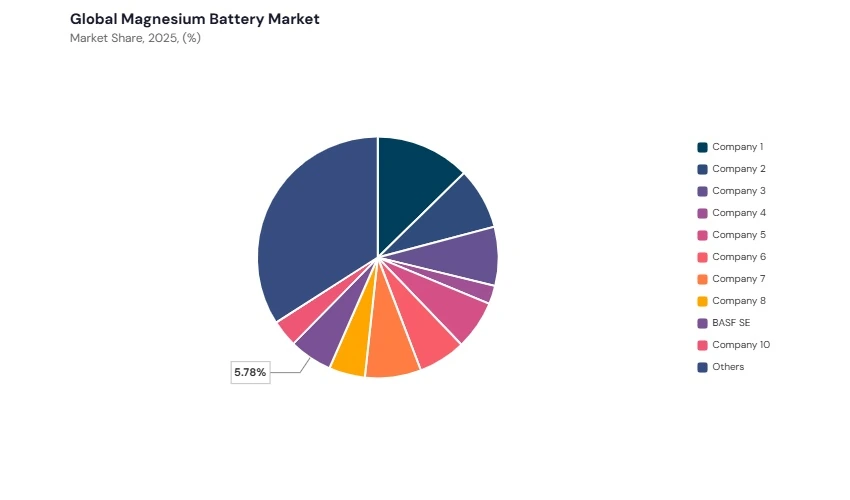
The market is led by companies including MagPower Systems, Samsung SDI Co., Ltd., Panasonic Energy Co., Ltd., and The Furukawa Battery Co., Ltd., which collectively account for a significant share of the global magnesium battery market. These companies benefit from strong research capabilities, battery manufacturing expertise, and investments in next-generation energy storage technologies.
Mid-tier and emerging participants including BASF SE, GS Yuasa Corporation, Wanxiang A123 Systems Corp., and CVMR Corporation are strengthening their market positions through advanced material innovation, pilot commercialization projects, and strategic partnerships. The market is expected to witness increasing competition as companies accelerate investments in solid-state technologies, scalable manufacturing, and sustainable battery development.
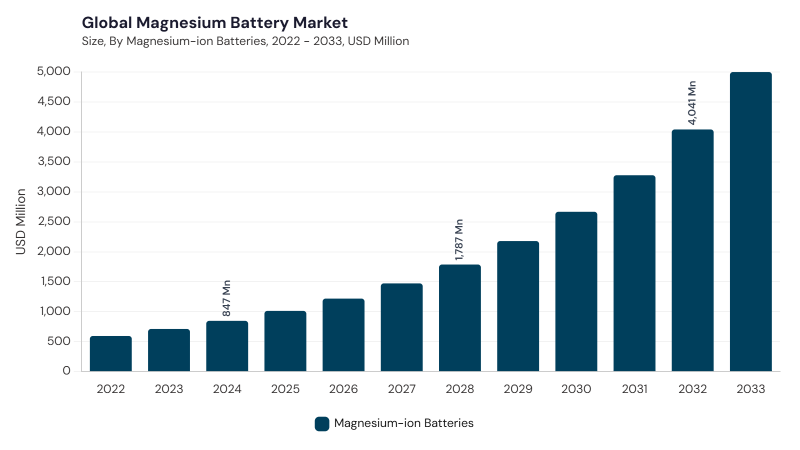
Based on type, the market is segmented into Magnesium-ion Batteries, Magnesium-air Batteries, and Other Type. Magnesium-ion Batteries dominated the market in 2025 owing to increasing demand for rechargeable and high-energy-density battery technologies across electric vehicles and energy storage applications. Advancements in electrolyte chemistry and electrode stability are supporting commercial adoption. Magnesium-air Batteries are also witnessing strong growth due to their high theoretical energy density and suitability for long-duration energy storage and backup applications.
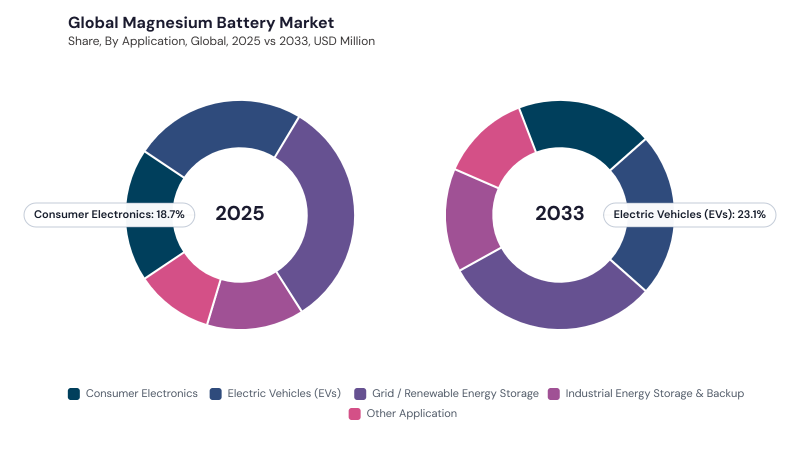
Based on application, the market is segmented into Grid / Renewable Energy Storage, Electric Vehicles (EVs), Consumer Electronics, Industrial Energy Storage & Backup, and Other Application. Grid / Renewable Energy Storage accounted for the largest share in 2025 driven by increasing deployment of renewable energy systems and growing demand for scalable energy storage infrastructure. Electric Vehicles (EVs) and Consumer Electronics are also witnessing considerable growth due to rising focus on safer battery chemistries, improved energy density, and sustainable mobility solutions.
Free Valuable Insights: Magnesium Battery Market Size to reach $8.12 Billion by 2033
Based on region, the market is segmented into North America, Europe, Asia Pacific, and LAMEA. Europe dominated the market in 2025 supported by strong investments in battery research, favorable sustainability regulations, and increasing renewable energy adoption. Asia Pacific is expected to witness the fastest growth owing to rapid industrialization, expanding electric vehicle manufacturing, and growing investments in advanced battery production capabilities.
The magnesium battery market is characterized by strong research-driven competition, with companies focusing heavily on advanced battery chemistry development, electrolyte optimization, and next-generation energy storage technologies. Market participants are increasingly investing in magnesium-ion and magnesium-air battery innovations to improve energy density, charging efficiency, thermal stability, and battery lifecycle performance. The competitive landscape is supported by collaborations between battery manufacturers, automotive OEMs, semiconductor companies, material science firms, and research institutions aimed at accelerating commercialization and reducing technology limitations associated with magnesium-based energy storage systems.
Companies are also emphasizing scalable manufacturing capabilities, sustainable raw material sourcing, and integration with electric mobility and renewable energy infrastructure to strengthen market positioning. AI-enabled battery management systems, smart monitoring technologies, and advanced automation platforms are increasingly being incorporated to improve operational efficiency and performance reliability. In addition, regional expansion strategies across Asia Pacific, Europe, and North America are intensifying as governments continue to support domestic battery manufacturing and clean energy initiatives. Pricing competitiveness, supply chain localization, and strategic partnerships remain key factors influencing long-term competitive differentiation in the global magnesium battery market.
| Report Attribute | Details |
|---|---|
| Market size value in 2026 | USD 1.93 billion |
| Market size forecast in 2033 | USD 8.12 billion |
| Base Year | 2025 |
| Historical period | 2022 to 2024 |
| Forecast Period | 2026 to 2033 |
| Revenue Growth Rate | CAGR of 22.8% from 2026 to 2033 |
| Number of Pages | 510 |
| Tables | 510 |
| Report Coverage | Market Trends, Revenue Estimation and Forecast, Segmentation Analysis, Regional and Country Breakdown, Competitive Landscape, Market Share Analysis, Company Profiling, Companies Strategic Developments |
| Segments Covered | Type, Application, Geography |
| Country Scope |
|
| Companies Included | Samsung SDI Co., Ltd., Panasonic Energy Co., Ltd., BASF SE, GS Yuasa Corporation, Wanxiang A123 Systems Corp., MagPower Systems, CVMR Corporation, The Furukawa Battery Co., Ltd., Toyota Battery Co., Ltd., Nippon Kinzoku Co., Ltd. |
By Type
By Application
By Geography
Valued at USD 1.93 billion in 2026, reaching USD 8.12 billion by 2033, growing at 22.8% CAGR during 2026-2033.
Magnesium-ion batteries lead the market, projected to achieve USD 4.99 billion by 2033.
Samsung SDI Co., Ltd., Panasonic Energy Co., Ltd., and BASF SE hold dominant positions in the space.
Asia Pacific dominates, reaching USD 2.52 billion by 2033. Europe grows at 22.5% CAGR during 2026-2033.
Safer battery technology demand, renewable energy storage adoption, and electric vehicle battery investments fuel expansion.
Grid/Renewable Energy Storage leads revenue generation, growing at 21.9% CAGR during the forecast period.
Our team of dedicated experts can provide you with attractive expansion opportunities for your business.







 Unique Offerings