“Global Liquid Cooled Optical Transceiver Market to reach a market value of USD 607.68 Million by 2033 growing at a CAGR of 22.1%”
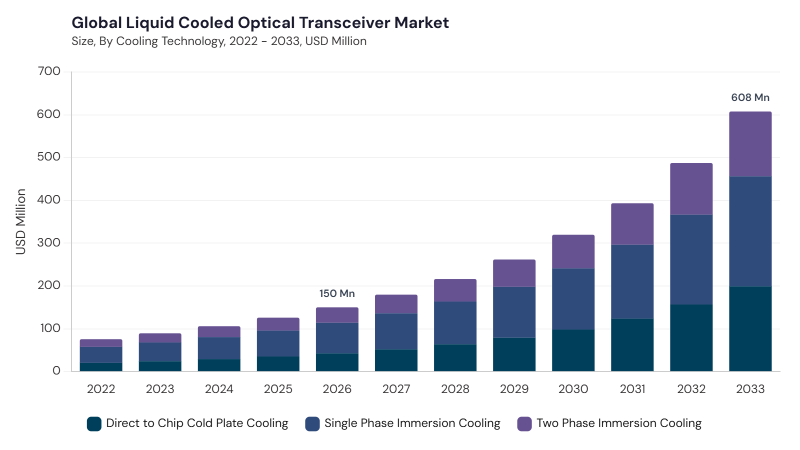
The Global Liquid Cooled Optical Transceiver Market is expected to reach USD 607.7 million by 2033, growing at a CAGR of 22.1% during 2026–2033. The report examines market size, growth trends, and opportunities by cooling technology, data rate, form factor, transmission reach, application, and geography.
A liquid-cooled optical transceiver module converts electrical and optical signals while using a specified liquid-based thermal pathway to remove operating heat. The category includes immersion-compatible optical transceivers designed for dielectric fluids and modules coupled to cold plates or other qualified liquid-cooling interfaces. Conventional air-cooled optical transceivers do not automatically enter this market simply because they are installed in a liquid-cooled rack. The scope depends on the module, thermal interface, operating fluid, and host configuration designed and qualified to work together.
Higher-capacity networking requires optical modules, electrical interfaces, and supporting electronics to operate within the host equipment’s thermal limits. Liquid cooling provides another way to move heat away from these assemblies when the conventional airflow arrangement is insufficient or unsuitable. Arista’s 2026 XPO announcement links an integrated cold plate with a higher-density pluggable architecture, illustrating this design direction. The commercial driver is the need to sustain useful bandwidth within practical equipment constraints. Demand should be assessed at the configuration level because module power, inlet conditions, thermal interfaces, and allowed operating temperatures determine whether liquid cooling solves the relevant limitation.
Immersion-cooled servers and switches require suitable interconnects at the boundary between submerged electronics and the external network. Ordinary transceivers cannot be assumed compatible with the liquid environment. Formerica’s immersion-oriented optical pigtail specification, listed by the Open Compute Project, illustrates products designed specifically for that requirement. This creates demand for modules whose optical paths, materials, cables, and connections are suitable for the intended fluid and operating conditions. The opportunity follows actual equipment immersion rather than the adoption of liquid cooling elsewhere in the facility. Suppliers need to demonstrate a dependable connection through the complete deployment, including the points where fibers leave the cooling environment.
Competition in liquid-cooled optical transceivers depends on more than optical bandwidth. Suppliers must address thermal integration, fluid compatibility where applicable, mechanical fit, host interoperability, and serviceability. Arista’s XPO announcement illustrates an integrated cold-plate approach to high-density pluggable optics, while Formerica’s immersion optical pigtail listed by the Open Compute Project illustrates a different deployment architecture. These examples show why buyers need to compare complete operating configurations rather than assume interchangeability across modules or fluids. Joint qualification and clearly assigned support responsibilities are relevant selection criteria.
Based on Cooling Technology, the market is segmented into Direct-to-Chip / Cold-Plate Cooling, Single-Phase Immersion Cooling, Two-Phase Immersion Cooling. Single-Phase Immersion Cooling dominated in 2025 and is projected to reach USD 257.1 million by 2033, growing at a CAGR of 20.1%. Direct-to-Chip / Cold-Plate Cooling is expected to record the highest CAGR of 24.6% during the forecast period.
Immersion cooling and cold-plate cooling create different requirements for optical modules. In single-phase immersion, components operate in a dielectric fluid without relying on a boiling cycle; two-phase systems involve fluid evaporation and condensation. Direct-to-chip or cold-plate approaches transfer heat through a defined interface into a liquid loop without necessarily immersing the entire module. For optical transceivers, material compatibility, thermal contact, fluid conditions, and fiber routing must be considered within the chosen architecture. Qualification for one cooling arrangement should not be assumed to establish suitability for another.
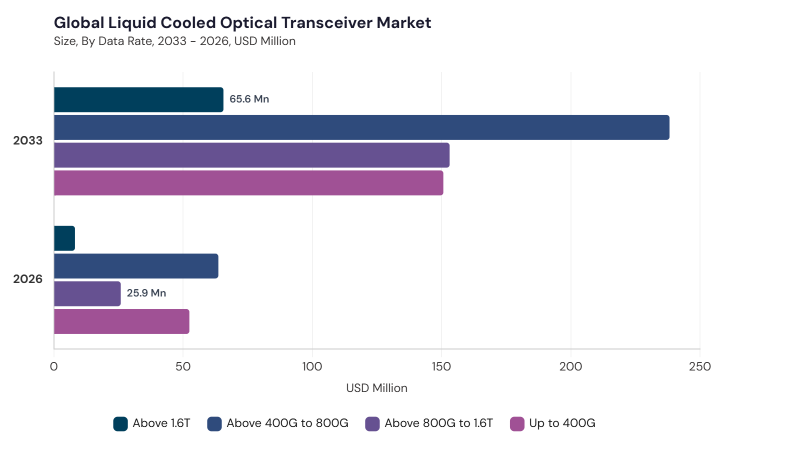
Based on Data Rate, the market is segmented into Up to 400G, Above 400G to 800G, Above 800G to 1.6T, Above 1.6T. Above 400G to 800G dominated in 2025 and is projected to reach USD 238.2 million by 2033, growing at a CAGR of 20.7%. Above 1.6T is expected to record the highest CAGR of 34.6% during the forecast period.
Data-rate requirements influence the electrical interface, optical design, and thermal requirements of a transceiver module. The report distinguishes Up to 400G, Above 400G to 800G, Above 800G to 1.6T, and Above 1.6T to reflect different bandwidth ranges. Higher bandwidth alone does not establish a need for liquid cooling; module power, port density, host airflow, and temperature limits also matter. Buyers therefore need to assess the target data rate together with the intended host and cooling conditions, rather than treating every high-speed optical module as liquid-cooled.
Based on Form Factor, the market is segmented into OSFP & OSFP-XD, QSFP-DD & QSFP Variants, XPO & Other High-Density Pluggables, Other Form Factor. QSFP-DD & QSFP Variants dominated in 2025 and is projected to reach USD 207.8 million by 2033, growing at a CAGR of 19.4%. XPO & Other High-Density Pluggables is expected to record the highest CAGR of 28.9% during the forecast period.
Form factor affects connector arrangements, faceplate density, mechanical access, and the space available for a cooling interface. OSFP and QSFP variants provide different integration constraints, while newer high-density pluggable architectures introduce additional design options. Arista’s XPO announcement describes an integrated cold plate, illustrating the link between module architecture and heat removal. A familiar form-factor name does not establish liquid compatibility or cooling performance: those depend on the specific product and qualified host configuration.
Based on Transmission Reach, the market is segmented into Short Reach (up to 500 m), Medium Reach (above 500 m to 2 km), Long Reach (above 2 km). Short Reach (up to 500 m) dominated in 2025 and is projected to reach USD 387.7 million by 2033, growing at a CAGR of 23.2%. Short Reach (up to 500 m) is expected to record the highest CAGR of 23.2% during the forecast period.
Transmission reach describes the optical link requirement rather than the cooling method. Short-reach connections can support links within computing environments, while medium- and long-reach applications involve different optical budgets and deployment conditions. Cooling-system integration must preserve the optical path through connectors, cables, and any boundary between an immersed assembly and external fiber infrastructure. Buyers should evaluate the specified reach alongside fiber type, connector arrangement, optical performance, and the tested thermal environment. Liquid cooling does not by itself determine how far a module can transmit.
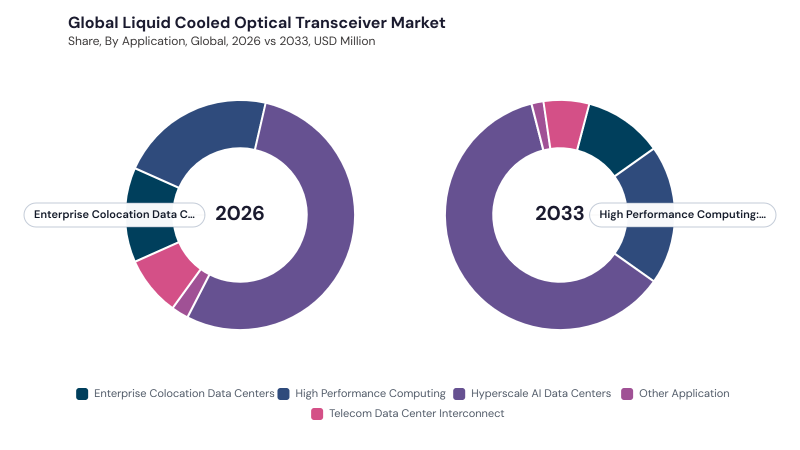
Based on Application, the market is segmented into Hyperscale & AI Data Centers, High-Performance Computing, Enterprise & Colocation Data Centers, Telecom & Data Center Interconnect, Other Application. Hyperscale & AI Data Centers dominated in 2025 and is projected to reach USD 371.9 million by 2033, growing at a CAGR of 24.3%. Hyperscale & AI Data Centers is expected to record the highest CAGR of 24.3% during the forecast period.
Hyperscale and AI data centers, high-performance computing, enterprise and colocation facilities, and telecom or data center interconnect deployments present different operating conditions. In each application, demand for liquid-cooled optical transceivers depends on whether the networking hardware actually uses immersion or a defined liquid-cooling interface. Liquid-cooled processors elsewhere in a facility do not establish that its optics use liquid cooling. Relevant purchase criteria include host compatibility, module service access, link requirements, and responsibilities for maintaining the thermal and optical interfaces.
Free Valuable Insights: Liquid Cooled Optical Transceiver Market Size to reach $607.7 Million by 2033
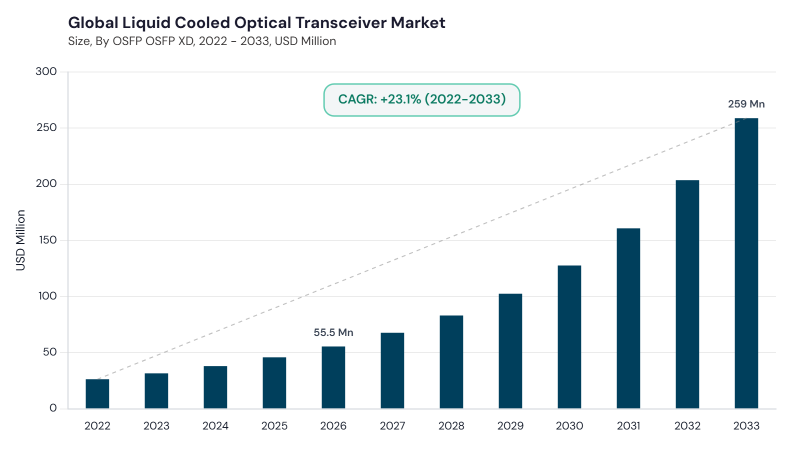
Region-wise, the Liquid Cooled Optical Transceiver Market is analyzed across North America, Europe, Asia Pacific, LAMEA. North America led in 2025 and is projected to reach USD 272.2 million by 2033, growing at a CAGR of 20.7%. Europe is projected to grow at a CAGR of 19.9%. Asia Pacific is projected to grow at a CAGR of 24.5%. LAMEA is projected to grow at a CAGR of 24.1%.
Regional opportunities depend on the deployment of compatible computing and networking systems, access to qualification expertise, and support from optical and cooling suppliers. North America, Europe, Asia Pacific, and LAMEA differ in infrastructure investment and the practical conditions for introducing new cooling architectures. The addressable market should be assessed through qualifying module deployments rather than general data center liquid-cooling expenditure. Local integration capabilities, servicing arrangements, and supply-chain access can influence the pace at which demonstrated technology becomes operational equipment.
By Cooling Technology
By Data Rate
By Form Factor
By Transmission Reach
By Application
By Geography
| Report Attribute | Details |
|---|---|
| Market size value in 2026 | USD 150.2 million |
| Market size forecast in 2033 | USD 607.7 million |
| Base Year | 2025 |
| Historical Period | 2022 to 2024 |
| Forecast Period | 2026 to 2033 |
| Revenue Growth Rate | CAGR of 22.1% from 2026 to 2033 |
| Number of Tables | 750 |
| Number of Figures | 125 |
| Report Coverage | Market Trends, Revenue Estimation and Forecast, Segmentation Analysis, Regional and Country Breakdown, Competitive Landscape |
| Segments Covered | Cooling Technology, Data Rate, Form Factor, Transmission Reach, Application and Geography |
| Country Scope |
|
By Geography
Expected to reach USD 607.7 million by 2033, growing at 22.1% CAGR during 2026-2033.
Optical connectivity inside immersed equipment is a key growth driver.
Top companies include Cisco, IBM, Microsoft, and Google.
Asia Pacific grows at 13.1% CAGR during 2026-2033.
Increasing bandwidth within constrained thermal budgets and pressure to improve network equipment density.
The market grows at 22.1% CAGR during the forecast period (2026-2033).
Our team of dedicated experts can provide you with attractive expansion opportunities for your business.