The sample copy of this report is available for access.
“Global Laser Hair Removal Market to reach a market value of by 2033 growing at a CAGR of %”
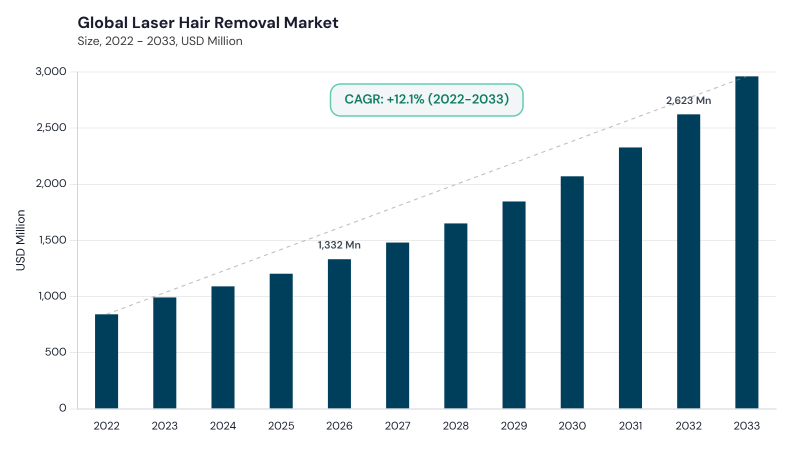
The Global Laser Hair Removal Market is expected to reach $3.0 million by 2033, growing at a CAGR of 12.1% during (2026 – 2033).
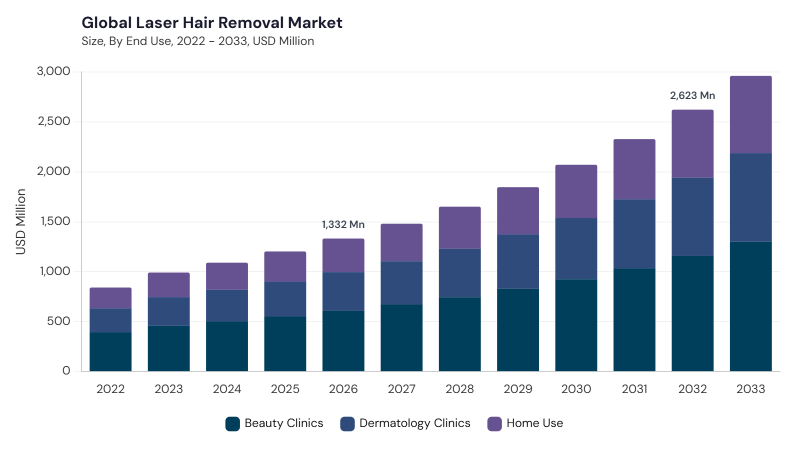
This growth during the forecast period, driven by rising demand for non-invasive aesthetic procedures, growing consumer focus on personal grooming, increasing adoption of advanced laser technologies, and expanding availability of professional and at-home hair removal solutions.
The Laser Hair Removal Market has evolved from early light-based hair reduction procedures into a mainstream aesthetic treatment ecosystem supported by diode, Alexandrite, Nd:YAG, IPL, and multi-wavelength laser platforms. Improvements in wavelength precision, pulse control, cooling systems, and skin-type adaptability have significantly improved treatment safety, comfort, and effectiveness.
The market is increasingly shaped by rising demand for long-term hair reduction solutions, growing preference for minimally invasive cosmetic procedures, and expanding adoption across beauty clinics, dermatology clinics, medical spas, and home-use settings. Consumers are increasingly seeking convenient, safe, and effective alternatives to shaving, waxing, and other temporary hair removal methods.
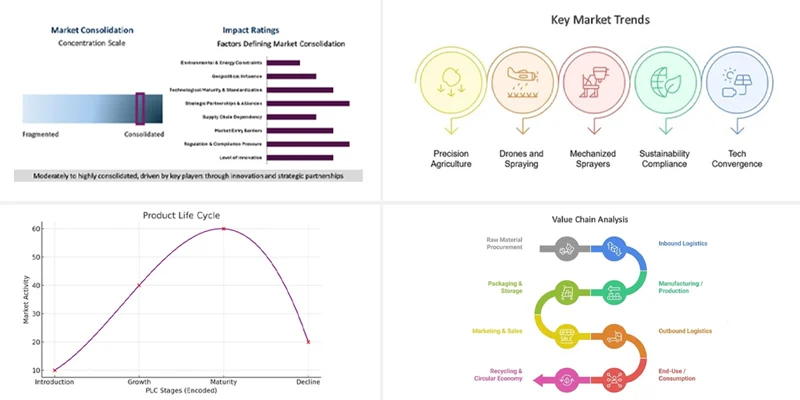

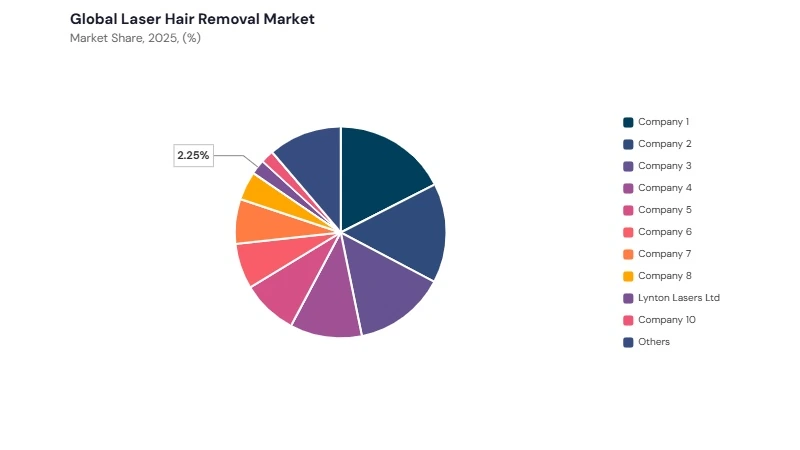
The global Laser Hair Removal market is moderately consolidated, with the top ten companies accounting for approximately 88.75% of total market share, while the remaining 11.25% is held by other players. Candela Corporation leads the market, supported by strong adoption of its GentleMax Pro and Gentle Pro platforms, broad dermatologist and med-spa presence, and expertise in Alexandrite and Nd:YAG technologies.
Lumenis, Cutera, and Sciton represent a strong second competitive tier, while Fotona, Venus Concept, Lynton Lasers, and BIOTEC SRL add competitive depth through multifunctional aesthetic systems, diode-based platforms, and regional laser technology offerings. Future competition is expected to be shaped by treatment comfort, platform versatility, multi-skin-type compatibility, procedural speed, AI-assisted personalization, and global service support.
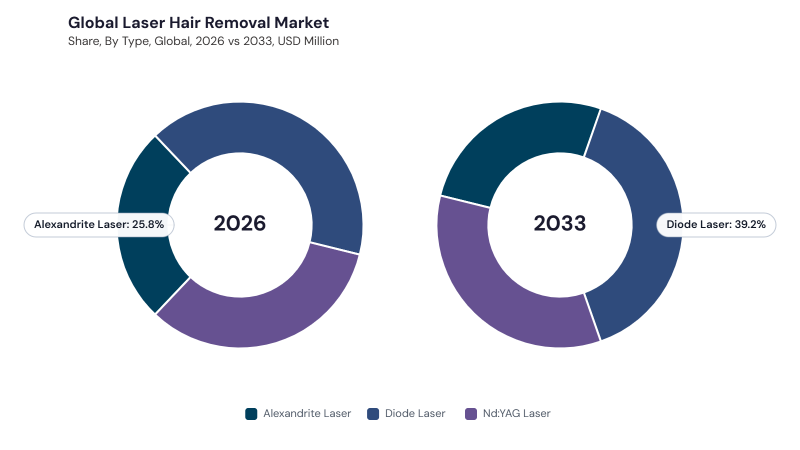
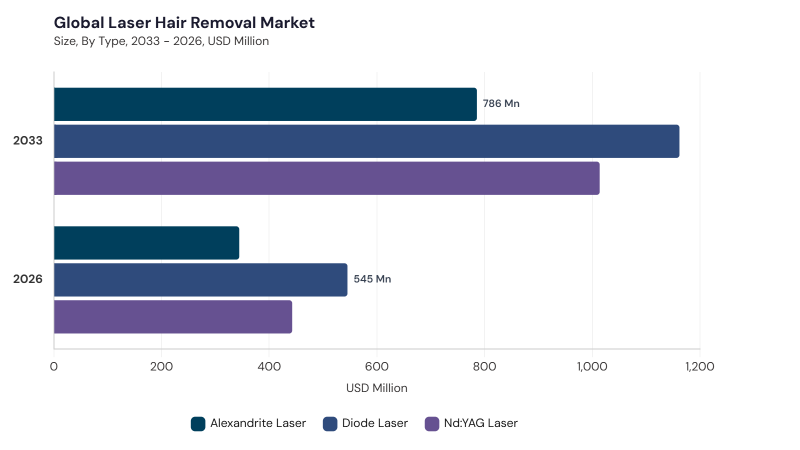
Based on type, the Laser Hair Removal Market is segmented into Diode Laser, Nd:YAG Laser, and Alexandrite Laser. The Diode Laser market dominated the Global Laser Hair Removal Market by Type in 2025, and would continue to be a dominant market till 2033; thereby, achieving a market value of $1161.8 million by 2033, growing at a CAGR of 11.4 % during the forecast period. The Nd:YAG Laser segment is witnessing significant growth due to its effectiveness in treating darker skin tones while minimizing the risk of pigmentation-related complications in 2025.
Based on end use, the Laser Hair Removal Market is classified into Beauty Clinics, Dermatology Clinics, and Home Use in 2025. The Beauty Clinics market dominated the Global Laser Hair Removal Market by End Use in 2025, and would continue to be a dominant market till 2033; thereby, achieving a market value of $1299.8 million by 2033, growing at a CAGR of 11.5 % during the forecast period. The Dermatology Clinics segment is experiencing steady growth as consumers increasingly seek medically supervised cosmetic procedures in 2025.
Region-wise, the Laser Hair Removal Market is analyzed across North America, Europe, Asia Pacific, and LAMEA. The North America market dominated the Global Laser Hair Removal Market by Region in 2025, and would continue to be a dominant market till 2033; thereby, achieving a market value of $1168.6 million by 2033, growing at a CAGR of 11.6 % during the forecast period.
Europe remains a major market supported by increasing demand for cosmetic enhancement procedures and rising investments in aesthetic healthcare infrastructure. Asia Pacific is witnessing strong growth due to rising disposable incomes, expanding beauty consciousness, and rapid growth of aesthetic treatment services. LAMEA is gradually expanding due to growing awareness regarding aesthetic procedures and increasing availability of beauty and wellness services.
The market is highly technology-driven, with competition centered on treatment efficacy, patient comfort, safety, multi-wavelength capabilities, cooling technologies, and suitability across diverse skin tones. Vendors are differentiating through advanced diode, Alexandrite, Nd:YAG, IPL, and hybrid laser systems that support faster, safer, and more customized treatments.
Professional service networks, med-spa partnerships, distributor relationships, and regional expansion strategies are becoming increasingly important as companies seek to increase treatment accessibility. Regulatory compliance, practitioner training, after-sales support, and clinical validation remain key competitive factors influencing customer trust and long-term adoption.
By Type
By End Use
By Geography
Expected to reach USD 3.0 billion by 2033, growing at 12.1% CAGR during the forecast period (2026-2033).
Diode Laser segment leads, projected to hit USD 1.16 billion by 2033.
Top companies include Lumenis, Cynosure, Candela, Syneron Medical, and Alma Lasers.
Beauty Clinics dominate, expected to reach USD 1.30 billion by 2033.
North America leads with 40.90% revenue share, projected to reach USD 1.17 billion by 2033.
Advanced laser technologies and rising consumer awareness enhance treatment precision and efficacy.
Our team of dedicated experts can provide you with attractive expansion opportunities for your business.








 Unique Offerings