The sample copy of this report is available for access.
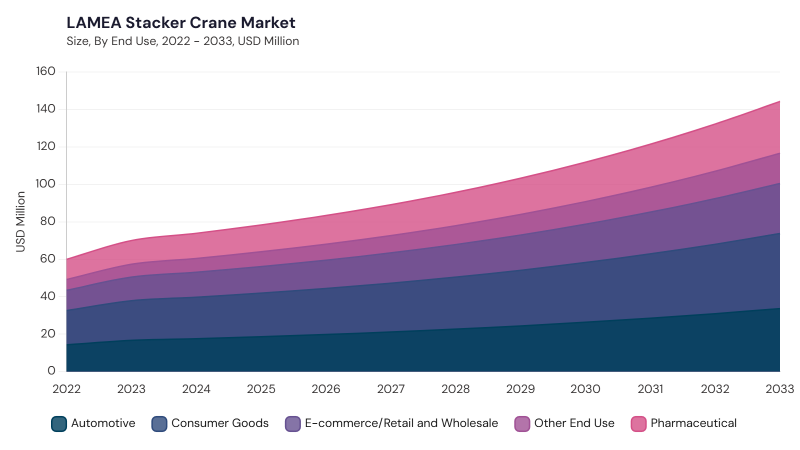
The LAMEA Stacker Crane Market is expected to reach USD 103.2 million by 2029, growing at a CAGR of 8.2% during (2026 – 2033).
Stacker crane adoption across Latin America, the Middle East, and Africa developed from manual and semi-automated material handling systems used within warehouses, logistics facilities, and industrial environments. Early implementations focused on mechanized storage and retrieval before advances in robotics, control systems, and automation software enabled greater precision and reduced human intervention. The expansion of e-commerce, industrial infrastructure, and modern distribution networks accelerated demand for scalable and modular systems. Recent developments increasingly emphasize warehouse management integration, real-time inventory visibility, IoT connectivity, and adaptable automation suited to varied facility sizes and operational conditions.
Industry development across LAMEA is increasingly influenced by e-commerce fulfillment, intelligent maintenance, sustainability, and broader warehouse digitalization. Operators are adopting IoT sensors, predictive maintenance tools, real-time analytics, and connected control systems to improve equipment reliability and reduce downtime. Energy-efficient electric drives, regenerative braking, and optimized structural designs are gaining relevance as operating costs and environmental requirements influence procurement decisions. Customizable and modular configurations are also becoming important as businesses seek scalable automation capable of supporting diverse warehouse layouts and evolving supply chain requirements.
Based on Operation, the market is segmented into Semi-automatic and Automatic. The Semi-automatic market dominated the LAMEA Stacker Crane Market by Operation in 2025, and would continue to be a dominant market till 2033; thereby, achieving a market value of USD 61.8 million by 2029, growing at a CAGR of 7.7 % during the forecast period. Additionally, The Automatic market is expected to witness highest CAGR of 8.8% during (2026 - 2033).
Semi-automatic systems lead as warehouses, manufacturing facilities, and logistics centers pursue productivity improvements while maintaining cost efficiency and operational flexibility. These systems support gradual automation by combining human supervision with automated handling functions and are particularly suitable for medium-scale facilities. Automatic stacker cranes are gaining traction in smart warehouses, high-volume distribution centers, cold storage facilities, and advanced industrial operations where continuous handling, warehouse management integration, reduced labor dependency, and higher precision are increasingly required.
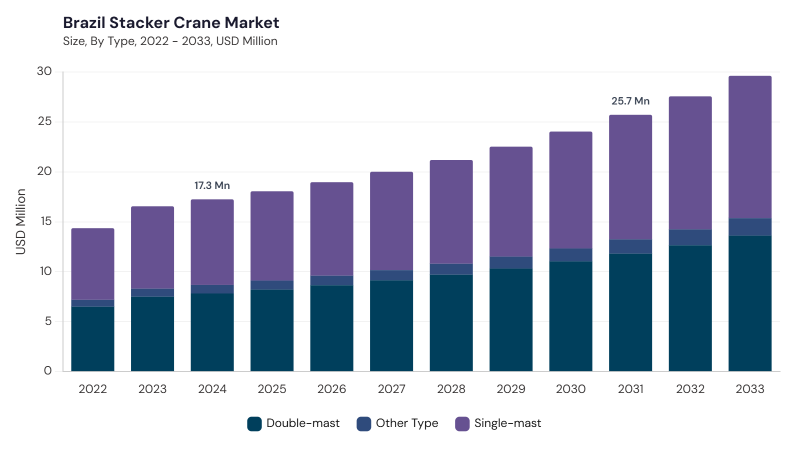
Based on Type, the market is segmented into Single-mast, Double-mast, and Other Type. The Single-mast market dominated the LAMEA Stacker Crane Market by Type in 2025, and would continue to be a dominant market till 2033; thereby, achieving a market value of USD 50.7 million by 2029, growing at a CAGR of 7.7 % during the forecast period. The Double-mast market is expected to witness a CAGR of 8.4% during (2026 - 2033). Additionally, The Other Type market is expected to witness highest CAGR of 10.7% during (2026 - 2033).
Single-mast stacker cranes maintain a leading position due to their compact footprint, lower installation requirements, and suitability for medium-capacity warehouses operating within constrained layouts. Double-mast systems support higher lifting capacity, greater stability, and demanding high-bay applications within manufacturing facilities and large logistics hubs. Other Type includes telescopic, articulated, hybrid, and customized configurations developed for narrow aisles, unusual load profiles, specialized storage environments, and technically complex material handling requirements.
Based on End Use, the market is segmented into Consumer Goods, Automotive, E-commerce/Retail and Wholesale, Pharmaceutical, and Other End Use. volumes increase the need for efficient storage, rapid replenishment, and automated order handling. Automotive facilities rely on stacker cranes for organized component storage, production support, and precise material movement.
E-commerce/Retail and Wholesale operations emphasize rapid fulfillment, high-density storage, and integration with automated warehouse systems, while Pharmaceutical facilities prioritize secure storage, traceability, controlled environments, and regulatory compliance. Other End Use includes food and beverage, chemicals, mining, electronics, metals, and logistics applications requiring specialized material handling solutions.
Free Valuable Insights: Stacker Crane Market Size Worth USD 2006.9 Billion billion by 2033
Based on Country, the market is segmented into Brazil, Argentina, UAE, Saudi Arabia, South Africa, Nigeria, and Rest of LAMEA. The Brazil market dominated the LAMEA Stacker Crane Market by Country in 2025, and would continue to be a dominant market till 2033; thereby, achieving a market value of USD 22.5 million by 2029, growing at a CAGR of 6.6 % during the forecast period. The Argentina market is expected to witness a CAGR of 8.8% during (2026 - 2033). Additionally, The UAE market is expected to witness a CAGR of 7.2% during (2026 - 2033).
Brazil demonstrates increasing adoption of intelligent automation, IoT integration, predictive maintenance, and customized systems supporting e-commerce and industrial modernization. Argentina is progressing through Industry 4.0 adoption, localized service capabilities, energy-efficient equipment, and digitally integrated warehouse operations. The UAE reflects strong demand for software-connected, modular, energy-efficient, and remotely monitored stacker cranes aligned with smart logistics and warehouse automation initiatives. Saudi Arabia is advancing through Industry 4.0 integration, IoT-enabled equipment, high-density storage automation, and sustainability-focused logistics modernization. South Africa is developing through AI-assisted controls, predictive maintenance, energy-efficient systems, and advanced warehouse automation. Nigeria reflects growing adoption of remote operation, digital monitoring, energy-efficient equipment, and automated handling across ports and logistics hubs.

By Operation
By Type
By End Use
By Country
Set to reach $103.2 Million by 2029, growing at 8.2% CAGR during 2026–2033.
Brazil leads with $22.5 million by 2029, growing at a CAGR of 6.6% during the forecast period.
The automatic segment is expected to witness the highest CAGR of 8.8% during 2026–2033.
The semi-automatic segment will reach $61.8 million by 2029, growing at a CAGR of 7.7% during the forecast period.
The UAE market is expected to witness a CAGR of 7.2% during 2026–2033.
The single-mast segment will reach $50.7 million by 2029, growing at a CAGR of 7.7% during the forecast period.
Our team of dedicated experts can provide you with attractive expansion opportunities for your business.




 Unique Offerings