The sample copy of this report is available for access.
The LAMEA Social Networking App Market is expected to reach USD 14.1 billion by 2029, growing at a CAGR of 29.9% during (2026 - 2033).
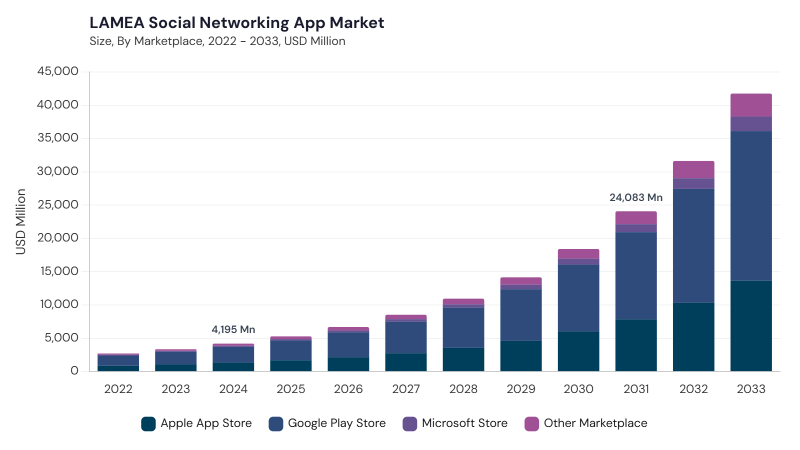
The LAMEA Social Networking App Market originated from the broader evolution of mobile communication and internet penetration across Latin America, the Middle East, and Africa. Early development was marked by the gradual adoption of smartphones and expanding mobile internet access, which shifted social networking platforms from web-based interfaces to mobile-first applications suited to diverse linguistic and cultural settings. Over time, affordable smartphones, 4G and emerging 5G infrastructure, multimedia sharing, live streaming, advanced privacy controls, localized content, vernacular features, indigenous platforms, and AI-driven moderation transformed the market into a diversified ecosystem of global and regional platforms.
Current market growth is shaped by mobile-first adoption, privacy and data sovereignty concerns, cultural customization, local-language support, digital payments, gamified social experiences, AI-powered personalization, and social commerce. Platforms are increasingly developing lightweight applications, low-bandwidth optimization, localized interfaces, creator tools, video-sharing features, transparent data controls, and region-specific moderation capabilities. Demand is also rising for apps that support community interaction, entertainment, digital content consumption, targeted advertising, e-commerce extensions, local business engagement, and culturally relevant user experiences across LAMEA.
Based on Device Type, the market is segmented into Smartphones and Other Device Type. The Smartphones market dominated the LAMEA Social Networking App Market by Device Type in 2025, and would continue to be a dominant market till 2033; thereby, achieving a market value of USD 12.9 billion by 2029, growing at a CAGR of 29.6 % during the forecast period. The Other Device Type market is expected to witness a CAGR of 33% during (2026 - 2033).
Smartphones remain the leading device type as they support instant messaging, video calls, stories, live streaming, mobile payments, AI-driven content curation, localized interfaces, region-specific language support, 4G and 5G access, real-time interaction, and multimedia sharing across urban and rural communities. Other Device Type maintains an emerging presence through tablets, computers, laptops, smart televisions, internet-enabled equipment, professional usage, content creation, larger-screen experiences, family entertainment, education, workplace communication, and extended browsing sessions.
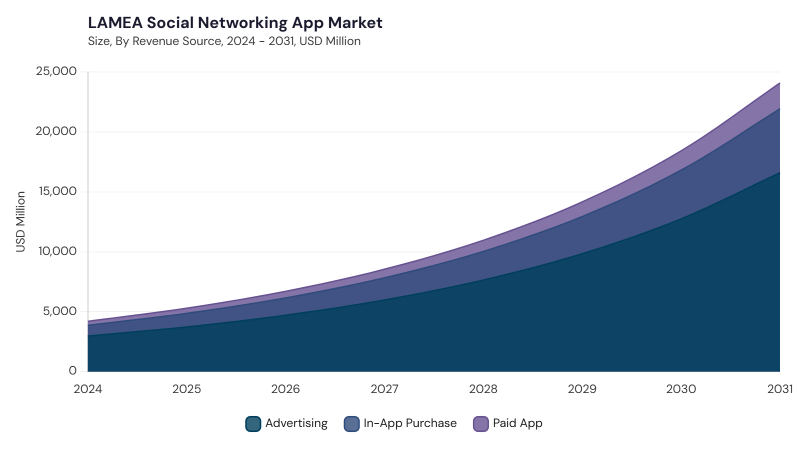
Based on Revenue Source, the market is segmented into Advertising, In-App Purchase, and Paid App. Advertising remains the leading revenue source as it supports display ads, video ads, sponsored content, native advertising, programmatic advertising, influencer marketing, targeted promotions, small and medium-sized enterprise digitalization, personalized offers, and free-access app models.
In-App Purchase develops a significant foothold through virtual gifting, optional subscriptions, premium features, creator-oriented transactions, virtual currencies, digital enhancements, gamified interactions, exclusive content, event tickets, and social commerce-linked spending. Paid App represents a promising outlook through subscription-based models, one-time purchase fees, exclusive communities, professional capabilities, enhanced privacy functions, ad-free experiences, specialized networking tools, and differentiated social platforms serving committed user groups.
Based on Marketplace, the market is segmented into Google Play Store, Apple App Store, Microsoft Store, and Other Marketplace. Google Play Store remains the leading marketplace as it supports Android-based social apps, affordable device users, mass-market reach, local-language applications, niche community platforms, in-app purchases, advertising, rapid updates, analytics tools, secure payments, and localized content adoption. Apple App Store maintains a substantial presence through premium-device users, affluent urban consumers, curated app quality, secure transactions, Apple Pay integration, sophisticated communication apps, creator applications, advanced social features, and privacy-focused user experiences.
Other Marketplace establishes a considerable standing through alternative application stores, third-party Android stores, local carrier shops, manufacturer ecosystems, direct distribution, decentralized marketplaces, lightweight apps, offline functions, and remote or underserved user access. Microsoft Store constitutes a promising presence through Windows-based access, professional networking, communication apps, community platforms, entertainment applications, collaboration tools, education users, corporate environments, productivity integration, and desktop-oriented social networking.
Free Valuable Insights: Social Networking App Market Size Worth USD 680.0 Billion billion by 2033
Based on Country, the market is segmented into Brazil, Argentina, UAE, Saudi Arabia, South Africa, Nigeria, and Rest of LAMEA. The Brazil market dominated the LAMEA Social Networking App Market by Country in 2025, and would continue to be a dominant market till 2033; thereby, achieving a market value of USD 4.0 billion by 2029, growing at a CAGR of 28.4 % during the forecast period. The Argentina market is expected to witness a CAGR of 30.9% during (2026 - 2033). Additionally, The UAE market is expected to witness a CAGR of 27.7% during (2026 - 2033).
Brazil is shaped by video-centric content, live streaming, AR filters, privacy-first design, social commerce, fintech partnerships, and localized Brazilian engagement, while Argentina reflects privacy demand, hyper-localized content, AR, live streaming, AI personalization, telecom partnerships, and culturally adapted user experiences. The UAE is supported by Arabic-language localization, e-commerce integration, privacy and data security, AI-driven personalization, AR functionality, 5G, cloud infrastructure, and regional fintech collaboration, whereas Saudi Arabia is driven by hyper-localization, AR and VR, data privacy, youth engagement, Vision-linked digital infrastructure, AI-powered moderation, and native language support. South Africa is advancing through fintech integration, localized content governance, AI-powered feeds, multilingual support, telecom partnerships, mobile-optimized interfaces, and cloud-based scalability. Nigeria is influenced by mobile-first access, low-data optimization, localized content, vernacular languages, AI moderation, mobile financial services, and partnerships with telecom, creator, and payment providers, while Rest of LAMEA is shaped by social commerce, niche communities, privacy protocols, AI moderation, hyper-local content, payment gateways, backend infrastructure, and culturally coherent digital engagement.

By Device Type
By Revenue Source
By Marketplace
By Country
Set to reach $14.1 Billion by 2029, growing at 29.9% CAGR during 2026-2033.
Brazil dominates with a market value of USD 4.0 billion by 2029, at a 28.4% CAGR during 2026-2033.
Smartphones dominate, reaching USD 12.9 billion by 2029, growing at a 29.6% CAGR during 2026-2033.
Smartphone segment hits USD 12.9 billion by 2029, at a 29.6% CAGR during 2026-2033.
Argentina is expected to witness a 30.9% CAGR during 2026-2033.
The UAE market is expected to witness a 27.7% CAGR during 2026-2033.
Our team of dedicated experts can provide you with attractive expansion opportunities for your business.




 Unique Offerings
