The sample copy of this report is available for access.
The LAMEA SoC as a Service Market is expected to reach $1.7 billion by 2029, growing at a CAGR of 10.9% during (2026 – 2033).
The LAMEA SoC as a Service Market developed as organizations across Latin America, the Middle East, and Africa began seeking outsourced security operations to manage rising digital risks. Earlier security monitoring was often limited to internal IT teams, basic tools, and fragmented incident handling processes. As digital payments, cloud platforms, telecom networks, public services, and critical infrastructure expanded, enterprises needed stronger threat visibility and faster response capabilities. Managed SOC models became more attractive because they reduced the need for heavy internal infrastructure and scarce cybersecurity talent.
The LAMEA SoC as a Service Market is being shaped by government-led cyber resilience programs, expanding cloud adoption, digital banking growth, endpoint exposure, and protection needs across energy, telecom, government, and public infrastructure. Providers are using AI-enabled analytics, threat intelligence, automated workflows, SIEM monitoring, vulnerability assessment, and cloud security visibility to strengthen service delivery. Demand is rising as organizations face ransomware, phishing, business email compromise, online fraud, and attacks on critical digital systems. Talent shortages across emerging markets are also encouraging enterprises to outsource SOC operations to specialized providers.
Based on Offering, the market is segmented into Fully Managed and Co-Managed. The Fully Managed market dominated the LAMEA SoC as a Service Market by Offering in 2025, and would continue to be a dominant market till 2033; thereby, achieving a market value of $1.0 billion by 2029, growing at a CAGR of 10.4 % during the forecast period. The Co-Managed market is expected to witness a CAGR of 11.6% during (2026 - 2033).
Fully Managed offerings lead as organizations increasingly prefer complete outsourcing of monitoring, threat detection, incident response, vulnerability support, compliance reporting, and security operations management. This model is highly relevant for SMEs, public agencies, banks, healthcare providers, telecom firms, and enterprises that lack internal cybersecurity teams or advanced security infrastructure. Fully Managed services provide access to expert analysts, 24/7 monitoring, threat intelligence, and predictable service costs. Co-Managed offerings remain important for larger enterprises and regulated sectors that want to retain internal governance while using external expertise, advanced detection tools, investigation support, and continuous monitoring capacity.
Based on Enterprise Size, the market is segmented into Large Enterprises and Small & Medium Enterprises (SMEs). The Large Enterprises market dominated the LAMEA SoC as a Service Market by Enterprise Size in 2025, and would continue to be a dominant market till 2033; thereby, achieving a market value of $1.1 billion by 2029, growing at a CAGR of 10.5 % during the forecast period. The Small & Medium Enterprises (SMEs) market is expected to witness a CAGR of 11.5% during (2026 - 2033).
Large Enterprises lead due to complex digital operations, regulatory pressure, critical infrastructure exposure, cloud adoption, and higher cybersecurity spending across industries such as oil & gas, finance, telecom, government, and utilities. These organizations use SOCaaS to improve enterprise-wide visibility, incident response, compliance reporting, network monitoring, cloud security, and protection of distributed systems. SMEs are steadily adopting SoC as a Service because subscription-based security models reduce upfront costs and simplify access to professional cybersecurity support. Their demand is supported by ransomware risks, phishing attacks, digital payment use, e-commerce growth, limited internal talent, and rising awareness of business continuity threats.
Based on Service, the market is segmented into Incident Response Services, Detection Services, and Prevention Services. The Detection Services market dominated the LAMEA SoC as a Service Market by Service in 2025, and would continue to be a dominant market till 2033; thereby, achieving a market value of $578.9 million by 2029, growing at a CAGR of 11.3 % during the forecast period. The Incident Response Services market is expected to witness highest CAGR of 10.1% during (2026 - 2033).
Incident Response Services lead as enterprises prioritize rapid containment, forensic investigation, impact assessment, recovery support, and remediation planning during cyber incidents. These services are important for reducing downtime and limiting financial, operational, and reputational damage from ransomware, phishing, malware, insider threats, and data breaches. Detection Services remain essential through log monitoring, SIEM analysis, threat hunting, anomaly detection, endpoint visibility, cloud activity monitoring, and early warning alerts. Prevention Services support proactive risk reduction through vulnerability management, patching guidance, firewall support, access control monitoring, cloud posture reviews, configuration assessment, and compliance-focused security improvements.
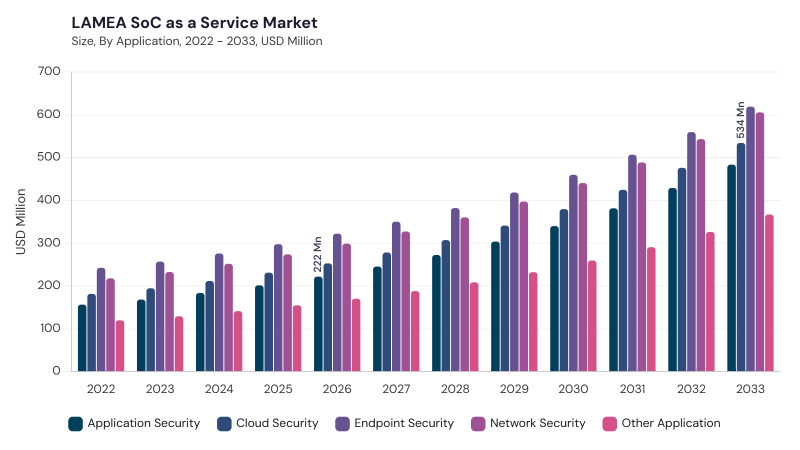
Based on Application, the market is segmented into Endpoint Security, Network Security, Cloud Security, Application Security, and Other Application. Endpoint Security leads as organizations protect laptops, desktops, mobile devices, tablets, and connected endpoints used across remote work, mobile banking, cloud productivity, and enterprise applications. SOCaaS providers support endpoint protection through malware detection, ransomware monitoring, suspicious behavior analysis, credential threat detection, and automated response.
Network Security remains significant through traffic monitoring, firewall management, intrusion detection, DDoS protection, and visibility across telecom, banking, government, and industrial networks. Cloud Security is gaining importance with public and hybrid cloud adoption, while Application Security and Other Application areas expand through API protection, identity monitoring, database security, OT security, compliance reporting, and specialized digital environments.
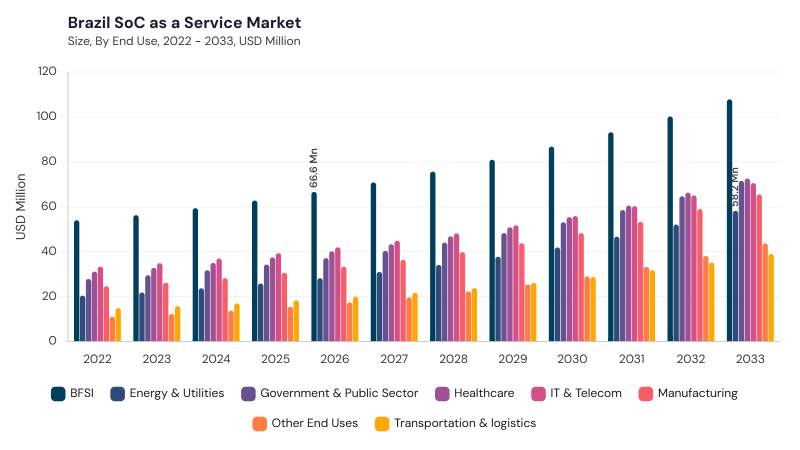
Based on End Use, the market is segmented into BFSI, IT & Telecom, Healthcare, Government & Public Sector, Manufacturing, Energy & Utilities, Transportation & Logistics, and Other End Uses. BFSI leads due to digital banking adoption, fintech expansion, payment fraud risks, customer data protection, transaction security, and rising demand for continuous threat monitoring. IT & Telecom follows due to cloud infrastructure growth, broadband expansion, data center investment, communication network protection, and next-generation connectivity requirements.
Healthcare adoption is supported by digital patient records, telemedicine, connected healthcare systems, and ransomware concerns. Government & Public Sector, Manufacturing, Energy & Utilities, Transportation & Logistics, and Other End Uses add demand through smart government platforms, oil & gas security, industrial modernization, utility protection, port digitization, digital freight systems, retail platforms, and business continuity needs.
Free Valuable Insights: SoC as a Service Market Size Worth USD 27.1 Billion billion by 2033
Based on Country, the market is segmented into Brazil, Argentina, UAE, Saudi Arabia, South Africa, Nigeria, and Rest of LAMEA. The Brazil market dominated the LAMEA SoC as a Service Market by Country in 2025, and would continue to be a dominant market till 2033; thereby, achieving a market value of $365.0 million by 2029, growing at a CAGR of 9.2 % during the forecast period. The Argentina market is expected to witness a CAGR of 12.4% during (2026 - 2033). Additionally, The UAE market is expected to witness a CAGR of 10% during (2026 - 2033).
Brazil leads due to digital transformation, cloud adoption, local data sovereignty needs, telecom modernization, fintech activity, and rising demand for managed cybersecurity services. Argentina supports market growth through secure digital infrastructure, cloud-enabled service models, AI-based monitoring, regulatory alignment, and demand from telecom, industrial, and financial sectors. The UAE contributes through smart government initiatives, cloud-native SOC platforms, AI-enabled detection, SOAR integration, data residency needs, and strong demand from oil & gas, finance, and government. Saudi Arabia, South Africa, and Nigeria add momentum through national digital programs, fintech growth, cybersecurity compliance, cloud infrastructure, public-sector security, and critical infrastructure protection, while Rest of LAMEA benefits from expanding digital services and rising cyber awareness.

By Offering
By Enterprise Size
By Service
By Application
By End Use
By Country
Set to reach $1.7 Billion by 2029, growing at 10.9% CAGR during 2026–2033.
Brazil leads with a market value of $365.0 million by 2029, growing at a 9.2% CAGR during the forecast period.
Rising demand for fully managed services, set to reach $1.0 billion by 2029 at 10.4% CAGR.
Detection Services will achieve $578.9 million by 2029, growing at an 11.3% CAGR during the forecast period.
The UAE market is expected to witness a CAGR of 10% during 2026–2033.
The Co-Managed segment is expected to witness a CAGR of 11.6% during 2026–2033.
Our team of dedicated experts can provide you with attractive expansion opportunities for your business.




 Unique Offerings
