The sample copy of this report is available for access.
The LAMEA Reinforcement Learning Market is expected to reach USD 2.6 billion by 2029, growing at a CAGR of 33.5% during (2026 – 2033).
The LAMEA Reinforcement Learning Market developed from early machine learning research focused on reward-based decision-making and sequential optimization. Initial use was largely experimental, with reinforcement learning tested in games, simulations, robotics, and controlled academic environments. Over time, improved computing power, stronger algorithms, and expanding datasets helped RL move into commercial and industrial use cases. The arrival of deep reinforcement learning allowed systems to process complex inputs and optimize decisions across dynamic environments.
The LAMEA Reinforcement Learning Market is being shaped by digital transformation, Industry 4.0 adoption, smart mobility, financial automation, AI talent development, and demand for decentralized decision-making. Organizations are using reinforcement learning to optimize logistics, automate navigation, personalize digital experiences, improve predictive maintenance, manage financial risk, and support adaptive pricing. Demand is supported by rising cloud adoption, AI innovation hubs, smart city initiatives, regional data privacy frameworks, and growing investment in intelligent automation. Vendors are focusing on distributed learning, explainable RL, scalable deployment models, localized data handling, domain-specific algorithms, and cost-efficient implementation.
Based on Component, the market is segmented into Software, Services, and Hardware. The Software market dominated the LAMEA Reinforcement Learning Market by Component in 2025, and would continue to be a dominant market till 2033; thereby, achieving a market value of USD 1.5 billion by 2029, growing at a CAGR of 32.9 % during the forecast period. The Services market is expected to witness a CAGR of 34.2% during (2026 - 2033).
Software leads due to accelerating enterprise digitalization, expanding cloud adoption, and increasing use of AI-powered applications across finance, manufacturing, telecom, logistics, and public services. These platforms support policy optimization, environment modeling, deep reinforcement learning, simulation, deployment, and continuous model improvement. Services remain important as organizations require consulting, system integration, workforce training, customization, compliance support, and post-deployment optimization. Hardware adds demand through GPUs, AI accelerators, edge devices, sensors, data centers, and high-performance infrastructure required for complex model training and real-time decision-making.
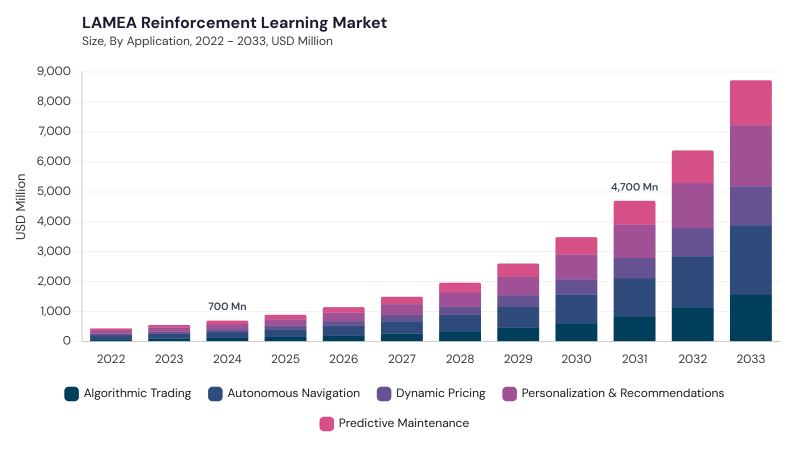
Based on Application, the market is segmented into Autonomous Navigation, Personalization & Recommendations, Algorithmic Trading, Predictive Maintenance, and Dynamic Pricing. The Autonomous Navigation market dominated the LAMEA Reinforcement Learning Market by Application in 2025, and would continue to be a dominant market till 2033; thereby, achieving a market value of USD 717.6 million by 2029, growing at a CAGR of 32.3 % during the forecast period. The Personalization & Recommendations market is expected to witness a CAGR of 32.9% during (2026 - 2033). Additionally, The Algorithmic Trading market is expected to witness highest CAGR of 34.4% during (2026 - 2033).
Autonomous Navigation leads due to rising adoption of intelligent transportation systems, autonomous mining equipment, warehouse robotics, smart mobility platforms, drones, and logistics automation. These solutions use reinforcement learning for route planning, obstacle avoidance, traffic optimization, and adaptive movement across uncertain operating environments. Personalization & Recommendations is gaining demand as digital platforms, retailers, banks, and online service providers use RL to improve customer engagement and tailored experiences. Algorithmic Trading, Predictive Maintenance, and Dynamic Pricing add demand through financial automation, fraud analytics, equipment uptime improvement, industrial asset management, retail pricing, aviation pricing, hospitality pricing, and transportation revenue optimization.
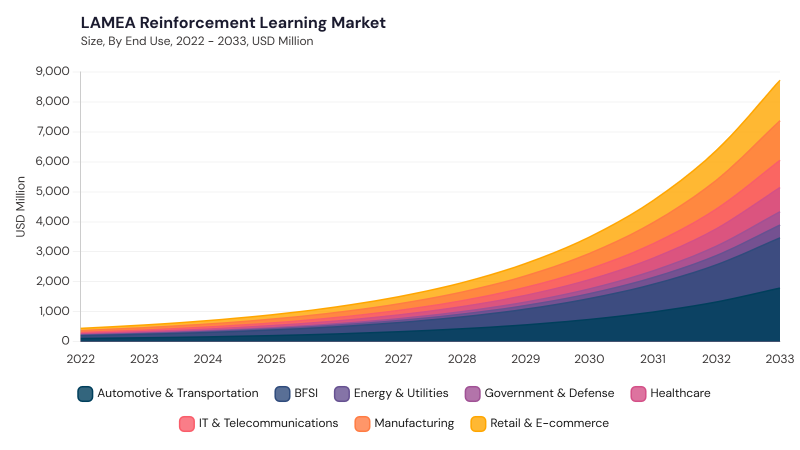
Based on End Use, the market is segmented into Automotive & Transportation, BFSI, Retail & E-commerce, Manufacturing, IT & Telecommunications, Healthcare, Energy & Utilities, and Government & Defense. Automotive & Transportation leads due to growing investment in smart transport infrastructure, fleet optimization, connected mobility, logistics modernization, traffic management, and autonomous navigation tools. BFSI uses reinforcement learning for fraud prevention, digital banking, algorithmic trading, risk assessment, portfolio management, and customer analytics.
Retail & E-commerce applies RL for recommendation engines, demand forecasting, personalized marketing, dynamic pricing, and inventory planning. Manufacturing, IT & Telecommunications, Healthcare, Energy & Utilities, and Government & Defense add demand through robotics, network optimization, clinical decision support, smart grids, oil and gas operations, cybersecurity, public safety, border security, and AI-enabled defense modernization.
Free Valuable Insights: Reinforcement Learning Market Size Worth USD 104.8 Billion billion by 2033
Based on Country, the market is segmented into Brazil, Argentina, UAE, Saudi Arabia, South Africa, Nigeria, and Rest of LAMEA. The Brazil market dominated the LAMEA Reinforcement Learning Market by Country in 2025, and would continue to be a dominant market till 2033; thereby, achieving a market value of USD 615.7 million by 2029, growing at a CAGR of 31.8 % during the forecast period. The Argentina market is expected to witness a CAGR of 34.3% during (2026 - 2033). Additionally, The UAE market is expected to witness a CAGR of 32.4% during (2026 - 2033).
Brazil leads due to AI-driven digital product adoption, contextual data governance, supply chain automation, geospatial resource management, and increasing use of RL across enterprise optimization. Argentina supports market growth through academic AI research, precision agriculture applications, logistics optimization, collaborative innovation networks, and responsible AI development. The UAE contributes through smart city initiatives, financial services automation, autonomous infrastructure, AI governance, and localized reinforcement learning deployment. Saudi Arabia, South Africa, and Nigeria add momentum through Vision-linked AI programs, mining automation, fintech adoption, digital infrastructure expansion, localized model development, and workforce upskilling, while Rest of LAMEA benefits from smart logistics, energy optimization, and regional AI partnerships.

By Component
By Application
By End Use
By Country
Set to reach $2.6 Billion by 2029, growing at 33.5% CAGR during 2026-2033.
Brazil leads with $615.7 million by 2029, growing at 31.8% CAGR during the forecast period.
Rising demand for autonomous navigation, expected to reach $717.6 million by 2029 at 32.3% CAGR.
Software segment to reach $1.5 billion by 2029, growing at 32.9% CAGR during the forecast period.
The UAE market is expected to witness a CAGR of 32.4% during 2026-2033.
Algorithmic Trading is expected to witness the highest CAGR of 34.4% during 2026-2033.
Our team of dedicated experts can provide you with attractive expansion opportunities for your business.




 Unique Offerings