The sample copy of this report is available for access.
The LAMEA Power Strip Market is expected to reach USD 1197.5 million by 2029, growing at a CAGR of 7.5% during (2026 - 2033).
The LAMEA Power Strip Market evolved from basic multi-socket devices used primarily for residential convenience into more advanced power-management products incorporating surge protection, circuit breakers, USB charging, and smart connectivity. Rising electrification, urbanization, and greater penetration of household and workplace electronics gradually increased demand for safer and more versatile solutions. Growing awareness of device protection and energy efficiency further accelerated the transition toward feature-rich products. The market now spans basic, smart, and specialized power strips designed for residential, commercial, telecommunications, healthcare, energy, and industrial environments across diverse LAMEA economies.
Smart technology integration, stronger safety requirements, commercial infrastructure growth, and energy-efficiency priorities are shaping current market development. Manufacturers are increasingly embedding IoT-enabled controls, remote outlet management, energy monitoring, programmable operation, and smart load-management functions into power strips. Regulatory pressure is encouraging certified components, enhanced surge suppression, fire-resistant materials, and improved circuit protection, while expanding commercial and industrial infrastructure is driving demand for heavy-duty and modular products. Sustainability considerations, localized designs, USB integration, and compatibility with varied electrical conditions are also expanding product differentiation across the region.
Based on Type, the market is segmented into Common, Smart, and Specialized. The Common market dominated the LAMEA Power Strip Market by Type in 2025, and would continue to be a dominant market till 2033; thereby, achieving a market value of USD 689.5 million by 2029, growing at a CAGR of 7% during the forecast period. The Smart market is expected to witness a CAGR of 7.9% during (2026 - 2033). The Specialized market is expected to witness a CAGR of 8.5% during (2026 - 2033).
Common power strips provide affordable multi-outlet access, basic surge protection, and straightforward operation for households, education, and small businesses, maintaining broad appeal across cost-sensitive markets. Smart power strips integrate Wi-Fi or Bluetooth connectivity, remote control, energy monitoring, programmable outlets, and smart-home compatibility, supporting digitally progressive residential and commercial environments. Specialized power strips address telecommunications sites, mining operations, healthcare facilities, server rooms, energy installations, manufacturing, and other demanding applications requiring rugged construction, high protection levels, customized configurations, and enhanced electrical performance.
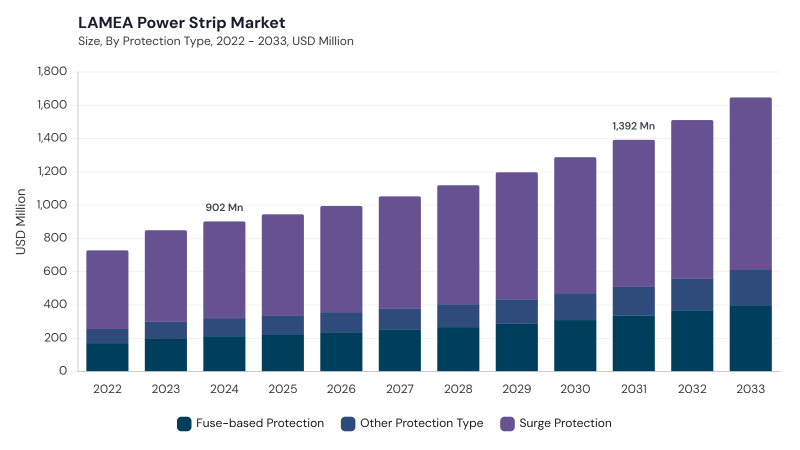
Based on Protection Type, the market is segmented into Surge Protection, Fuse-based Protection, and Other Protection Type. The Surge Protection market dominated the LAMEA Power Strip Market by Protection Type in 2025, and would continue to be a dominant market till 2033; thereby, achieving a market value of USD 763.2 million by 2029, growing at a CAGR of 7.1 % during the forecast period. The Fuse-based Protection market is expected to witness a CAGR of 7.8% during (2026 - 2033). The Other Protection Type market is expected to witness a CAGR of 8.6% during (2026 - 2033).
Surge Protection power strips use components such as metal oxide varistors and related protective mechanisms to absorb voltage spikes and reduce damage to sensitive electronics across residential, commercial, and institutional environments. Fuse-based Protection interrupts current when safe thresholds are exceeded, providing simple, economical, and familiar overload protection for households and smaller businesses. Other Protection Type includes resettable circuit breakers, thermal protection, overload controls, child-safety features, and intelligent cutoff mechanisms that address more complex risks in telecommunications, industrial, healthcare, institutional, and other demanding environments.
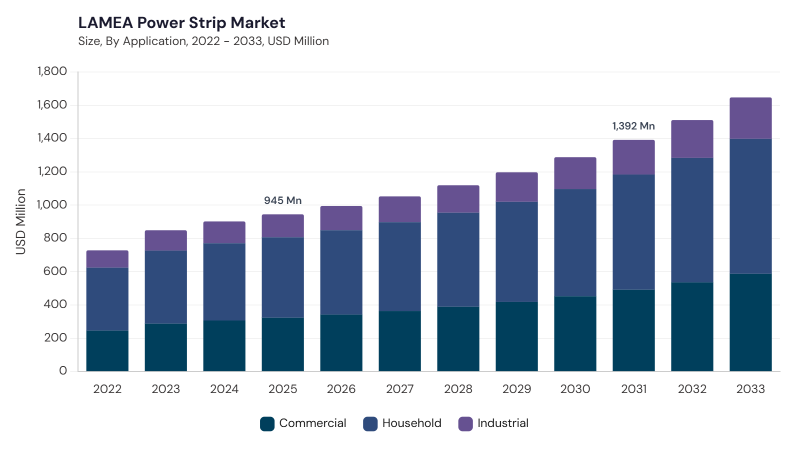
Based on Application, the market is segmented into Household, Commercial, and Industrial. Household applications emphasize affordability, multi-outlet convenience, surge protection, USB charging, compact designs, and increasingly smart controls for consumer electronics and home appliances. Commercial applications serve offices, hospitality, retail, education, healthcare, telecommunications, and other service environments requiring reliable power access, higher durability, load monitoring, and enhanced safety.
Industrial applications require rugged, high-capacity power strips for oil and gas operations, mining, processing facilities, logistics hubs, utilities, manufacturing, and construction settings where moisture, dust, temperature variations, heavy loads, and operational continuity influence product design.
Free Valuable Insights: Power Strip Market Size Worth USD 15.4 Billion billion by 2033
Based on Country, the market is segmented into Brazil, Argentina, UAE, Saudi Arabia, South Africa, Nigeria, and Rest of LAMEA. The Brazil market dominated the LAMEA Power Strip Market by Country in 2025, and would continue to be a dominant market till 2033; thereby, achieving a market value of USD 316.7 million by 2029, growing at a CAGR of 6.2 % during the forecast period. The Argentina market is expected to witness a CAGR of 9% during (2026 - 2033). Additionally, The UAE market is expected to witness a CAGR of 6.3% during (2026 - 2033).
Across LAMEA, power strip adoption is being shaped by smart connectivity, electrical safety, energy efficiency, localization, grid instability, and infrastructure modernization. Brazil emphasizes advanced surge protection, smart controls, localization, energy management, and adaptation to domestic electrical conditions, while Argentina focuses on safety compliance, smart-home functionality, energy efficiency, and localized product design. The UAE is advancing IoT-enabled strips, energy monitoring, premium safety features, digital distribution, and locally adapted solutions, whereas Saudi Arabia emphasizes smart connectivity, energy-saving functions, localized manufacturing, advanced safety, and compatibility with smart infrastructure. South Africa focuses on surge protection, smart energy management, renewable-energy compatibility, safety compliance, and adaptation to variable power conditions, while Nigeria emphasizes voltage protection, local manufacturing, multi-plug compatibility, USB integration, and smart control. Rest of LAMEA continues to develop advanced surge protection, IoT-enabled power management, energy-efficient products, sustainable materials, localized configurations, and products suited to unstable electrical infrastructure.

By Type
By Protection Type
By Application
By Country
Set to reach $1197.5 Million by 2029, growing at 7.5% CAGR during 2026-2033.
Brazil leads, reaching $316.7 million by 2029, with a 6.2% CAGR during 2026-2033.
The common type will reach $689.5 million by 2029, at a 7% CAGR during 2026-2033.
The UAE market is expected to grow at a 6.3% CAGR during 2026-2033.
Surge protection will reach $763.2 million by 2029, growing at a 7.1% CAGR during 2026-2033.
Our team of dedicated experts can provide you with attractive expansion opportunities for your business.




 Unique Offerings