The sample copy of this report is available for access.
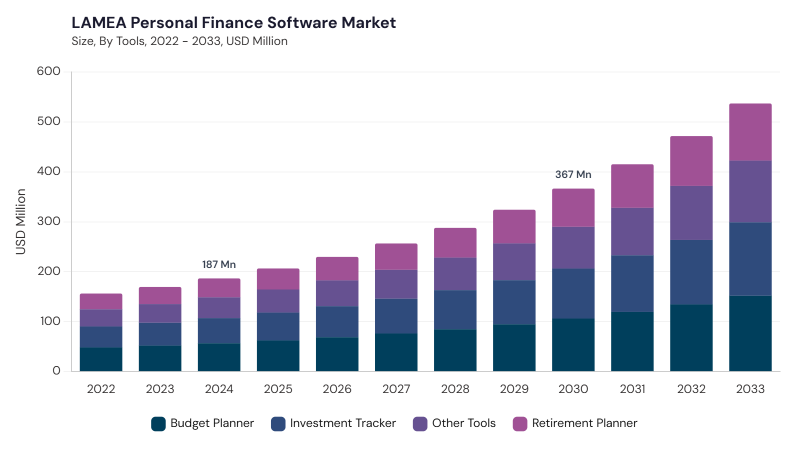
The LAMEA Personal Finance Software Market is expected to reach USD 324.1 million by 2029, growing at a CAGR of 12.9% during (2026 - 2033).
The LAMEA Personal Finance Software Market evolved from basic desktop-based budgeting and accounting applications into increasingly mobile, cloud-enabled, and integrated financial management platforms. Early adoption was concentrated in urban centers because of limited digital infrastructure, while rising smartphone ownership and mobile internet access broadened participation across Latin America, the Middle East, and Africa. Localization through regional languages, financial behaviors, and banking integration further strengthened accessibility. The market has consequently progressed from basic expense tracking toward multifunctional platforms incorporating automated budgeting, AI-driven analytics, financial planning, and connections with broader banking and payment ecosystems.
AI-powered personalization, integrated fintech ecosystems, cloud deployment, cybersecurity, and financial inclusion are shaping current market development. Personal finance platforms increasingly use artificial intelligence to analyze spending patterns, automate financial tasks, forecast cash flows, and deliver personalized financial guidance. Partnerships with banks, payment providers, telecom operators, and fintech firms are expanding interoperability, while localized interfaces and multi-currency capabilities address the region’s diverse consumer needs. Sustainability-oriented investment guidance, RegTech integration, mobile-first accessibility, multilingual financial education, and stronger data protection are also expanding the functional scope and consumer relevance of personal finance software across LAMEA.
Based on Type, the market is segmented into Desktop-based and Mobile-based. The Desktop-based market dominated the LAMEA Personal Finance Software Market by Type in 2025, and would continue to be a dominant market till 2033; thereby, achieving a market value of USD 183.1 million by 2029, growing at a CAGR of 12.5 % during the forecast period. The Mobile-based market is expected to witness a CAGR of 13.4% during (2026 - 2033).
Desktop-based software provides detailed budgeting, reporting, investment tracking, tax planning, financial analysis, and local data management for users requiring extensive control and structured financial administration. Offline accessibility and local storage remain relevant in areas with inconsistent connectivity or among privacy-conscious users. Mobile-based software emphasizes real-time expense monitoring, banking connectivity, payment management, financial alerts, and accessible budgeting through smartphones and tablets. Biometric authentication, multilingual interfaces, mobile-money integration, offline capabilities, and AI-driven insights are strengthening adoption among younger, urban, semi-urban, underbanked, and increasingly digitally active users.
Based on Deployment, the market is segmented into Cloud and On-premise. The Cloud market dominated the LAMEA Personal Finance Software Market by Deployment in 2025, and would continue to be a dominant market till 2033; thereby, achieving a market value of USD 187.5 million by 2029, growing at a CAGR of 13.1 % during the forecast period. The On-premise market is expected to witness a CAGR of 12.6% during (2026 - 2033).
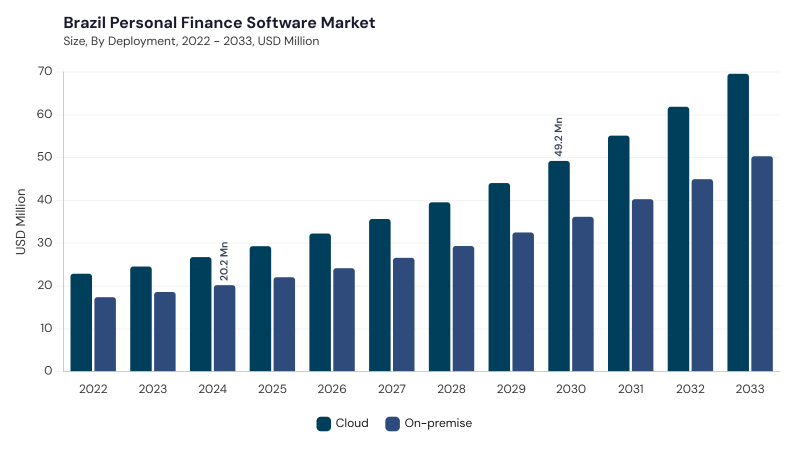
Cloud deployment enables synchronized access across devices, automatic software updates, scalable infrastructure, digital-payment integration, and real-time financial monitoring without substantial local IT requirements. It is particularly relevant for individuals and small businesses seeking affordable, flexible, subscription-based or freemium financial management. On-premise deployment provides direct control over sensitive information, offline accessibility, localized storage, customized configurations, and integration with internal systems. This model remains relevant where internet reliability, data sovereignty, cybersecurity concerns, or specific regulatory requirements make locally controlled financial records preferable.
Based on End Use, the market is segmented into Individuals and Small Businesses. Individuals use personal finance software for budgeting, savings planning, expense tracking, debt management, investment monitoring, remittance oversight, and financial goal setting. Mobile-first platforms, AI-based categorization, personalized recommendations, multilingual support, and integration with digital payment systems are broadening adoption across varied socioeconomic groups.
Small Businesses use these solutions for cash-flow management, expense tracking, invoicing, billing, payroll-related tasks, tax compliance, and financial forecasting. Cloud accessibility, affordable subscription models, automation, multi-user functionality, and localized reporting capabilities are supporting adoption among microenterprises, informal businesses, startups, and SMEs.
Based on Tools, the market is segmented into Budget Planner, Investment Tracker, Retirement Planner, and Other Tools. Budget Planner tools support income tracking, expense categorization, bill management, cash-flow visibility, savings goals, and day-to-day spending discipline, making them an accessible entry point for users with varying financial literacy. Investment Tracker tools provide portfolio monitoring, market information, performance analytics, risk assessment, and visibility across domestic and international assets.
Retirement Planner tools support pension planning, future-income estimation, long-term savings scenarios, and retirement-readiness assessment as private retirement products and long-term financial awareness develop. Other Tools include debt-management utilities, remittance tracking, currency functions, tax assistance, loan calculators, credit monitoring, savings calculators, and expense-sharing capabilities addressing diverse regional financial requirements.
Free Valuable Insights: Personal Finance Software Market Size Worth USD 4383.8 Million billion by 2033
Based on Country, the market is segmented into Brazil, Argentina, UAE, Saudi Arabia, South Africa, Nigeria, and Rest of LAMEA. The Brazil market dominated the LAMEA Personal Finance Software Market by Country in 2025, and would continue to be a dominant market till 2033; thereby, achieving a market value of USD 76.5 million by 2029, growing at a CAGR of 11.4 % during the forecast period. The Argentina market is expected to witness a CAGR of 13.7% during (2026 - 2033). Additionally, The UAE market is expected to witness a CAGR of 11.7% during (2026 - 2033).
Across LAMEA, personal finance software adoption is being shaped by mobile financial services, AI personalization, financial inclusion, cloud platforms, localization, cybersecurity, and financial ecosystem integration. Brazil emphasizes open finance APIs, AI-based financial insights, integrated cloud tools, and cybersecurity, while Argentina focuses on inflation-aware financial management, multi-currency functionality, financial inclusion, AI automation, and local banking integration. The UAE is advancing AI-powered financial advice, open finance, cloud infrastructure, multilingual services, blockchain-enabled security, and integrated financial ecosystems, whereas Saudi Arabia emphasizes mobile-first platforms, AI analytics, digital financial inclusion, cloud adoption, cybersecurity, and localized financial management aligned with digital modernization. South Africa focuses on mobile accessibility, offline functionality, AI-driven financial coaching, localized interfaces, banking integration, and flexible pricing, while Nigeria emphasizes financial inclusion, mobile-first applications, vernacular support, cloud-based access, AI financial guidance, and partnerships with banks and telecom operators. Rest of LAMEA continues to develop localized, multilingual, secure, AI-enabled, mobile-first platforms connected with banking services, payment systems, and regional financial ecosystems.

By Type
By Deployment
By End Use
By Tools
By Country
Set to reach $324.1 Million by 2029, growing at 12.9% CAGR during 2026-2033.
Brazil leads with $76.5 million by 2029, growing at 11.4% CAGR during the forecast period.
Cloud deployment dominates with a market value of $187.5 million by 2029, at 13.1% CAGR during 2026-2033.
Mobile-based segment is expected to witness a 13.4% CAGR during 2026-2033.
The UAE market is expected to witness a CAGR of 11.7% during 2026-2033.
Our team of dedicated experts can provide you with attractive expansion opportunities for your business.




 Unique Offerings