The Latin America, Middle East and Africa Natural Language Processing Market is expected to reach $9.26 billion by 2028 and would witness market growth of 34.2% CAGR during the forecast period (2025-2032).
The Brazil market dominated the LAMEA Natural Language Processing Market by Country in 2024, and would continue to be a dominant market till 2032; thereby, achieving a market value of $7,744.9 million by 2032. The Argentina market is showcasing a CAGR of 35% during (2025 - 2032). Additionally, The UAE market would register a CAGR of 32.8% during (2025 - 2032). The Brazil and Argentina led the LAMEA Natural Language Processing Market by Country with a market share of 26.9% and 8% in 2024. The South Africa market is expected to witness a CAGR of 35.3% during throughout the forecast period.
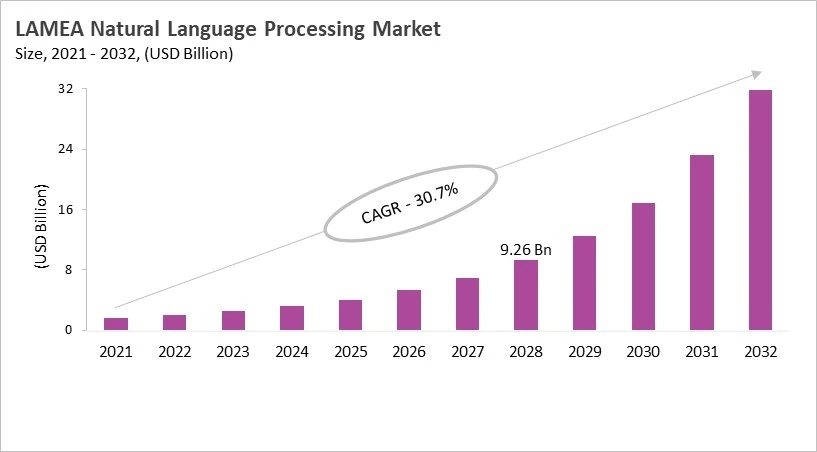
The LAMEA Natural Language Processing (NLP) market has changed a lot because of faster digitization, more people getting online, and government-led digital transformation projects in Latin America, the Middle East, and Africa. Adoption was slow at first in less developed areas because of problems with technology and infrastructure. However, the market has picked up speed thanks to improvements in machine learning, deep learning, and transformer-based architectures. To deal with the region's linguistic diversity, more and more businesses are using NLP solutions for things like multilingual customer engagement, sentiment analysis, speech recognition, and machine translation. The rise in unstructured data from social media, call centers, and public databases has made the need for smart language processing tools even stronger. Because of this, the market has moved from rule-based systems to more advanced AI-driven models that can understand language in a way that is sensitive to context and culture.
The LAMEA NLP market is being shaped by a number of important trends, such as the growth of AI-powered customer engagement platforms, better regional language processing capabilities, and the use of NLP with cloud computing, robotic process automation, and big data analytics. Top companies use partnership-driven strategies to make their products more relevant and scalable in different regions. They do this by investing in localized datasets, research and development, cloud-based deployments, and collaborative ventures. There are global tech companies, regional companies, and agile startups all competing for market share. They all use innovation and localization to do this. Regulatory compliance, data privacy requirements, and the need for solutions that work in different cultures all have an effect on strategic positioning. Overall, more competition and more cross-sector uses are still driving innovation and market growth in the LAMEA region.
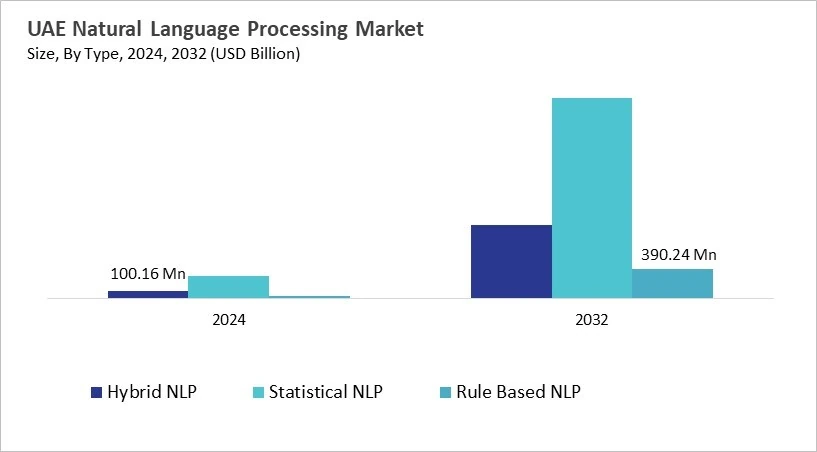
Based on Type, the market is segmented into Hybrid NLP, Statistical NLP, and Rule Based NLP. The Statistical NLP market segment dominated the UAE Natural Language Processing Market by Type is expected to grow at a CAGR of 32.3 % during the forecast period thereby continuing its dominance until 2032. Also, The Rule Based NLP market is anticipated to grow as a CAGR of 34.7 % during the forecast period during (2025 - 2032).
Based on End-use, the market is segmented into BFSI, IT & Telecommunication, Retail & E-commerce, Healthcare, Media & Entertainment, Education, and Other End-use. Among various Brazil Natural Language Processing Market by End-use; The BFSI market achieved a market size of USD $194.9 Million in 2024 and is expected to grow at a CAGR of 29.8 % during the forecast period. The Education market is predicted to experience a CAGR of 35.3% throughout the forecast period from (2025 - 2032).
Free Valuable Insights: Natural Language Processing Market Size Worth USD 321.30 billion by 2032
The Brazil Natural Language Processing (NLP) market has grown from simple text processing tools to advanced AI-driven language models that can do complex semantic and contextual analysis in Brazilian Portuguese. Growth has been driven by more people using the internet and smartphones, more cloud infrastructure being built, and more sectors like banking, healthcare, e-commerce, and public administration needing automation. Some of the most important trends are the quick use of conversational AI, better sentiment analysis for customer insights, and the use of technologies like robotic process automation and the Internet of Things (IoT). To boost adoption and innovation, market leaders are focusing on localized R&D, cloud-based scalability, strategic partnerships, and following the rules. Global tech companies and nimble local players are competing in the market by specializing in languages, using proprietary algorithms, and building collaborative ecosystems. Together, these companies are driving the market's rapid growth.

By Component
By Deployment
By Type
By Enterprise Size
By End-use
By Application
By Country
Our team of dedicated experts can provide you with attractive expansion opportunities for your business.



 Unique Offerings