The Asia Pacific Natural Language Processing Market is expected to reach $38.26 billion by 2029 and would witness market growth of 33.1% CAGR during the forecast period (2025-2032).
The China market dominated the Asia Pacific Natural Language Processing Market by Country in 2024, and would continue to be a dominant market till 2032; thereby, achieving a market value of $35,350.8 million by 2032. The Japan market is registering a CAGR of 32% during (2025 - 2032). Additionally, The India market would showcase a CAGR of 34.1% during (2025 - 2032). The China and Japan led the Asia Pacific Natural Language Processing Market by Country with a market share of 40.5% and 14.7% in 2024. The Singapore market is expected to witness a CAGR of 35.5% during throughout the forecast period.
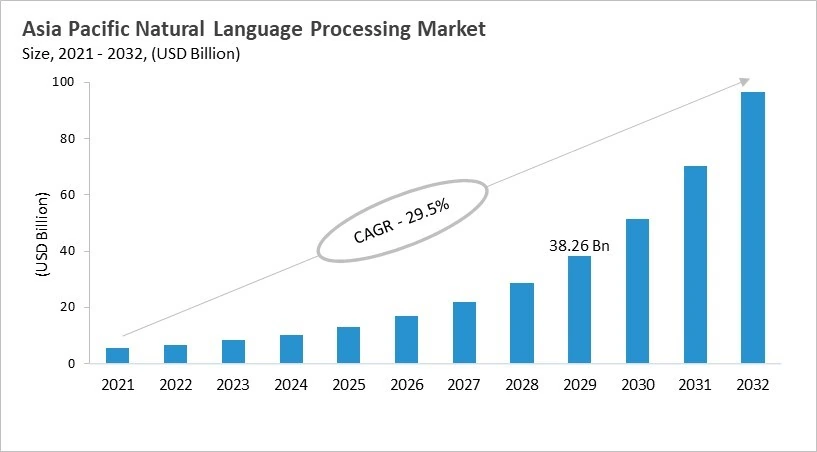
The Asia Pacific Natural Language Processing (NLP) market has grown from simple translation and text analysis to sophisticated natural language understanding systems. This is because of rapid progress in artificial intelligence and the widespread digital transformation in economies like China, India, Japan, South Korea, and Australia. The rise in internet use, the growth of multilingual digital content, and the rise in mobile and e-commerce use have all sped up adoption in many areas. More and more, businesses and governments are using NLP to improve operational efficiency and user engagement in customer service, sentiment analysis, intelligent search, and document automation. The region's many languages have led to new multilingual and cross-lingual models. After the pandemic, the shift to contactless services has also increased demand for conversational AI apps like chatbots and virtual assistants.
The region's competitive landscape is made up of a mix of global tech giants and nimble local innovators who are putting a lot of money into research, localization, and strategic partnerships. Companies are working on proprietary language models that work best with Asian languages. They are also adding more vertical-specific solutions for banking, healthcare, retail, and education. To deal with concerns about scalability, latency, and data privacy, they are using hybrid cloud and edge-based architectures. Mergers and acquisitions, as well as partnerships with schools and government agencies, are important for improving technology and expanding the company's presence in the region. In the fast-growing Asia Pacific NLP market, leadership is defined by innovation intensity, regulatory compliance, and the ability to provide accurate, scalable, and context-aware solutions.
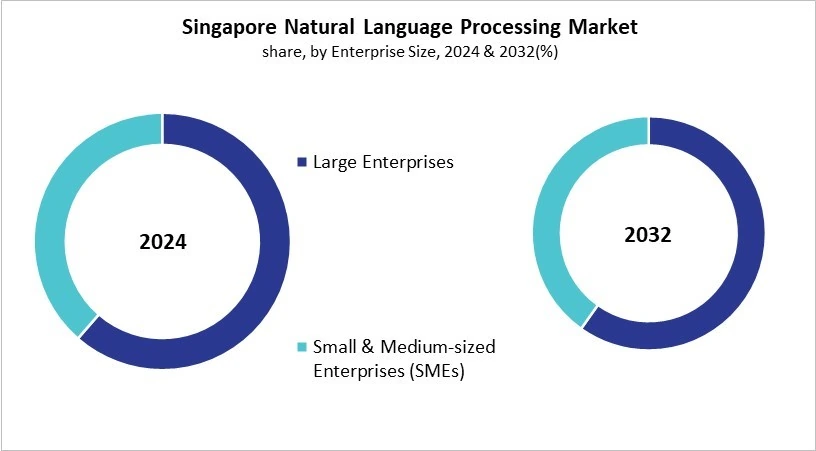
Based on Enterprise Size, the market is segmented into Large Enterprises, and Small & Medium-sized Enterprises (SMEs). The Large Enterprises market segment dominated the Singapore Natural Language Processing Market by Enterprise Size is expected to grow at a CAGR of 35.1 % during the forecast period thereby continuing its dominance until 2032. Also, The Small & Medium-sized Enterprises (SMEs) market is anticipated to grow as a CAGR of 36.2 % during the forecast period during (2025 - 2032).
Based on End-use, the market is segmented into BFSI, IT & Telecommunication, Retail & E-commerce, Healthcare, Media & Entertainment, Education, and Other End-use. Among various China Natural Language Processing Market by End-use; The BFSI market achieved a market size of USD $952.3 Million in 2024 and is expected to grow at a CAGR of 28.7 % during the forecast period. The Education market is predicted to experience a CAGR of 34.1% throughout the forecast period from (2025 - 2032).
Free Valuable Insights: Natural Language Processing Market is Predicted to reach USD 321.30 billion by 2032, at a CAGR of 32.2%
The China Natural Language Processing (NLP) market has quickly changed from simple rule-based systems to a complex AI-driven ecosystem that uses deep learning, large language models, and huge linguistic datasets that are made for the many different Chinese languages and dialects. Growth has sped up because there is more digital content, more people are using mobile phones and the internet, and the government is strongly supporting the development and commercialization of artificial intelligence. Some important trends are the rise of multi-modal and contextual NLP systems, the integration of AI into specific fields for regulated industries, and the creation of advanced pre-trained large language models that focus on Chinese. Top companies compete by doing a lot of research and development, working with universities, forming strategic partnerships with other companies in the same industry, and integrating AI into their own products. They also make sure they follow data privacy and ethical rules. The competitive landscape is always changing, with established tech giants and nimble startups pushing for new ideas in a wide range of industries.

By Component
By Deployment
By Type
By Enterprise Size
By End-use
By Application
By Country
Our team of dedicated experts can provide you with attractive expansion opportunities for your business.




 Unique Offerings