The sample copy of this report is available for access.
The LAMEA Mobile Virtual Network Aggregator Market is projected to reach USD 93.18 million by 2033, growing at a CAGR of 12.1% during 2026 - 2033.
The Brazil market dominated the LAMEA Mobile Virtual Network Aggregator Market by Country in 2025, and would continue to be a dominant market till 2033; thereby, achieving a market value of USD 20.52 million by 2029, growing at a CAGR of 10.5% during the forecast period.
The LAMEA Mobile Virtual Network Aggregator (MVNA) Market is witnessing considerable growth driven by increasing mobile penetration, rapid digital transformation, expanding IoT deployments, and the growing need for flexible and cost-efficient connectivity solutions across Latin America, the Middle East, and Africa. Rising investments in telecom infrastructure, regulatory liberalization, and the proliferation of digital financial services are further accelerating market development across the region.
The current market landscape reflects a rapidly evolving and technology-oriented environment where MVNAs play a vital role in enabling digital inclusion, enterprise mobility, IoT connectivity, and mobile financial ecosystems. Increasing adoption of 5G technologies, edge computing, AI-enabled network management, and cloud-native platforms continues strengthening operational efficiency and service flexibility. Additionally, partnerships between telecom operators, fintech companies, cloud providers, and digital service vendors are reshaping the competitive dynamics of the market. Regulatory reforms encouraging fair network access and telecom liberalization are also supporting long-term market expansion throughout the LAMEA region.
Based on Service, the market is segmented into Data, Voice, Value Added Services, and Messaging. The Data segment garnered the highest revenue share in the LAMEA Mobile Virtual Network Aggregator Market owing to increasing smartphone adoption, rising internet penetration, and growing demand for mobile broadband services across emerging economies. Expansion of digital applications such as fintech, video streaming, social media, e-commerce, and cloud services continues supporting strong data consumption growth.
The Voice segment recorded a significant revenue share due to the continued reliance on voice communication services, especially in regions where mobile internet adoption is still evolving. The Value Added Services segment witnessed substantial growth driven by increasing demand for mobile entertainment, mobile payment platforms, location-based services, digital content delivery, and IoT-enabled applications. Meanwhile, the Messaging segment maintained relevance through enterprise communication, customer notifications, authentication services, and transactional messaging solutions.
Based on End Use, the market is segmented into Consumer MVNOs, Enterprise MVNOs, IoT/M2M MVNOs, and Other End Use.
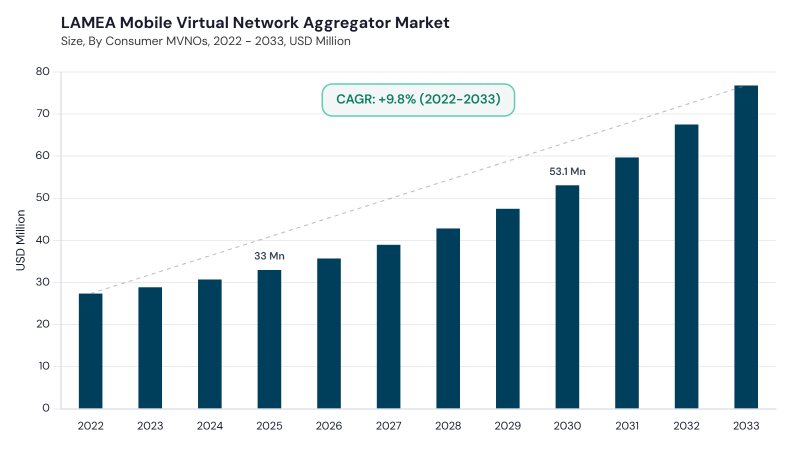
The Consumer MVNOs market dominated the LAMEA Mobile Virtual Network Aggregator Market by End Use in 2025, and would continue to be a dominant market till 2033; thereby, achieving a market value of USD 47.51 million by 2029, growing at a CAGR of 11.6 % during the forecast period. The Enterprise MVNOs market is expected to witness a CAGR of 12.3% during (2026 - 2033).
The Consumer MVNOs segment dominated the LAMEA Mobile Virtual Network Aggregator Market due to increasing demand for affordable mobile services, prepaid connectivity plans, and flexible subscription models among price-sensitive consumers. Rising mobile penetration and digital adoption across urban and rural populations further support segment growth.
Free Valuable Insights: Mobile Virtual Network Aggregator Market Size Worth USD 1,626.38 Million billion by 2033
Based on Country, the market is segmented into Brazil, Argentina, UAE, Saudi Arabia, South Africa, Nigeria, and Rest of LAMEA. Brazil dominated the LAMEA Mobile Virtual Network Aggregator Market owing to increasing enterprise connectivity demand, rising adoption of cloud-native telecom platforms, and strong growth in IoT and digital services ecosystems. Market participants in Brazil are increasingly focusing on AI-enabled network management, enterprise mobility solutions, and advanced digital service integration.
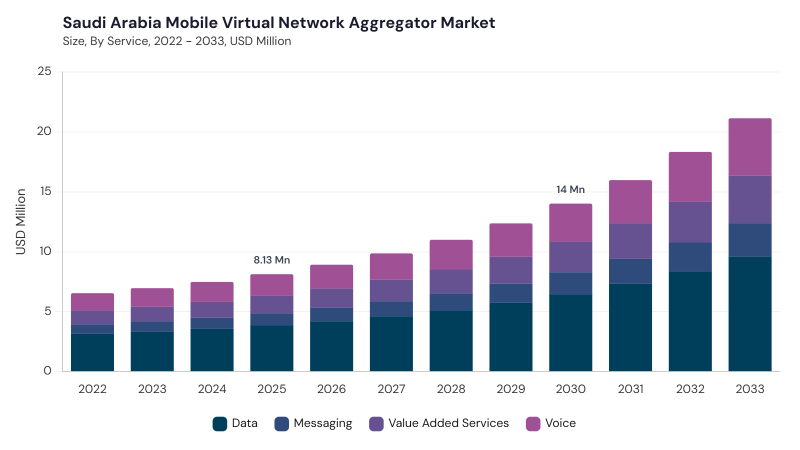
The UAE market is witnessing strong growth supported by advanced telecom infrastructure, aggressive 5G deployment, edge computing integration, and government-led digital transformation initiatives. Saudi Arabia is also projected to witness substantial expansion owing to Vision 2030 initiatives, increasing enterprise digitalization, and rapid development of smart city infrastructure. South Africa continues experiencing strong MVNA growth through expanding fintech ecosystems, localized digital services, and increasing mobile internet penetration. Nigeria is emerging as a significant growth market due to rapid smartphone adoption, expanding mobile financial services, and increasing telecom liberalization initiatives.

By Service
By End Use
By Country
Set to reach $93.18 Million by 2033, growing at 12.1% CAGR during 2026-2033.
Brazil leads, achieving $20.52 million by 2029, growing at 10.5% CAGR during the forecast period.
Consumer MVNOs dominate, reaching $47.51 million by 2029, with an 11.6% CAGR during the forecast period.
Enterprise MVNOs are expected to grow at a 12.3% CAGR during 2026-2033.
Our team of dedicated experts can provide you with attractive expansion opportunities for your business.




 Unique Offerings