The sample copy of this report is available for access.
The LAMEA Microbolometer Market attained a market size of USD40.0 million in 2025 and is expected to reach USD50.51 million by 2033, growing at a CAGR of 8.3% during the forecast period.
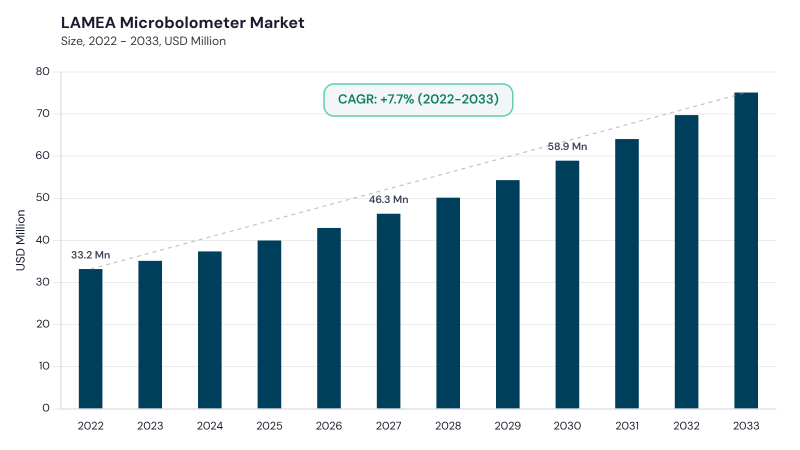
The Brazil market dominated the LAMEA Microbolometer Market by Country in 2025 and would continue to remain dominant till 2033; thereby, achieving a market value of USD14.5 million by 2033, growing at a CAGR of 6.6% during the forecast period. The Argentina market is expected to witness a CAGR of 8.8% during (2026 - 2033). Additionally, the Nigeria market is expected to register the highest CAGR of 9.8% during the forecast period. Brazil and UAE accounted for approximately 21.8% and 13.6% share of the regional market respectively in 2025. The LAMEA market expanded from USD33.2 million in 2022 to USD40.0 million in 2025 and is projected to witness strong momentum through 2033, driven by increasing defense modernization initiatives, growing investments in smart surveillance infrastructure, expanding industrial thermography adoption, and rising deployment of thermal imaging technologies across oil & gas, automotive, and public security applications.
The LAMEA microbolometer market has evolved steadily with increasing utilization of infrared imaging systems across aerospace & defense, industrial monitoring, automotive sensing, healthcare diagnostics, and perimeter surveillance applications. Early adoption across the region was primarily concentrated within military modernization and border security operations, particularly in the Middle East and parts of Latin America. Over time, improvements in uncooled infrared detector technologies, declining sensor costs, and advancements in thermal imaging accuracy have expanded commercial and industrial deployment opportunities throughout the region. Growing urbanization, smart infrastructure development, and rising investments in energy and industrial projects across Saudi Arabia, UAE, Brazil, and South Africa continue to accelerate adoption of thermal imaging systems in operational monitoring and predictive maintenance environments.
The market is increasingly influenced by AI-powered thermal analytics, smart surveillance ecosystems, autonomous mobility technologies, and rising demand for compact low-power infrared sensing solutions. Governments across LAMEA continue investing in public safety infrastructure, military surveillance capabilities, critical asset protection, and transportation modernization, creating sustained demand for high-performance thermal imaging systems. Industrial operators are integrating thermal imaging into predictive maintenance and safety monitoring systems, while automotive OEMs are increasingly deploying thermal sensors for driver assistance and collision avoidance technologies. Competitive dynamics are centered around sensor sensitivity, imaging resolution, cost optimization, and miniaturization of focal plane array technologies. Strategic collaborations between semiconductor manufacturers, defense contractors, and thermal imaging providers are further accelerating innovation and commercialization across the regional microbolometer ecosystem.
Based on Resolution, the market is segmented into 640 × 480, Below 320 × 240, and 1024 × 768 and Above. The 640 × 480 segment dominated the LAMEA Microbolometer Market by Resolution in 2025 and would continue to remain dominant till 2033; thereby, achieving a market value of USD32.8 million by 2033, growing at a CAGR of 7.7% during the forecast period. The dominance of this segment is supported by widespread deployment across defense surveillance systems, industrial thermography solutions, automotive sensing platforms, and perimeter security applications where balanced performance and cost efficiency remain critical.
The 1024 × 768 and Above segment is anticipated to witness the highest CAGR of 9.0% during (2026 - 2033), while the Below 320 × 240 segment is expected to grow at a CAGR of 8.7%. Increasing demand for advanced thermal imaging systems with enhanced spatial accuracy, high-performance infrared analytics, and precision industrial diagnostics is accelerating adoption of higher-resolution detector technologies across the region. Analysis & Future Outlook: Continuous improvements in detector sensitivity, imaging accuracy, and compact infrared sensing architectures are expected to strengthen long-term growth opportunities across both mainstream and high-resolution microbolometer segments.
Based on Material, the market is segmented into Vanadium Oxide (VOx), Amorphous Silicon (a-Si), and Other Material. The Vanadium Oxide (VOx) segment dominated the LAMEA Microbolometer Market by Material in 2025 and would continue to remain dominant till 2033; thereby, achieving a market value of USD39.3 million by 2033, growing at a CAGR of 7.8% during the forecast period. The segment continues to maintain leadership due to superior thermal sensitivity, stable infrared detection performance, and extensive integration across military-grade thermal imaging and industrial thermography systems.
The Other Material segment is expected to witness the highest CAGR of 9.2% during (2026 - 2033), followed by Amorphous Silicon (a-Si) at 8.8%. Increasing investments in next-generation detector materials, semiconductor innovation, and low-power infrared sensing technologies are accelerating commercialization of alternative material platforms across the region. Analysis & Future Outlook: Ongoing advancements in semiconductor fabrication processes, infrared absorption technologies, and miniaturized detector architectures are expected to intensify innovation and product differentiation within the regional microbolometer market.
Based on Application, the market is segmented into Aerospace & Defense, Security & Surveillance, Automotive, Industrial (Monitoring & Thermography), Healthcare, Consumer Electronics, and Other Application. The Aerospace & Defense segment dominated the LAMEA Microbolometer Market by Application in 2025 and would continue to remain dominant till 2033; thereby, achieving a market value of USD25.4 million by 2033, growing at a CAGR of 7.5% during the forecast period. Rising defense expenditure, border monitoring initiatives, UAV-based thermal imaging deployments, and critical infrastructure surveillance programs continue supporting strong segment growth across the region.
The Other Application segment is anticipated to witness the highest CAGR of 12.6% during (2026 - 2033), followed by Consumer Electronics at 11.6% and Healthcare at 9.7%. Growing integration of thermal imaging technologies into wearable electronics, smart devices, connected healthcare systems, and IoT-enabled sensing platforms is accelerating demand across emerging commercial applications. Analysis & Future Outlook: Expanding deployment of AI-integrated thermal analytics, connected surveillance infrastructure, and industrial automation technologies is expected to create substantial long-term growth opportunities across enterprise and consumer application environments.
Free Valuable Insights: Microbolometer Market Size Worth USD 843.73 Million billion by 2033
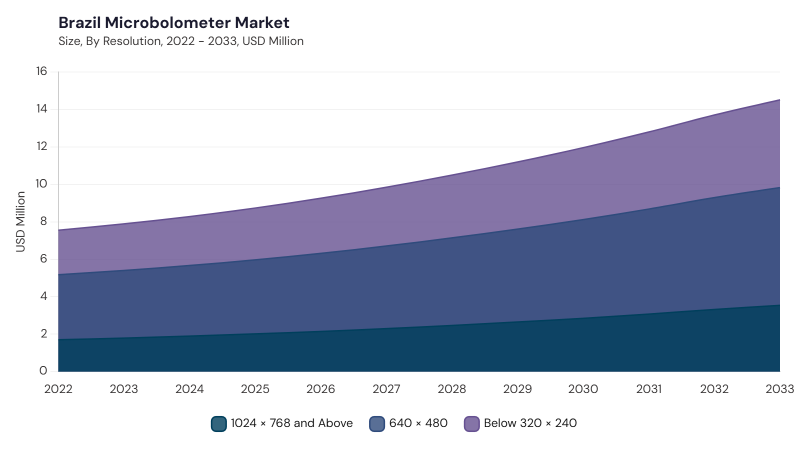
Brazil represents the largest microbolometer market across the LAMEA region, supported by expanding industrial infrastructure, increasing defense modernization efforts, and rising deployment of thermal imaging systems across security, automotive, and industrial applications. The country continues to witness growing adoption of infrared imaging technologies within oil & gas facilities, manufacturing operations, smart transportation systems, and public safety infrastructure. Brazil’s large industrial base and increasing focus on predictive maintenance and operational efficiency optimization are further strengthening demand for advanced thermography systems.
Additionally, government investments in border surveillance, urban security modernization, and industrial automation initiatives are contributing to sustained market expansion across the country. The growing integration of AI-enabled thermal analytics, connected monitoring systems, and smart surveillance technologies is further enhancing the adoption potential of next-generation microbolometer solutions. Future market growth is expected to be supported by continued investments in industrial digitalization, transportation modernization, defense electronics, and advanced infrared sensing technologies across Brazil and the wider LAMEA region.

By Resolution
By Material
By Application
By Country
Market will reach $50.51 million by 2033, growing at 6.2% CAGR during 2026-2033.
Brazil dominates with $14.5 million by 2033 and held 21.8% regional share in 2025.
The 1024 × 768 and Above segment leads growth at 9.0% CAGR during 2026-2033.
Vanadium Oxide (VOx) leads the market, while Other Material grows fastest at 9.2% CAGR during 2026-2033.
UAE held 13.6% of the regional market share in 2025.
Our team of dedicated experts can provide you with attractive expansion opportunities for your business.




 Unique Offerings