The Latin America, Middle East and Africa High-speed Camera Market would witness market growth of 13.6% CAGR during the forecast period (2025-2032).
The Brazil market dominated the LAMEA High-speed Camera Market by Country in 2024, and would continue to be a dominant market till 2032; thereby, achieving a market value of $27.6 million by 2032. The Argentina market is experiencing a CAGR of 14.2% during (2025 - 2032). Additionally, The UAE market would showcase a CAGR of 12.7% during (2025 - 2032). The Brazil and UAE led the LAMEA High-speed Camera Market by Country with a market share of 23.8% and 18% in 2024.The South Africa market is expected to witness a CAGR of 14.3% during throughout the forecast period.
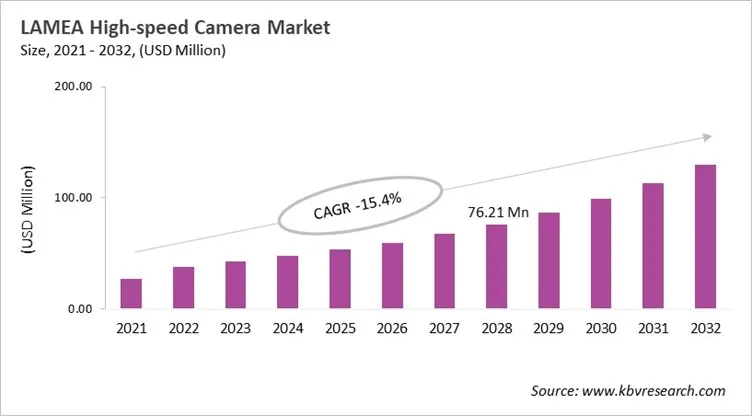
The LAMEA high-speed camera market has grown from being used only in a few academic and government research projects to being widely used in industry. Early demand came from research in aerospace, crash testing cars, diagnosing energy problems, and studying infrastructure. The cost of sensors has gone down, and CMOS technology has gotten better, making them much easier to use and more powerful. Middle Eastern countries put a lot of money into aerospace, defense, and petrochemicals, which increased the need for advanced imaging. Latin America saw more use in manufacturing, robotics, and sports analytics. African countries started using high-speed cameras for mining, civil engineering, and STEM education. This change made high-speed imaging an important tool for analysis in many fields.
The market has been growing recently because of the use of AI, machine learning, and automated inspection systems. High-speed cameras now help with smart manufacturing, robotics validation, and Industry 4.0 projects all over LAMEA. Increasingly, governments and research institutions use these systems for testing projectiles, analyzing propulsion, and studying materials. Vendors focus on new ideas, like higher frame rates, better performance in low light, and more advanced software analytics. Strategic partnerships with universities and industrial labs help more people in the area use the technology. Local service support and modular product offerings help get around problems with cost and skill. Competition is still strong between global OEMs and regional providers, who focus on customization and customer service.
Based on Frame Rate, the market is segmented into 1,000 – 10,000 FPS, 10,000 – 30,000 FPS, 30,000 – 50,000 FPS, 250 – 1,000 FPS and Above 50,000 FPS. The 1000 – 10000 FPS market segment dominated the UAE High-speed Camera Market by Frame Rate is expected to grow at a CAGR of 12.1 % during the forecast period thereby continuing its dominance until 2032. Also, the 250 – 1000 FPS market is anticipated to grow as a CAGR of 13.8 % during the forecast period during (2025 - 2032).
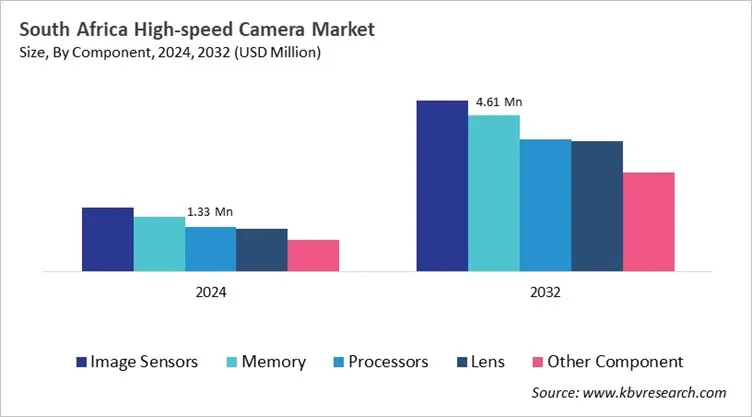
Based on Component, the market is segmented into Image Sensors, Memory, Processors, Lens and Other Component. Among various South Africa High-speed Camera Market by Component; The Image Sensors market achieved a market size of USD $1.9 Million in 2024 and is expected to grow at a CAGR of 13.2 % during the forecast period. The Processors market is predicted to experience a CAGR of 14.8% throughout the forecast period from (2025 - 2032).
Free Valuable Insights: The Worldwide High-speed Camera Market is Projected to reach USD 1.70 Billion by 2032, at a CAGR of 12.2%
Digital transformation and more money being spent on research and development are helping Brazil's high-speed camera market grow into an important part of the country's industrial, scientific, and sports ecosystems. The growing automotive, aerospace, and manufacturing industries are driving up the need for high-speed imaging in crash testing, material analysis, flight testing, and production monitoring. The sports and broadcasting industries also help by using motion analysis and slow-motion content. Market trends show that more people are moving toward advanced systems with higher frame rates, better resolution, AI-powered analytics, and cloud connectivity for real-time monitoring. More universities and research centers are using these cameras for biomechanical and scientific research. Smaller labs and local broadcasters can now use more compact and portable solutions. Competition includes global manufacturers backed by local integrators who offer customization and services after the sale. Even though people are price-sensitive, demand is still high because of the need for more automation, quality control, and new ideas.

By Component
By Application
By Frame Rate
By Spectrum
By Country
Our team of dedicated experts can provide you with attractive expansion opportunities for your business.



 Unique Offerings