The sample copy of this report is available for access.
The LAMEA Financial Aggregator Market would witness market growth of 16.2% CAGR during the forecast period (2026-2033) and would reach a market size of USD 1,077.8 million by 2029.
The Brazil market dominated the LAMEA Financial Aggregator Market by Country in 2025, and would continue to be a dominant market till 2032; thereby, achieving a market value of USD 297.5 million by 2029. The UAE market is expected to witness a CAGR of 15.7% during (2026-2033). Additionally, the Saudi Arabia market is expected to witness a CAGR of 17.9% during (2026-2033).
The LAMEA financial aggregator market has evolved significantly over the last decade due to rising digital banking penetration, expanding fintech ecosystems, regulatory modernization, and growing demand for financial inclusion. Financial aggregators are platforms that collect and organize customer-authorized financial information from multiple institutions into unified interfaces that support banking, lending, payments, investment management, and financial planning services. The market initially developed slowly because many countries within the region had fragmented banking systems, low digital infrastructure penetration, and limited interoperability among financial institutions. However, the rapid adoption of smartphones, internet connectivity, and digital payment systems gradually accelerated the growth of financial aggregation services across multiple economies within the region.
Latin America emerged as one of the most active regions for financial aggregator development due to strong fintech innovation and open banking initiatives. Brazil became a leading market following the introduction of the Central Bank of Brazil’s Open Finance framework, which enabled secure customer-authorized sharing of banking, payment, and financial data across institutions through standardized APIs. Financial aggregators in Brazil increasingly expanded beyond account aggregation into lending, digital payments, insurance integration, and wealth management services. Mexico also contributed to regional growth through fintech regulations supporting data-sharing ecosystems and digital financial inclusion initiatives.
The Middle East experienced rapid financial aggregator market growth due to government-led digital transformation strategies and fintech ecosystem development. Countries such as the United Arab Emirates and Saudi Arabia introduced regulatory sandboxes and open banking frameworks to encourage innovation within digital finance markets. Financial institutions increasingly collaborated with fintech firms to develop secure API-based infrastructures capable of supporting account aggregation, digital lending, and embedded finance services.
Africa’s financial aggregator market evolved largely through mobile money ecosystems and financial inclusion initiatives. The widespread adoption of mobile payment services across countries such as Kenya, Nigeria, South Africa, and Ghana created strong demand for interoperable financial platforms capable of integrating banking and mobile financial services. Fintech firms increasingly introduced aggregation platforms to help consumers manage mobile wallets, bank accounts, lending services, and payment systems through unified digital applications.
Based on Component, the market is segmented into Platform and Services. The Platform segment dominated the LAMEA Financial Aggregator Market by Component in 2025, and would continue to be a dominant segment till 2032; thereby, achieving a market value of USD 746.4 million by 2029. The Services segment is expected to witness a CAGR of 17.8% during (2026-2033).
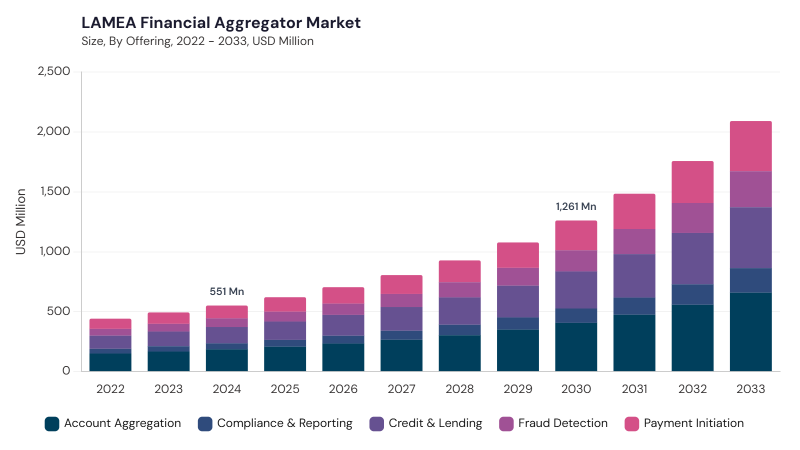
Based on Offering, the market is segmented into Account Aggregation, Credit & Lending, Payment Initiation, Fraud Detection, and Compliance & Reporting. The Account Aggregation segment acquired the highest revenue share in the LAMEA Financial Aggregator Market in 2025 owing to increasing demand for unified financial visibility and expansion of digital banking ecosystems across emerging economies.
The Credit & Lending segment is projected to witness a CAGR of 16.5% during (2026-2033) supported by increasing adoption of AI-driven lending assessment and alternative credit scoring solutions. Additionally, the Payment Initiation segment accounted for a considerable market share in 2025 due to rapid growth in digital wallets, mobile banking, and real-time payment ecosystems across Latin America, the Middle East, and Africa.
The Fraud Detection segment continues witnessing strong growth because of increasing cybersecurity concerns and rising implementation of AI-powered transaction monitoring systems. Meanwhile, the Compliance & Reporting segment is expected to expand steadily due to evolving financial regulations, open banking compliance requirements, and increasing focus on financial transparency.
Based on Application, the market is segmented into Personal Finance, Lending, Business Finance, Wealth Management, Payments, and Other Application. The Personal Finance segment dominated the LAMEA Financial Aggregator Market by Application in 2025 due to increasing smartphone penetration, rising fintech adoption, and growing consumer demand for digital budgeting and financial planning applications.
The Lending segment is anticipated to witness a CAGR of 15.8% during (2026-2033) driven by increasing use of financial aggregation technologies within digital lending and SME financing ecosystems. The Business Finance segment also accounted for a significant revenue share in 2025 owing to growing enterprise demand for treasury visibility, automated accounting, and cash-flow monitoring solutions.
Meanwhile, the Wealth Management segment is gradually gaining traction due to increasing adoption of digital investment and portfolio management platforms. The Payments segment also maintained a notable market share in 2025 supported by the rapid expansion of digital wallets, QR-code payments, and mobile-first financial ecosystems throughout the region.
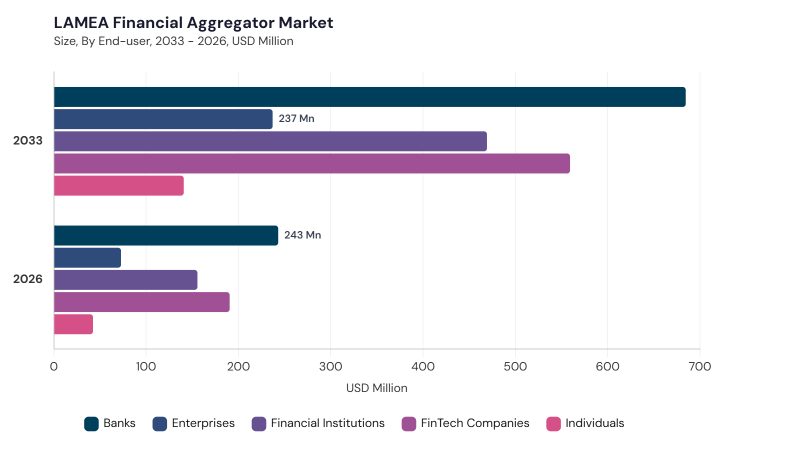
Based on End-user, the market is segmented into Banks, FinTech Companies, Financial Institutions, Enterprises, and Individuals. The Banks segment dominated the LAMEA Financial Aggregator Market by End-user in 2025 owing to increasing investments in digital banking transformation, API modernization, and customer engagement platforms.
The FinTech Companies segment is expected to register the fastest CAGR of 16.6% during (2026-2033) supported by rising fintech innovation, embedded finance adoption, and open banking ecosystem development across the region.
The Financial Institutions segment secured a considerable revenue share in 2025 due to increasing adoption of integrated financial data management and compliance monitoring solutions. Additionally, the Enterprises segment is witnessing growing adoption of aggregation platforms for financial planning and analytics, while the Individuals segment continues expanding with rising usage of personal financial management applications.
Free Valuable Insights: Financial Aggregator Market Size Worth USD 20,088.4 Million billion by 2033
The Brazil market dominated the LAMEA Financial Aggregator Market by Country in 2025, and would continue to be a dominant market till 2032; thereby, achieving a market value of USD 297.5 million by 2029. The UAE market is expected to witness a CAGR of 15.7% during (2026-2033). Additionally, the Saudi Arabia market is projected to witness a CAGR of 17.9% during the forecast period.
The regional market continues benefiting from rising digital payment adoption, increasing fintech investments, and expanding implementation of open banking and open finance frameworks. Government-led financial inclusion initiatives, mobile-first banking ecosystems, and API-driven financial infrastructure modernization are further accelerating demand for financial aggregation platforms across LAMEA. Moreover, increasing deployment of AI-powered analytics, cloud-based financial management systems, and embedded finance solutions continues strengthening adoption of aggregation technologies across banks, fintech firms, enterprises, and consumers throughout the region.

By Component
By Offering
By Application
By End-user
By Country
Set to reach USD 1,077.8 million by 2033, growing at 16.2% CAGR during 2026-2033.
Brazil leads with USD 297.5 million by 2029, maintaining dominance till 2032.
Increasing adoption of AI-driven lending assessment and alternative credit scoring boosts the Credit & Lending segment at 16.5% CAGR during 2026-2033.
The Platform segment will achieve USD 746.4 million by 2029, remaining dominant till 2032.
The UAE market is expected to witness a CAGR of 15.7% during 2026-2033.
FinTech Companies segment registers the fastest CAGR of 16.6% during 2026-2033.
Our team of dedicated experts can provide you with attractive expansion opportunities for your business.




 Unique Offerings