The Latin America, Middle East and Africa Data Broker Market is expected to reach $30.30 billion by 2028 and would witness market growth of 8.8% CAGR during the forecast period (2025-2032).
The Brazil market dominated the LAMEA Data Broker Market by Country in 2024, and would continue to be a dominant market till 2032; thereby, achieving a market value of $10,949.6 million by 2032. The Argentina market is showcasing a CAGR of 9.6% during (2025 - 2032). Additionally, The UAE market would register a CAGR of 7.8% during (2025 - 2032). The Brazil and UAE led the LAMEA Data Broker Market by Country with a market share of 27.8% and 14.5% in 2024. The Saudi Arabia market is expected to witness a CAGR of 9.7% during throughout the forecast period.
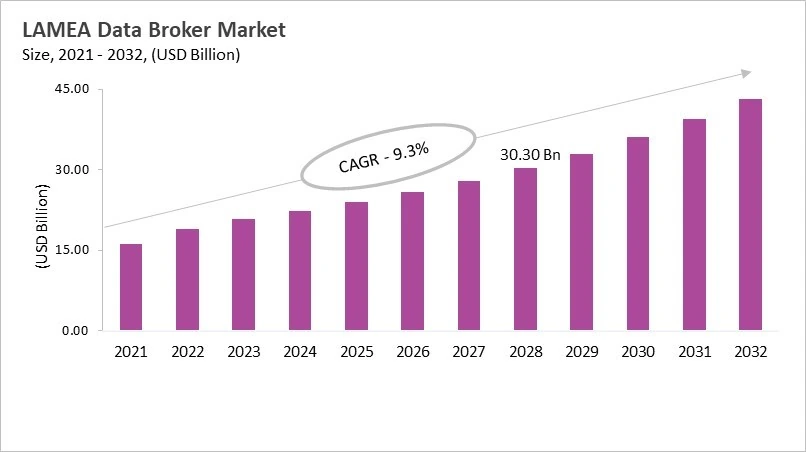
The LAMEA Data Broker Market has changed as digital transformation has sped up, financial inclusion efforts have grown, and telecommunications and e-commerce ecosystems have grown in Latin America, the Middle East, and Africa. Data brokers are very important for collecting, combining, and analyzing legally obtained information from public records, financial transactions, and commercial databases. This information is used for things like credit reporting, fraud detection, identity verification, and targeted marketing. Regulatory changes, like Brazil's General Data Protection Law (LGPD), the UAE Personal Data Protection Law, and South Africa's Protection of Personal Information Act (POPIA), have had a big impact on how businesses work by adding rules about consent, transparency, and responsible data processing. These rules have made governance standards stronger and helped protect consumer privacy and trust. As digital economies grow in the area, businesses and government agencies are using structured data analytics more and more to help with financial services, following the rules, and making business decisions.
Some of the most important trends affecting the market are the growth of digital financial services and alternative credit scoring models, the rise in demand for identity verification and fraud prevention solutions, and the spread of comprehensive data protection laws. In Brazil, Nigeria, and Kenya, for example, financial regulators and central banks are pushing for new ideas in fintech and digital payments. This is leading to the use of alternative data sources like mobile transactions and utility payments in credit assessments. Market leaders are reacting by putting in place plans that focus on following the rules, updating technology, diversifying into new markets, and improving cybersecurity. Putting money into cloud-based analytics, AI, and secure data infrastructure makes it easier to find fraud and make predictions. As a result, the LAMEA Data Broker Market is still only moderately fragmented. Competition is based on things like technological capability, regulatory maturity, data integration capacity, and the growing importance of safe and compliant data management practices.
Based on Data Type, the market is segmented into Structured Data, Unstructured Data, and Custom Structure Data. With a compound annual growth rate (CAGR) of 7.1% over the projection period, the Structured Data Market, dominate the Brazil Data Broker Market by Data Type in 2024 and would be a prominent market until 2032. The Unstructured Data market is expected to witness a CAGR of 7.6% during (2025 - 2032).
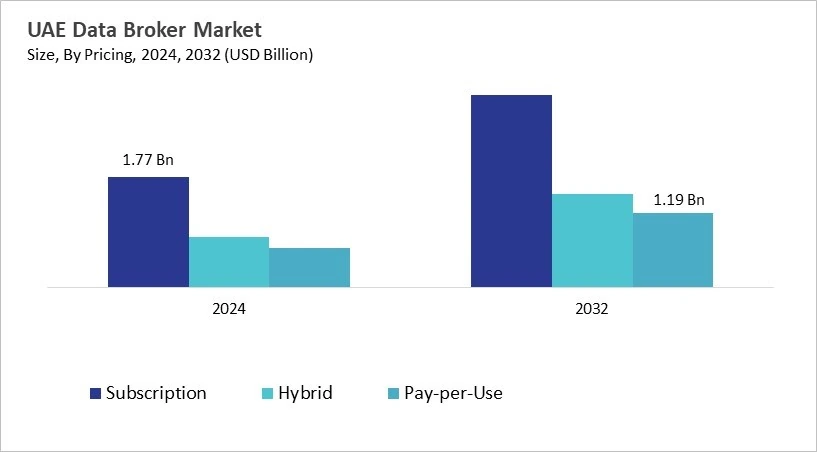
Based on Pricing, the market is segmented into Subscription, Hybrid, and Pay-per-Use. The Subscription market segment dominated the UAE Data Broker Market by Pricing is expected to grow at a CAGR of 7.4 % during the forecast period thereby continuing its dominance until 2032. Also, The Pay-per-Use market is anticipated to grow as a CAGR of 8.4 % during the forecast period during (2025 - 2032).
Free Valuable Insights: Data Broker Market Size Worth USD 464.75 billion by 2032
Brazil has the most organized and regulated data broker market in Latin America. This is because it has a strong credit reporting system, and the General Data Protection Law (LGPD) is enforced by the Autoridade Nacional de Proteção de Dados (ANPD). The country's large population, growing digital economy, and well-established banking system all make people want services that collect consumer data, analyze credit risk, verify identities, and stop fraud. Regulatory oversight stresses openness, protecting consumer rights, and handling data responsibly, which affects how brokers gather and sell personal information. The rise of fintech, digital banking, and e-commerce is making financial and behavioral datasets more available and useful. Market trends show that big data analytics and artificial intelligence are becoming more common in credit scoring and risk modeling. However, competition is still mostly between well-known credit bureaus and global data analytics companies like Serasa Experian and Boa Vista Serviços. Overall, the market is likely to stay compliance-driven, with a steady need for solutions for financial analytics, fraud detection, and marketing intelligence.

By Data Type
By Pricing
By Data Category
By End-Use Industry
By Country
Set to reach $30.30 billion by 2028 at 8.8% CAGR during 2025-2032.
Brazil dominates with 27.8% market share in 2024, reaching $10,949.6 million by 2032.
Digital transformation across emerging economies and expanding data monetization needs fuel regional expansion.
UAE holds 14.5% market share and will grow at 7.8% CAGR during 2025-2032.
Structured data leads Brazil's market, growing at 7.1% CAGR during the projection period.
Subscription model dominates UAE market, expanding at 7.4% CAGR during 2025-2032.
Our team of dedicated experts can provide you with attractive expansion opportunities for your business.




 Unique Offerings