The sample copy of this report is available for access.
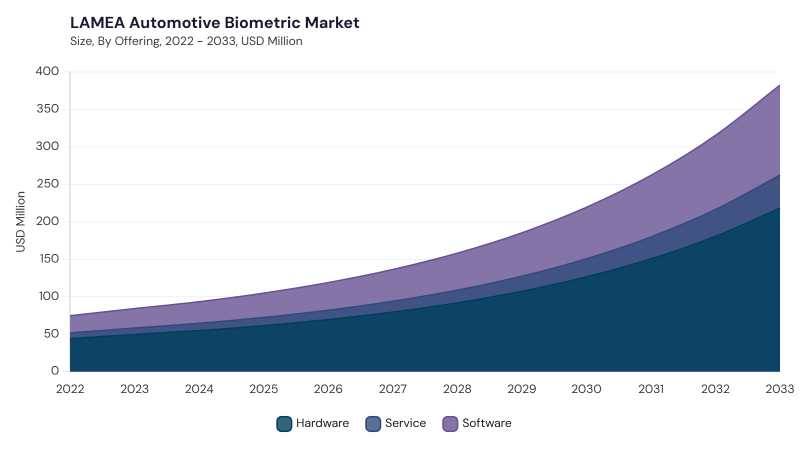
The LAMEA Automotive Biometric Market is expected to reach USD 185.28 million by 2029, growing at a CAGR of 18.2% during 2026 - 2033.
The LAMEA Automotive Biometric Market originated amid growing demand for enhanced vehicle security, user authentication, and personalized mobility experiences across Latin America, the Middle East, and Africa. Initially, biometric applications were limited to fingerprint-based vehicle access systems deployed primarily in premium vehicle segments. Over time, advancements in sensor technologies, artificial intelligence, and connected vehicle architectures enabled the integration of facial recognition, voice recognition, and iris scanning into automotive platforms. The evolution of smart mobility initiatives, connected vehicles, advanced driver assistance systems (ADAS), and rising concerns regarding vehicle theft accelerated the adoption of biometric technologies.
Based on Vehicle Type, the market is segmented into Passenger Cars and Commercial Vehicles. The Passenger Cars market dominated the LAMEA Automotive Biometric Market by Vehicle Type in 2025, and would continue to be a dominant market till 2033; thereby, achieving a market value of USD 136.19 million by 2029, growing at a CAGR of 17.9 % during the forecast period. The Commercial Vehicles market is expected to witness a CAGR of 19.1% during (2026 - 2033).
Passenger Cars account for the dominant share of the LAMEA Automotive Biometric Market due to increasing consumer demand for advanced vehicle security, convenience, and personalized driving experiences. Automakers are increasingly integrating fingerprint scanners, facial recognition systems, and voice-based authentication into passenger vehicles to enhance user experience and security. Commercial Vehicles are witnessing growing adoption of biometric technologies for driver identification, fleet security, access management, and fatigue monitoring. Logistics operators, public transportation agencies, and fleet owners are leveraging biometric solutions to improve operational efficiency, ensure authorized vehicle usage, and comply with evolving transportation safety regulations.
Based on Offering, the market is segmented into Hardware, Software, and Services. Hardware constitutes a significant portion of the market owing to the deployment of biometric sensors, fingerprint readers, facial recognition cameras, iris scanners, and voice capture devices. Software is emerging as a high-growth segment driven by advancements in AI-powered biometric algorithms, identity verification platforms, behavioral analytics, and cybersecurity applications. Services continue to expand as automotive OEMs and fleet operators require consulting, integration, maintenance, software upgrades, and cybersecurity support to ensure optimal deployment and lifecycle management of biometric systems across vehicle fleets and connected mobility ecosystems.
Based on Technology, the market is segmented into Fingerprint Recognition, Facial Recognition, Voice Recognition, and Iris Recognition. Fingerprint Recognition remains the most established technology due to its affordability, reliability, and suitability for vehicle access control and ignition systems. Facial Recognition is experiencing strong growth as automakers increasingly incorporate driver monitoring systems, contactless authentication, and occupant identification capabilities. Voice Recognition is gaining traction within infotainment systems and human-machine interfaces, enabling secure and hands-free interactions. Iris Recognition represents a premium security solution offering high authentication accuracy and is gradually finding adoption in luxury vehicles and government fleets where enhanced security is a key priority.
Based on Application, the market is segmented into Driver Monitoring Systems (DMS), Vehicle Access Control, Driver Identification & Personalization, Infotainment & HMI Control, and In-Car Payment Authentication. The Driver Monitoring Systems (DMS) market dominated the LAMEA Automotive Biometric Market by Application in 2025, and would continue to be a dominant market till 2033; thereby, achieving a market value of USD 59.48 million by 2029, growing at a CAGR of 17.2 % during the forecast period. The Vehicle Access Control market is expected to witness a CAGR of 17.9% during (2026 - 2033). Additionally, The Driver Identification & Personalization market is expected to witness highest CAGR of 18.6% during (2026 - 2033).
Driver Monitoring Systems are among the fastest-growing applications due to increasing emphasis on road safety and regulations targeting driver fatigue and distraction. Vehicle Access Control remains a core application, replacing traditional keys with biometric authentication mechanisms. Driver Identification & Personalization allows vehicles to automatically configure seating, climate control, navigation preferences, and entertainment settings based on authenticated users. Infotainment & HMI Control utilizes biometrics to provide secure and personalized interactions with vehicle systems.
Free Valuable Insights: Automotive Biometric Market Size Worth USD 5,002 Million billion by 2033
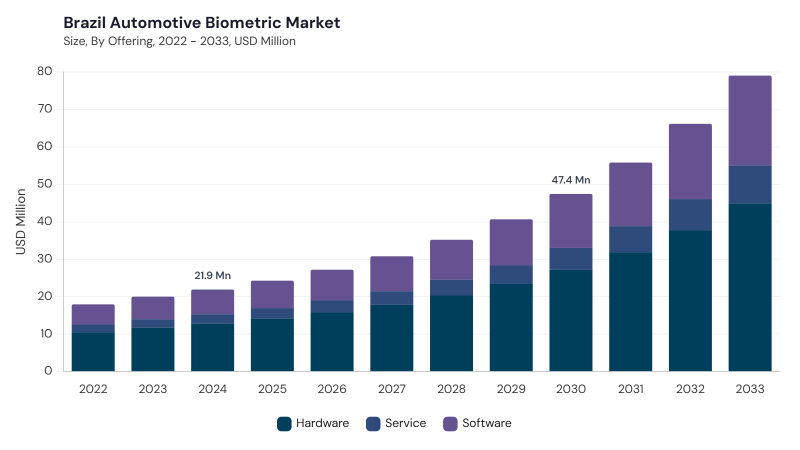
Based on Country, the market is segmented into Brazil, Argentina, UAE, Saudi Arabia, South Africa, Nigeria, and Rest of LAMEA. The Brazil and UAE led the LAMEA Automotive Biometric Market by Country with a market share of 23.2% and 17.6% in 2025.The South Africa market is expected to witness a CAGR of 19.3% during throughout the forecast period.
Brazil leads the Latin American market due to its large automotive industry, growing connected vehicle adoption, and increasing focus on vehicle security. Argentina is witnessing gradual adoption driven by rising demand for advanced automotive technologies and anti-theft solutions. The UAE and Saudi Arabia are emerging as major growth centers supported by smart city initiatives, luxury vehicle penetration, connected mobility investments, and strong digital transformation programs. South Africa remains a key market due to its developed automotive manufacturing sector and increasing deployment of vehicle safety technologies. Nigeria is experiencing growing opportunities as vehicle ownership rises and digital infrastructure improves. technologies.

By Vehicle Type
By Offering
By Technology
By Application
By Country
Set to reach $185.28 Million by 2029, growing at 18.2% CAGR during 2026-2033.
Brazil and UAE lead with market shares of 23.2% and 17.6% in 2025, respectively.
Rising demand in Passenger Cars, expected to reach $136.19 million by 2029 at 17.9% CAGR during the forecast period.
Expected to reach $59.48 million by 2029, growing at 17.2% CAGR during the forecast period.
South Africa is expected to witness a CAGR of 19.3% throughout the forecast period.
Driver Identification & Personalization is expected to witness the highest CAGR of 18.6% during 2026-2033.
Our team of dedicated experts can provide you with attractive expansion opportunities for your business.




 Unique Offerings