The Latin America, Middle East and Africa App Analytics Market is expected to reach $451.79 million by 2028 and would witness market growth of 19.0% CAGR during the forecast period (2025-2032).
The Brazil market dominated the LAMEA App Analytics Market by Country in 2024, and would continue to be a dominant market till 2032; thereby, achieving a market value of $187.3 million by 2032. The Argentina market is showcasing a CAGR of 20.5% during (2025 - 2032). Additionally, The UAE market would register a CAGR of 17.8% during (2025 - 2032). The Brazil and Saudi Arabia led the LAMEA App Analytics Market by Country with a market share of 22.8% and 17.3% in 2024. The South Africa market is expected to witness a CAGR of 20% during throughout the forecast period.
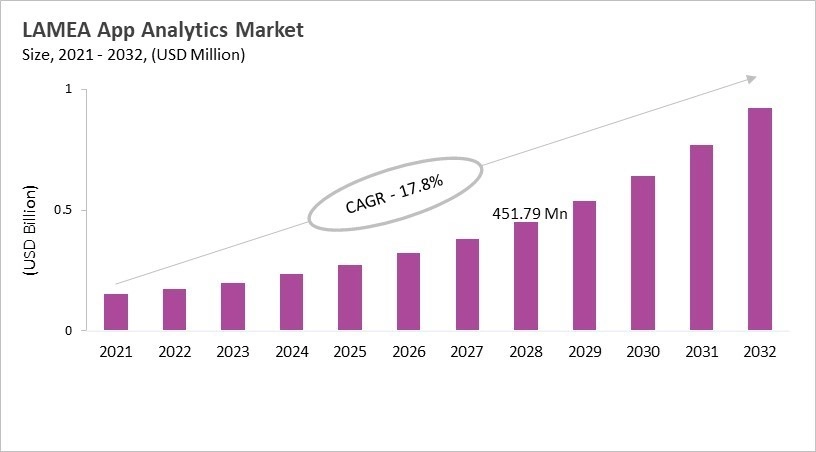
Rapid growth in mobile connectivity and a wider digital transformation across Latin America, the Middle East, and Africa are closely linked to the rise of app analytics in the LAMEA region. The use of apps and the amount of data they generate have gone up a lot because more people are getting smartphones, mobile broadband is becoming more common, and advanced networks like 5G are being rolled out. App analytics started out as a way to track basic performance, but it has since grown into a strategic tool that lets businesses look at user behavior, engagement, and retention. Digital initiatives in the public sector help this change by making data-driven decision-making a part of e-government and digital inclusion plans. At the same time, private companies are using analytics more and more to stay competitive in mobile-first markets.
There are three main things that shape the app analytics landscape in LAMEA today: widespread mobile connectivity, the use of analytics in public digital transformation, and strong business demand for personalized user insights. Governments use analytics to make services easier to access and more useful. Businesses in fields like finance, retail, healthcare, and education use insights to improve the user experience and make more money. The switch to real-time and predictive analytics is happening faster because of the use of AI, machine learning, and cloud technologies. Overall, the competition in the area is about how well stakeholders can turn more and more mobile data into useful information that improves service quality, user satisfaction, and digital inclusion.
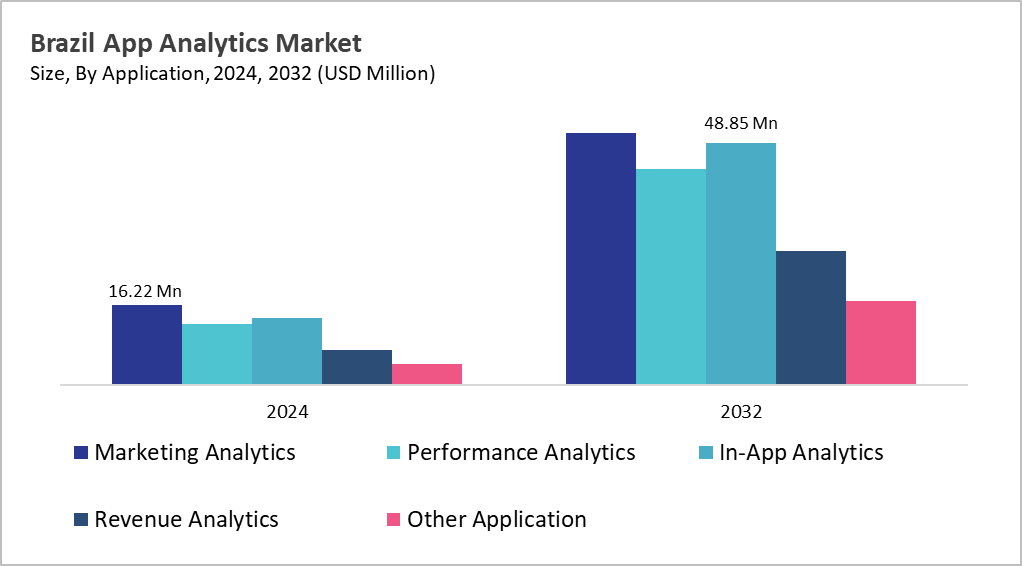
Based on Application, the market is segmented into Marketing Analytics, Performance Analytics, In-App Analytics, Revenue Analytics, and Other Application. Among various Brazil App Analytics Market by Application; The Marketing Analytics market achieved a market size of USD $16.2 Million in 2024 and is expected to grow at a CAGR of 15.5 % during the forecast period. The Revenue Analytics market is predicted to experience a CAGR of 18.5% throughout the forecast period from (2025 - 2032).
Based on Vertical, the market is segmented into Gaming & Entertainment, Retail & E-commerce, Social Media, IT & Telecommunications, BFSI, Health & Fitness, Travel & Hospitality, Education & Learning, and Other Verticals. With a compound annual growth rate (CAGR) of 18.1% over the projection period, the Gaming & Entertainment Market, dominate the Argentina App Analytics Market by Vertical in 2024 and would be a prominent market until 2032. The Health & Fitness market is expected to witness a CAGR of 22.6% during (2025 - 2032).
Brazil's digital ecosystem is mobile-first, which means that mobile apps are the main way people communicate, shop, have fun, and get financial services. This leads to very high app engagement across the country. Apps take up most of the time people spend online, so app analytics is now necessary to understand how people use apps, how they adopt new features, and how they engage with apps in different regions and demographics. The need for data-driven insight is even greater because of strong mobile connectivity, a culture that is already comfortable with technology, and the rapid growth of app-based banking, payments, and on-demand services. Analytics use in Brazil has grown from just tracking basic usage to more advanced behavioral analysis that helps with onboarding, retention, and making products better all the time. The growing use of testing and performance monitoring tools shows a move toward real-time, insight-driven development. The competitive landscape includes both global analytics platforms and specialized third-party and local providers. This makes analytics capability a key factor in the success of an app.

By Type
By Deployment
By Component
By Application
By Vertical
By Country
Our team of dedicated experts can provide you with attractive expansion opportunities for your business.




 Unique Offerings