“Global Intrinsically Safe Equipment Market to reach a market value of 5.87 Billion by 2032 growing at a CAGR of 6.9%”
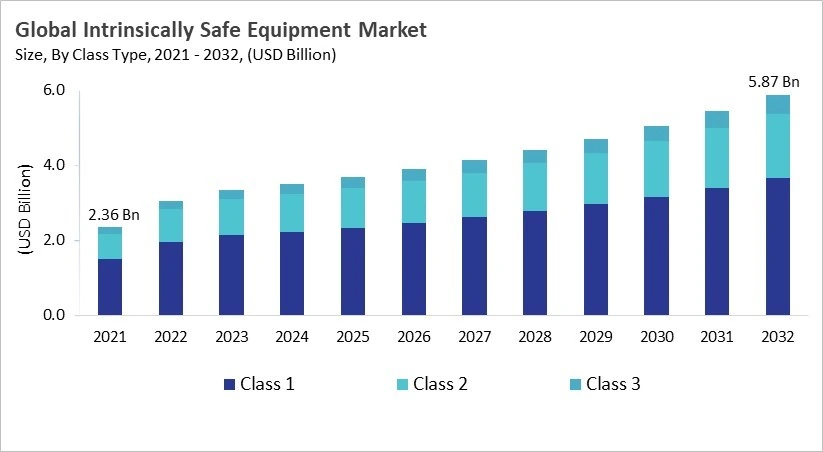
The Global Intrinsically Safe Equipment Market size is estimated at $3.68 billion in 2025 and is expected to reach $5.87 billion by 2032, rising at a market growth of 6.9% CAGR during the forecast period (2025-2032). This growth is due to stricter safety rules in dangerous fields like oil and gas, mining, and chemicals, as well as more automation and industrialization around the world. Technological progress and more people being aware of workplace safety also support demand, which explains the steady growth.
The intrinsically safe equipment market developed from the requirement to assure safety in hazardous industrial environments by preventing ignition in energized devices. Advancements in circuit design, materials, and electronic components allow the development of more efficient, compact, and sophisticated equipment capable of maintaining strict safety compliance along with supporting operational complexity. The intrinsically safe equipment market has expanded into sectors such as food processing, pharmaceuticals, and manufacturing, driven by strict regulations and wider application requirements. Intrinsically safe equipment aligns with Industry 5.0 and Industry 4.0 trends, implementing features like digital monitoring, wireless connectivity, and automation integration to support smart industrial operations.
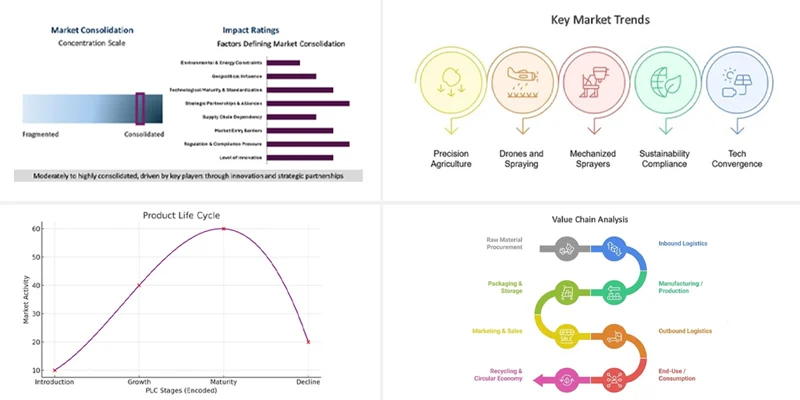
The intrinsically safe equipment market is driven by key trends, including the adoption of connected, smart devices powered by advanced and IIoT sensors, allowing predictive maintenance and real-time monitoring to improve efficiency and safety. Rising regulatory harmonization is encouraging manufacturers to exceed compliance standards, supporting innovation and market expansion. Key market players maintain competitiveness through strategic partnerships, continuous innovation, regional customization, and investments in asset management systems and digital manufacturing. The competitive landscape is intense with global players leveraging certification breadth, and regional companies focus on customer-specific solutions.

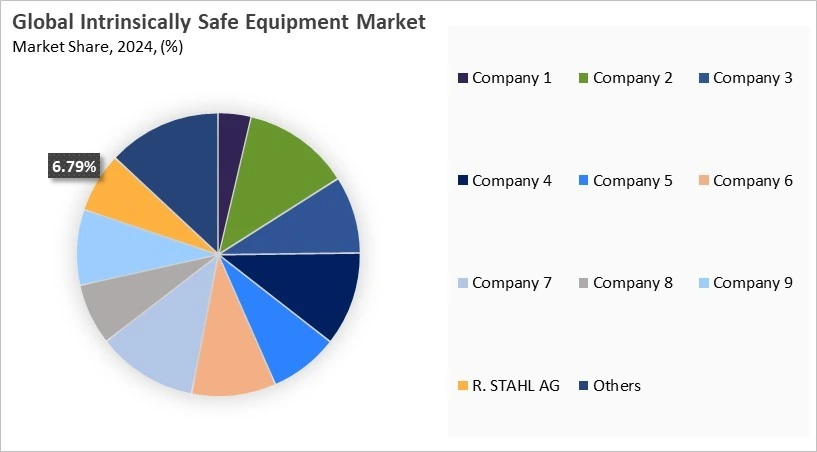
The leading players in the market are competing with diverse innovative offerings to remain competitive in the market. The above illustration shows the percentage of revenue shared by some of the leading companies in the market. The leading players of the market are adopting various strategies in order to cater demand coming from the different industries. The key developmental strategies in the market are Acquisitions, and Partnerships & Collaborations.
Before the COVID-19 pandemic, the market for intrinsically safe equipment grew steadily due to strict safety rules in the workplace and more use in dangerous places. However, the pandemic changed this path by causing problems in the supply chain, slowing down manufacturing, and limiting the workforce, which delayed production and the completion of projects. Demand fell for a short time because important end-use industries like oil and gas, mining, and chemicals put off investments because of uncertainty in the economy. Even though these problems arose, the crisis sped up the use of digital and remote technologies, such as IoT-enabled monitoring and predictive maintenance solutions, to make sure safety compliance with as little physical intervention as possible. As businesses changed, the market began to recover, with stronger supply chains and better strategic sourcing methods. Even though the pandemic had a mostly bad effect on the economy, it also changed the market by encouraging new ideas and speeding up the use of smart, connected safety solutions. Thus, the COVID-19 pandemic had a Negative impact on the Intrinsically Safe Equipment Market.
Based on Class Type, the market is segmented into Class 1, Class 2, and Class 3. The Class 2 segment garnered 28.53% revenue share in the Intrinsically Safe Equipment market in 2024. This segment is witnessing considerable demand due to its use in environments with combustible dust, such as food processing and chemical industries. Increasing industrial safety awareness and regulatory enforcement are key growth drivers. Technological enhancements in dust ignition prevention systems are also supporting expansion.
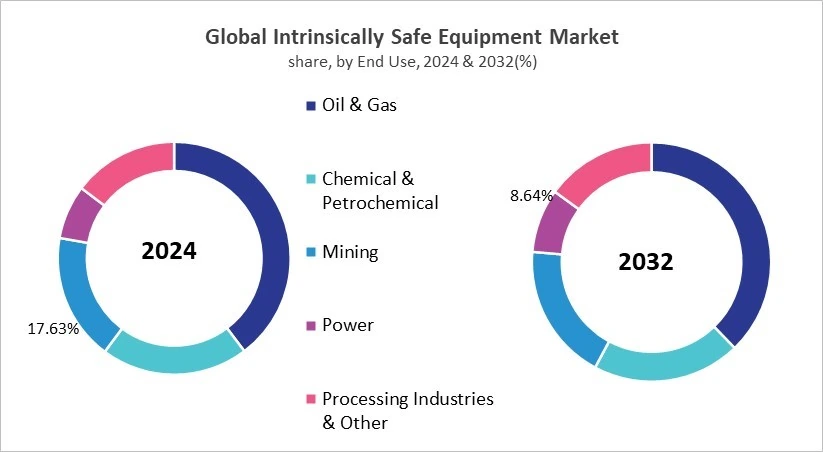
Based on End Use, the market is segmented into Oil & Gas, Chemical & Petrochemical, Mining, Power, Power, and Processing Industries & Other. The Chemical & Petrochemical segment garnered 20.47% revenue share in the Intrinsically Safe Equipment market in 2024. This segment is witnessing strong demand due to the presence of volatile substances and hazardous processing conditions. Adoption is driven by strict safety norms and the need to prevent ignition risks. Technological advancements in monitoring and control systems further enhance growth.
Free Valuable Insights: Intrinsically Safe Equipment Market Size to reach $5.87 by 2032
Region-wise, the Intrinsically Safe Equipment Market is analyzed across North America, Europe, Asia Pacific, and LAMEA. The North America segment recorded 34.66% revenue share in the market in 2024. The intrinsically safe equipment market is anticipated to grow at a significant rate in the North America and Europe regions. The market is driven by strict safety frameworks like NEC and OSHA standards, alongside well-established mining, chemical, and oil & gas industries that need certified equipment for hazardous environments. The region further benefits from high adoption of advanced technologies such as 5G connectivity and IIoT-enabled devices, which improve operational safety and real-time monitoring. Additionally, Europe intrinsically safe equipment market is growing at a steady pace. This is because of stringent compliance with ATEX directives, which mandates rigorous certification for equipment used in explosive atmospheres. A robust petrochemical sector, strong industrial automation, and increased focus on worker safety further raise demand across the region.
In the Asia Pacific and LAMEA regions, the intrinsically safe equipment market is projected to capture prominent growth rate. The market is supported by rising safety awareness and industrial expansion. The regional market is propelled by rapid industrialization in nations such as India, China, and Southeast Asia, alongside rising investments in mining, oil & gas, and chemical industries. Rising adoption of automation technologies and government initiatives to enhance workplace safety standards further surge market expansion. Moreover, the LAMEA intrinsically safe equipment market is expected to expand at a significant rate. This is because of ongoing infrastructure development and the strong oil & gas industry in the Middle East. Latin America benefits from expanding energy and mining activities, leading to market expansion.
| Report Attribute | Details |
|---|---|
| Market size value in 2025 | USD 3.68 Billion |
| Market size forecast in 2032 | USD 5.87 Billion |
| Base Year | 2024 |
| Historical period | 2021 to 2023 |
| Forecast Period | 2025 to 2032 |
| Revenue Growth Rate | CAGR of 6.9% from 2025 to 2032 |
| Number of Pages | 657 |
| Tables | 535 |
| Report Coverage | Market Trends, Revenue Estimation and Forecast, Segmentation Analysis, Regional and Country Breakdown, Market Share Analysis, Porter’s 5 Forces Analysis, Company Profiling, Companies Strategic Developments, SWOT Analysis, Winning Imperatives |
| Segments Covered | Class Type, End Use, Zone, Product, Region |
| Country Scope |
|
| Companies Included | Banner Engineering Corporation, Honeywell International Inc., Eaton Corporation plc, Emerson Electric Co., Rockwell Automation, Inc., Schneider Electric SE, Siemens AG, Fluke Corporation (Fortive Corporation), Pepperl+Fuchs SE, and R. STAHL AG |
By Class Type
By End Use
By Zone
By Product
By Geography
Valued at USD 3.68 billion in 2025, growing at 6.9% CAGR during 2025-2032 to reach USD 5.87 billion by 2032.
Class 1 dominates with a projected market value of $3.7 billion by 2032.
Banner Engineering Corporation, Honeywell International Inc., Eaton Corporation plc, Emerson Electric Co., and Rockwell Automation hold dominant positions.
North America leads at $1,921.1 million by 2032; Asia Pacific grows at 7.6% CAGR during 2025-2032.
Oil & Gas represents the largest share, growing at 6.2% CAGR during the forecast period.
Zone 1 leads with a projected market value of $1.9 billion by 2032.
Our team of dedicated experts can provide you with attractive expansion opportunities for your business.







 Unique Offerings