The sample copy of this report is available for access.
“Global Interposer and Silicon Bridge Market to reach a market value of by 2033 growing at a CAGR of %”
The Global Interposer and Silicon Bridge Market is expected to reach $11.8 billion by 2033, growing at a CAGR of 21.2% during (2026 – 2033).
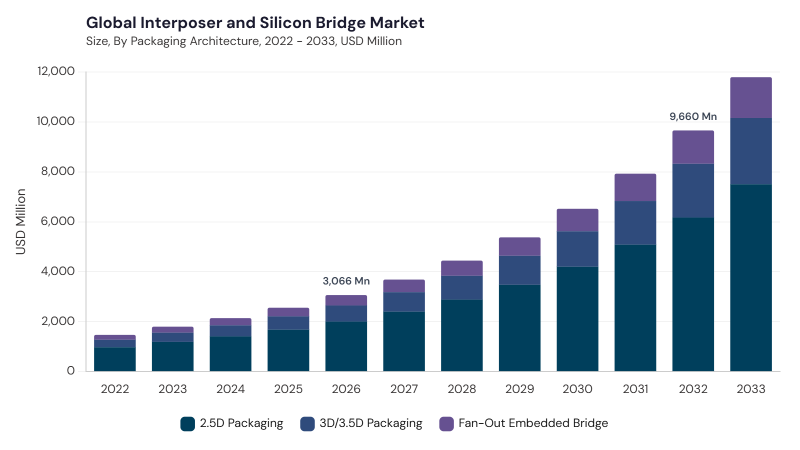
Market growth is being supported by rising adoption of heterogeneous semiconductor integration, increasing AI and high-performance computing workloads, and growing demand for advanced chip packaging technologies that improve bandwidth, latency, and power efficiency across next-generation computing platforms.
The Interposer and Silicon Bridge market has evolved significantly as semiconductor manufacturers increasingly adopt advanced packaging architectures to overcome the scaling limitations of traditional monolithic chip designs. Interposers and silicon bridges have emerged as critical enabling technologies supporting heterogeneous integration, chiplet architectures, and high-density interconnect solutions required for modern AI, data center, and high-performance computing systems.
The market is witnessing rapid transformation driven by increasing demand for advanced semiconductor integration technologies capable of supporting ultra-high bandwidth communication, lower latency, enhanced thermal management, and improved power efficiency. Silicon interposers continue to play a foundational role in 2.5D packaging architectures, while silicon bridges are gaining traction as flexible and scalable solutions for chiplet-based semiconductor ecosystems.
Key market participants are strengthening their positions through strategic acquisitions, advanced packaging platform development, ecosystem partnerships, and regional manufacturing expansion initiatives. The market is also being influenced by geopolitical semiconductor sovereignty initiatives, sustainability-focused manufacturing regulations, and increasing investments in co-packaged optics and silicon photonics technologies.
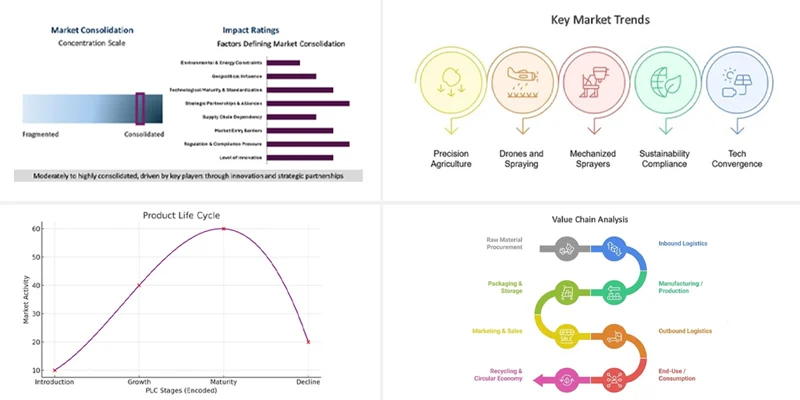

The global Interposer and Silicon Bridge market is highly consolidated, with the top ten companies accounting for approximately 95.36% of total market share, while the remaining share is distributed among smaller specialized packaging and substrate providers. Taiwan Semiconductor Manufacturing Company Limited (TSMC) leads the market due to its dominant position in CoWoS advanced packaging, silicon interposer manufacturing, and AI/HPC packaging ecosystems.
ASE Technology Holding and Amkor Technology represent major outsourced semiconductor assembly and test (OSAT) participants providing advanced packaging, fan-out bridge architectures, and heterogeneous integration services. Companies such as AMD and NVIDIA play influential ecosystem roles by driving demand for AI accelerators, GPUs, HBM integration, and advanced package architectures.
Based on technology, the market is segmented into silicon interposer, silicon bridge, and hybrid interposer-bridge. The Silicon Interposer market dominated the Global Interposer and Silicon Bridge Market by Technology in 2025, and would continue to be a dominant market till 2033; thereby, achieving a market value of $6631.4 million by 2033, growing at a CAGR of 20.7 % during the forecast period. Silicon bridge technologies are gaining momentum as semiconductor manufacturers increasingly seek flexible and cost-efficient chiplet integration architectures that reduce complexity associated with full silicon interposer designs.
Based on packaging architecture, the market is categorized into 2.5D packaging, 3D/3.5D packaging, and fan-out embedded bridge. The 2.5D Packaging market dominated the Global Interposer and Silicon Bridge Market by Packaging Architecture in 2025, and would continue to be a dominant market till 2033; thereby, achieving a market value of $7504.1 million by 2033, growing at a CAGR of 20.8 % during the forecast period. The 3D/3.5D packaging segment is expanding steadily as semiconductor companies increasingly adopt vertical stacking technologies to support compact, high-density, and power-efficient semiconductor architectures.
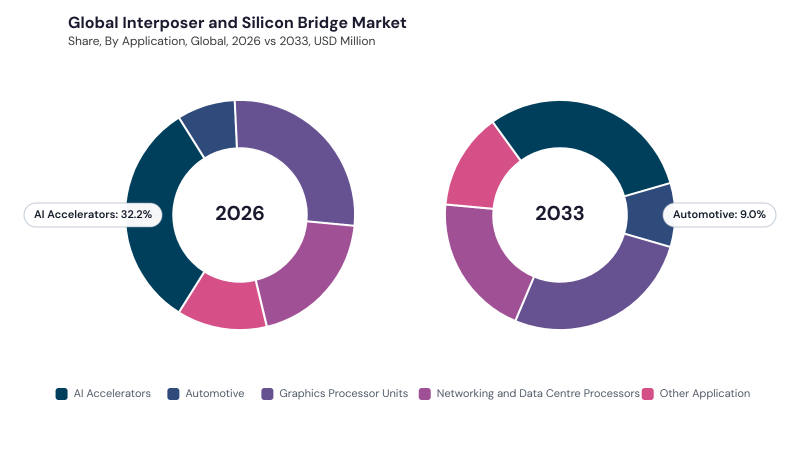
Based on application, the market includes AI accelerators, graphics processing units, networking & data centre processors, automotive, and other applications. AI accelerators remain the leading application segment as organizations increasingly deploy generative AI, machine learning, and advanced computing workloads requiring ultra-high bandwidth semiconductor integration. Graphics processing units continue to represent a significant market segment supported by increasing demand across gaming, visualization, AI processing, and cloud computing applications.
Region-wise, the Interposer and Silicon Bridge Market is analyzed across North America, Europe, Asia Pacific, and LAMEA. The Asia Pacific market dominated the Global AI Accelerators Market by Region in 2025, and would continue to be a dominant market till 2033; thereby, achieving a market value of $1.8 billion by 2033, growing at a CAGR of 20.6 % during the forecast period.
Asia Pacific dominated the market in 2025 supported by the strong presence of semiconductor foundries, advanced packaging infrastructure, and electronics manufacturing ecosystems across Taiwan, China, South Korea, and Japan. North America remains a major market due to increasing investments in AI infrastructure, advanced semiconductor manufacturing, and heterogeneous integration technologies. Europe is witnessing steady growth driven by semiconductor innovation across automotive electronics, industrial automation, and advanced networking applications.
The market is highly innovation-driven, with competition centered on advanced packaging performance, interconnect density, thermal efficiency, heterogeneous integration capability, and support for chiplet ecosystems. Vendors are differentiating through proprietary packaging platforms, advanced silicon bridge architectures, and scalable semiconductor integration technologies.
Strategic collaborations among foundries, OSAT providers, photonics companies, and semiconductor manufacturers are becoming increasingly important as organizations seek to accelerate commercialization of advanced packaging technologies supporting AI and HPC infrastructure.
Geopolitical supply chain diversification strategies, semiconductor sovereignty initiatives, and sustainability-focused semiconductor manufacturing regulations are also influencing market competition and investment priorities across the global advanced packaging ecosystem.
By Technology
By Packaging Architecture
By Application
By Geography
Expected to reach USD 11.8 billion by 2033, with a 21.2% CAGR during the forecast period.
Silicon Interposer leads the market, projected to hit USD 6.63 billion by 2033.
Top companies include Cisco, IBM, Microsoft, and Google.
2.5D Packaging dominates, achieving USD 7.50 billion by 2033.
Asia Pacific leads with 48.33% revenue share in 2025, maintaining dominance through 2033.
Advancements in heterogeneous integration and chiplet architectures are key growth drivers.
Our team of dedicated experts can provide you with attractive expansion opportunities for your business.








 Unique Offerings