In-Chip Microfluidic Cooling Market

Global In-Chip Microfluidic Cooling Market Size, Share & Industry Analysis Report By Cooling Technology (Single-Phase Liquid Cooling and Two-Phase Liquid Cooling), By Integration Type (Direct In-Die Microchannels, Backside-Integrated Microchannels, and 3D-Stacked & Interlayer Microfluidic Cooling), By Chip Type, By Coolant Type, By End Use, By Regional Outlook and Forecast, 2026 - 2033

Report Id: KBV-32141 Publication Date: November-2026 Number of Pages: Report Format: PDF + Excel + Interactive Dashboard
2026
USD 79.82 Million
2033
USD 399.10 Million
CAGR
25.85%
Historical Data
2022 to 2024

“Global In-Chip Microfluidic Cooling Market to reach a market value of USD 399.10 Million by 2033 growing at a CAGR of 25.85%”

In-Chip Microfluidic Cooling Market Interactive Sample

Interactive chartsMarket tablesSegmentation
View Full Sample
KBV Research · Report enquiry

Send Enquiry

In-Chip Microfluidic Cooling Market

Loading your enquiry form…

Analysis Market Size and Future Outlook

The Global In-Chip Microfluidic Cooling Market is expected to reach USD 399.1 million by 2033, growing at a CAGR of 25.8% during (2026 - 2033).
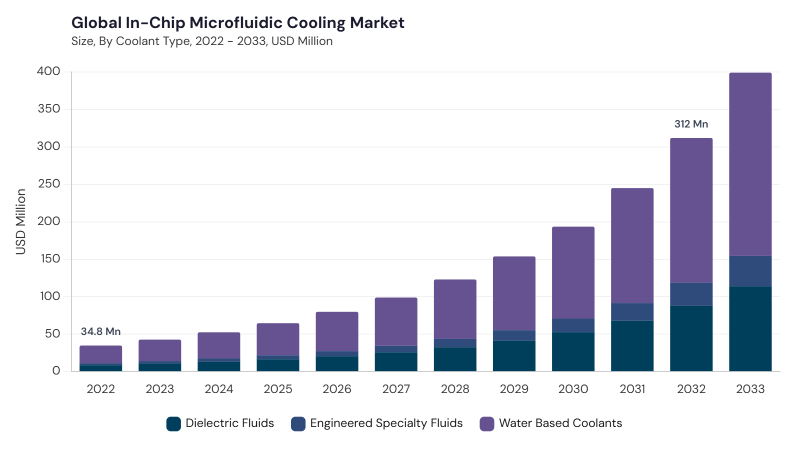
In-Chip Microfluidic Cooling Market size and growth forecast (2022-2033)

For More Details on This Report - Download FREE Sample Copy – Delivered Instantly!

In-chip microfluidic cooling refers to thermal management systems that circulate coolant through microscopic channels formed within a semiconductor die, its backside, or closely integrated layers of a chip stack. The approach brings coolant nearer to heat-generating regions, shortening the thermal path between active devices and the cooling fluid. Conventional external cold plates and immersion systems belong to the broader liquid-cooling ecosystem; they contribute to this market only when their products or components support an in-chip architecture.

Key Market Trends & Insights

  • By Cooling Technology, Single-Phase Liquid Cooling led in 2025 with USD 51.5 million and is projected to reach USD 294.5 million by 2033, growing at a CAGR of 24.6%.
  • Two-Phase Liquid Cooling is the fastest-growing Cooling Technology segment, with a projected CAGR of 30.0% during (2026 - 2033).
  • By Integration Type, Direct In-Die Microchannels led in 2025 with USD 28.6 million and is projected to reach USD 162.0 million by 2033, growing at a CAGR of 24.4%.
  • 3D-Stacked & Interlayer Microfluidic Cooling is the fastest-growing Integration Type segment, with a projected CAGR of 28.9% during (2026 - 2033).
  • By Chip Type, GPUs led in 2025 with USD 18.3 million and is projected to reach USD 120.1 million by 2033, growing at a CAGR of 26.9%.
  • AI Accelerators & ASICs is the fastest-growing Chip Type segment, with a projected CAGR of 29.2% during (2026 - 2033).
  • By Coolant Type, Water-Based Coolants led in 2025 with USD 42.8 million and is projected to reach USD 244.6 million by 2033, growing at a CAGR of 24.6%.
  • Engineered & Specialty Fluids is the fastest-growing Coolant Type segment, with a projected CAGR of 29.2% during (2026 - 2033).
  • By End Use, Data Centers & AI Infrastructure led in 2025 with USD 20.0 million and is projected to reach USD 148.1 million by 2033, growing at a CAGR of 28.8%.
  • Data Centers & AI Infrastructure is the fastest-growing End Use segment, with a projected CAGR of 28.8% during (2026 - 2033).
  • Regionally, North America led in 2025 with USD 24.3 million and is projected to reach USD 141.3 million by 2033; LAMEA has the fastest projected CAGR of 28.1%.

Dense compute architectures can generate uneven power distributions that make localized temperatures more restrictive than average chip temperature. Moving coolant nearer these regions provides a route to lowering the thermal resistance between the heat source and fluid. Corintis researchers have examined channel optimization around chip power maps, illustrating the relevance of targeted cooling. Commercial demand arises when conventional thermal arrangements constrain sustained performance or require undesirable operating conditions. Developers must still demonstrate that the benefit persists across changing workloads. For buyers, the strongest justification is improved useful computation within acceptable temperature and energy limits, rather than a laboratory peak that cannot be maintained in service.

Vertical integration places heat-generating components above one another and can make heat removal from internal layers more difficult. Embedded fluid paths offer additional thermal access where cooling from an outer surface may be insufficient. IBM research distinguishes intra-chip channels from fluid paths between stacked chips and evaluates their different thermal and pressure characteristics. This creates demand for cooling approaches that can be considered alongside the stack architecture. Commercial value depends on enabling a useful combination of integration density, operating power, and reliability. Designers need to weigh the thermal benefit against the area, connections, and assembly changes required to route coolant through the structure.
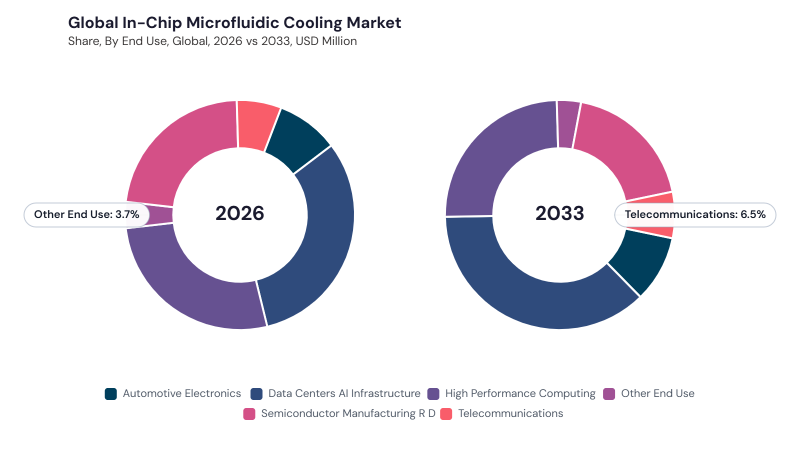
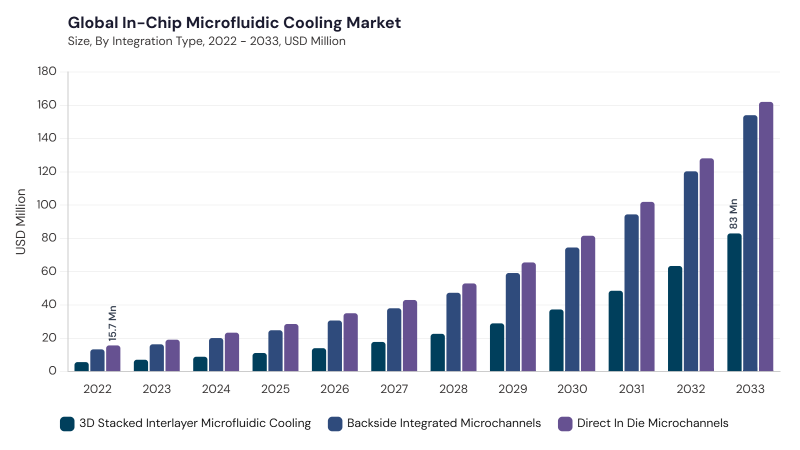
In-Chip Microfluidic Cooling Market segment Share

For More Details on This Report - Download FREE Sample Copy – Delivered Instantly!

Driving and Restraining Factors

In-Chip Microfluidic Cooling Market
  • Increasing Heat Concentration in AI and High Performance Computing Chips
  • Need to Reduce Thermal Barriers in Advanced Chip Stacks
  • Pressure to Improve the Economics of Cooling Infrastructure
  • Progress in Semiconductor Compatible Microfluidic Fabrication
  • Additional Manufacturing Cost and Integration Requirements
  • Qualification Burden and Limited Operational Evidence
  • Competition From Less Intrusive Cooling Architectures
  • Cooling Structures Designed Around Custom Accelerators
  • Fluidic Integration for Memory and Three Dimensional Packages
  • Expansion Into Compact Power Electronic Applications
  • Balancing Heat Removal With Pressure and Flow Constraints
  • Maintaining Clean Stable and Leak Tight Fluid Paths
  • Controlling Boiling and Avoiding Dryout in Two Phase Designs

Cooling Technology Outlook

In-Chip Microfluidic Cooling Market segment size and growth forecast

For More Details on This Report - Download FREE Sample Copy – Delivered Instantly!

Based on Cooling Technology, the market is segmented into Single-Phase Liquid Cooling, Two-Phase Liquid Cooling. Single-Phase Liquid Cooling dominated in 2025 and is projected to reach USD 294.5 million by 2033, growing at a CAGR of 24.6%. Two-Phase Liquid Cooling is expected to record the highest CAGR of 30.0% during the forecast period.

Integration Type Outlook

Based on Integration Type, the market is segmented into Direct In-Die Microchannels, Backside-Integrated Microchannels, 3D-Stacked & Interlayer Microfluidic Cooling. Direct In-Die Microchannels dominated in 2025 and is projected to reach USD 162.0 million by 2033, growing at a CAGR of 24.4%. 3D-Stacked & Interlayer Microfluidic Cooling is expected to record the highest CAGR of 28.9% during the forecast period.

Chip Type Outlook

Based on Chip Type, the market is segmented into GPUs, CPUs, AI Accelerators & ASICs, Memory & 3D-Stacked Chips, Power Semiconductors, Other Chip Type. GPUs dominated in 2025 and is projected to reach USD 120.1 million by 2033, growing at a CAGR of 26.9%. AI Accelerators & ASICs is expected to record the highest CAGR of 29.2% during the forecast period.

Coolant Type Outlook

Based on Coolant Type, the market is segmented into Water-Based Coolants, Dielectric Fluids, Engineered & Specialty Fluids. Water-Based Coolants dominated in 2025 and is projected to reach USD 244.6 million by 2033, growing at a CAGR of 24.6%. Engineered & Specialty Fluids is expected to record the highest CAGR of 29.2% during the forecast period.

End Use Outlook

Based on End Use, the market is segmented into Data Centers & AI Infrastructure, High-Performance Computing, Semiconductor Manufacturing & R&D, Automotive Electronics, Telecommunications, Other End Use. Data Centers & AI Infrastructure dominated in 2025 and is projected to reach USD 148.1 million by 2033, growing at a CAGR of 28.8%. Data Centers & AI Infrastructure is expected to record the highest CAGR of 28.8% during the forecast period.

Regional Outlook

In-Chip Microfluidic Cooling Market CAGR and growth forecast

For More Details on This Report - Download FREE Sample Copy – Delivered Instantly!

Region-wise, the In-Chip Microfluidic Cooling Market is analyzed across North America, Europe, Asia Pacific, LAMEA. North America led in 2025 and is projected to reach USD 141.3 million by 2033, growing at a CAGR of 24.9%. Europe is projected to grow at a CAGR of 24.6%. Asia Pacific is projected to grow at a CAGR of 27.5%. LAMEA is projected to grow at a CAGR of 28.1%.

Global In-Chip Microfluidic Cooling Market Report Segmentation

By Cooling Technology

  • Single-Phase Liquid Cooling
  • Two-Phase Liquid Cooling

By Integration Type

  • Direct In-Die Microchannels
  • Backside-Integrated Microchannels
  • 3D-Stacked & Interlayer Microfluidic Cooling

By Chip Type

  • GPUs
  • CPUs
  • AI Accelerators & ASICs
  • Memory & 3D-Stacked Chips
  • Power Semiconductors
  • Other Chip Type

By Coolant Type

  • Water-Based Coolants
  • Dielectric Fluids
  • Engineered & Specialty Fluids

By End Use

  • Data Centers & AI Infrastructure
  • High-Performance Computing
  • Semiconductor Manufacturing & R&D
  • Automotive Electronics
  • Telecommunications
  • Other End Use

By Geography

  • North America
    • United States
    • Canada
    • Mexico
    • Rest of North America
  • Europe
    • Germany
    • United Kingdom
    • France
    • Russia
    • Spain
    • Italy
    • Rest of Europe
  • Asia Pacific
    • China
    • Japan
    • India
    • South Korea
    • Singapore
    • Malaysia
    • Rest of Asia Pacific
  • LAMEA
    • Brazil
    • Argentina
    • United Arab Emirates
    • Saudi Arabia
    • South Africa
    • Nigeria
    • Rest of LAMEA
In-Chip Microfluidic Cooling Market Report Coverage
Report AttributeDetails
Market size value in 2026 USD 79.8 million
Market size forecast in 2033 USD 399.1 million
Base Year 2025
Historical Period 2022 to 2024
Forecast Period 2026 to 2033
Revenue Growth Rate CAGR of 25.8% from 2026 to 2033
Number of Pages 780
Tables 130
Report Coverage Market Trends, Revenue Estimation and Forecast, Segmentation Analysis, Regional and Country Breakdown, Competitive Landscape
Segments Covered Cooling Technology, Integration Type, Chip Type, Coolant Type, End Use and Geography
Country Scope
  • North America: United States, Canada, Mexico, Rest of North America;
  • Europe: Germany, United Kingdom, France, Russia, Spain, Italy, Rest of Europe;
  • Asia Pacific: China, Japan, India, South Korea, Singapore, Malaysia, Rest of Asia Pacific;
  • LAMEA: Brazil, Argentina, United Arab Emirates, Saudi Arabia, South Africa, Nigeria, Rest of LAMEA
Need a report that reflects how COVID-19 has impacted this market and its growth? Download Free Sample Now

By Geography

  • North America
    • United States
    • Canada
    • Mexico
    • Rest of North America
  • Europe
    • Germany
    • United Kingdom
    • France
    • Russia
    • Spain
    • Italy
    • Rest of Europe
  • Asia Pacific
    • China
    • Japan
    • India
    • South Korea
    • Singapore
    • Malaysia
    • Rest of Asia Pacific
  • LAMEA
    • Brazil
    • Argentina
    • United Arab Emirates
    • Saudi Arabia
    • South Africa
    • Nigeria
    • Rest of LAMEA


Frequently Asked Questions About This Report

Expected to reach USD 399.1 million by 2033, growing at 25.8% CAGR during the forecast period (2026-2033).

High performance computing chips lead due to increasing heat concentration and need for thermal barrier reduction.

Top companies include Cisco, IBM, Microsoft, and Google.

North America is expected to dominate due to pressure to improve cooling infrastructure economics.

Increasing heat concentration in AI chips and need to reduce thermal barriers drive market growth.

The market is projected to grow at 25.8% CAGR during the forecast period (2026-2033).

Trusted by over
5000+ clients

Our team of dedicated experts can provide you with attractive expansion opportunities for your business.

Client Logo