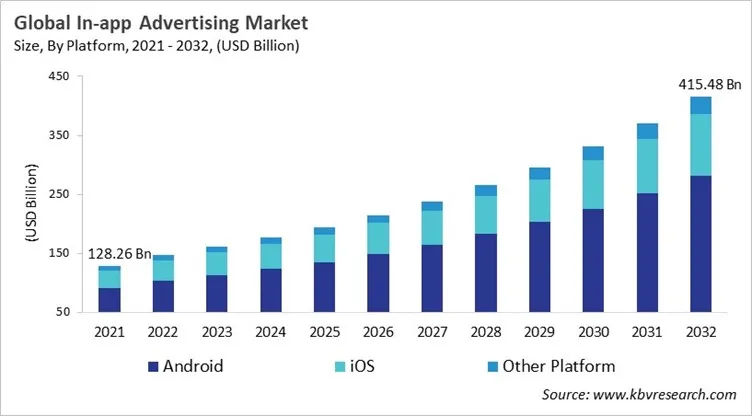
“Global In-app Advertising Market to reach a market value of USD 415.48 Billion by 2032 growing at a CAGR of 11.4%”
The Global In-app Advertising Market size is expected to reach $415.48 billion by 2032, rising at a market growth of 11.4% CAGR during the forecast period.
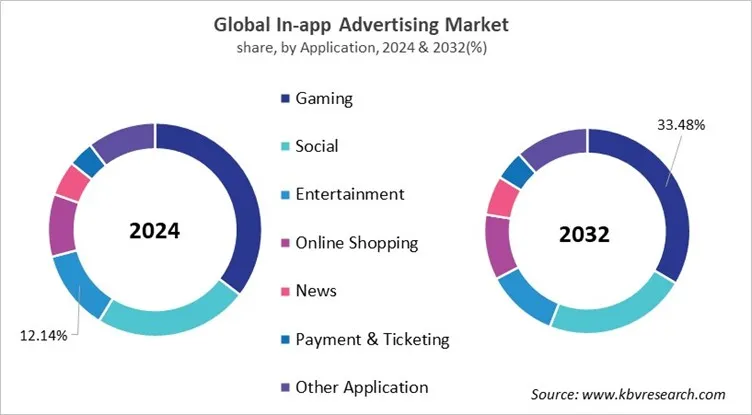
The massive growth of mobile gaming in all demographics has positioned the gaming segment at the top of the in-app advertising market. Mobile gaming apps are very suitable for product placement and advertisement due to their highly engaging environment users spend a lot of time on mobile gaming. The World Economic Forum predicts continued growth in gaming revenues driven by rising in-app advertising spend. Video games accounted for 6% of global entertainment spending in 2017, expected to rise to 11% by 2026.
Furthermore, China and the U.S. led the industry in 2021, future growth may emerge from developing nations with growing populations. Advertisers use these formats to promote the installation of apps, products, and services that typically yield high conversion rates. Gaming apps also support performance-driven marketing initiatives that align with user behaviour and in-app progression. This market keeps growing as casual and ultra-casual games attract sizable audiences worldwide.
The COVID-19 pandemic had a slight negative impact on the in-app advertising market in the initial stages of the pandemic due to low consumer spending, uncertain economic stability, and less or no funds for advertising from the companies for their marketing expenses. The temporary shut down of the industries like retail, tourism, and hospitality impact on the market negatively. Brands shifted focus from the advertising to COVID-19 related messages.

The rapid and high smartphone penetration across the world is one of the main factors driving the growth of the in-app advertising market. According to the International Telecommunication Union (ITU), there were more than 8.58 billion mobile subscriptions in use worldwide in 2022, compared to a global population of 7.95 billion halfway through the year. Then mobile phone is the easiest way to connect with people and companies use these vast networks of smartphones to market their products and services, which raises the demand for the in-app advertising solutions in particularly in developing nations. Also, as per the 5G Americas, the increasing rates of 5G connection worldwide playing an important role in the growth of the market, for example, 5G global connections reach nearly 2 billion in Q1 2024 with 185 million new additions, projected to hit 7.7 billion by 2028. Rising internet generation, especially I the emerging and developing regions is crucial for the growth of the market. Hence, rapid smartphone penetration and mobile internet adoption is propelling the growth of the market.
The ability of in-app advertisements to customize and personalize users' experiences is among their best features. Applications give in-app advertisements access to a wealth of first-party data, including demographics, device types, usage patterns, location data, and behavioral cues. This is not the same as advertisements that appear in print or on websites. Advertisers can use this rich dataset to precisely segment their audiences and customize their messaging based on people's preferences, actions, and desires. In-app advertising is therefore one of the most efficient and customized forms of digital marketing due to the distinct depth of user data and the astute use of real-time technologies in mobile applications.
Data privacy is one of the biggest challenges of digital transformation in the current times. To make advanced targeting and personalization capabilities possible, in-app advertising companies should have advanced technology to process and analyze vast data sets collected from the different sources. Over the few years the cases of the cyber-attacks and frauds are increasing, for instance, as per the World Bank, globally, from 2019–2023, approximately $5.2 trillion in global value will be at risk from cyberattacks. 10.5 million records are lost or stolen every month; 438,000 every hour, and a single large-scale attack can trigger $53 billion in economic losses. The rising rates of data fraud and cyber attacks have led to push back from customers, advocacy groups, and investors. Regulatory authorities from all over the world are aggressively taking measures to reduce cyberattacks and improve data safety. They are making strict acts and regulations like California's Consumer Privacy Act (CCPA), European Union's General Data Protection Regulation (GDPR), Brazil’s LGPD and similar national data protection laws significantly influence how user data is collected, stored, and shared. In conclusion, increasing focus on the data privacy and user tracking is driving the growth of the market.
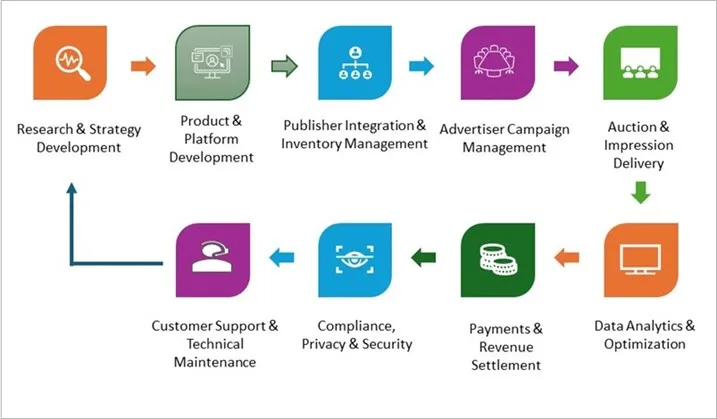
The In-App Advertising Market begins with Research & Strategy Development, where companies assess user behavior and market trends. This informs Product & Platform Development, creating scalable ad tech solutions. Then comes Publisher Integration & Inventory Management, linking publishers and managing ad space. Advertiser Campaign Management ensures targeted, optimized ad strategies. Ads are executed via Auction & Impression Delivery, using real-time bidding. Post-delivery, Data Analytics & Optimization evaluates performance. Payments & Revenue Settlement ensures fair transactions. Compliance, Privacy & Security safeguards data usage. Customer Support & Technical Maintenance resolve issues, completing the cycle with ongoing improvements for optimal user and advertiser satisfaction.
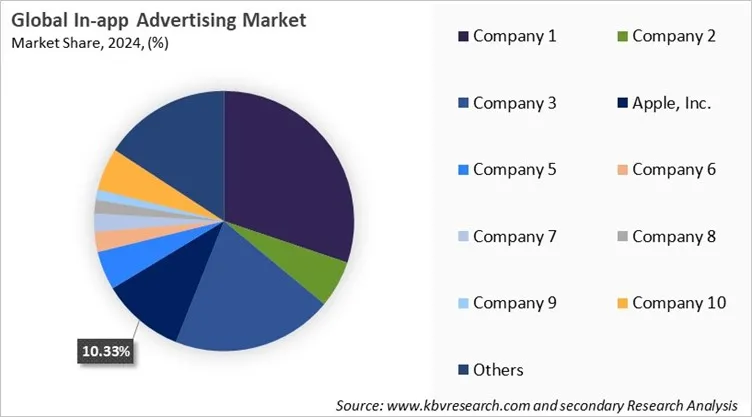
The leading players in the market are competing with diverse innovative offerings to remain competitive in the market. The above illustration shows the percentage of revenue shared by some of the leading companies in the market. The leading players of the market are adopting various strategies to cater to demand coming from the different industries. The key developmental strategies in the market are Acquisitions, and Partnerships & Collaborations.
Based on type, the market is characterized into banner ads, interstitial ads, video ads, rich media ads, and native ads. The banner ads segment garnered 36% revenue share in the in-app advertising market in 2024. Banner ads are the most popular type of in-app advertising because they are easy to set up, reach a lot of people, and are simple to use. These static or animated ad formats show up at the top or bottom of mobile app screens and are always visible without bothering the user too much. Advertisers with tight budgets like them because they are cost-effective, especially for campaigns to raise brand awareness. Even though the click-through rates may be lower than with other formats, they get a lot of impressions, which means a lot of people see them. They are still a key part of many ways to make money with mobile apps.
| Category | Details |
|---|---|
| Use Case Title | Confidential |
| Date | 2025 |
| Entities Involved | Confidential |
| Objective | Educate chronic disease patients on available therapies and encourage pharmacy visits using hyper-local, context-aware banner ads. |
| Context and Background | Patients managing chronic conditions often use mobile apps for tracking vitals and medication. Banner ads integrated into such apps offer a subtle but regular channel to educate or notify them about new treatments or pharmacy offers. |
| Description | GSK partnered with HealthTap to deploy geo-personalized banner ads based on user condition profiles (e.g., hypertension, diabetes). These banner placements dynamically showed clinic maps, drug reminders, or coupons redeemable at nearby pharmacies. Adform’s DSP ensured automated bidding and delivery based on time-of-day and geofencing. |
| Key Capabilities Deployed |
|
| Regions Covered |
|
| Benefits |
|
| Source | Confidential |
On the basis of platform, the in-app advertising market is classified into Android, IOS, and others. The others segment held 6% revenue share in the in-app advertising market in 2024. The others segment includes less common platforms such as HarmonyOS, KaiOS, and legacy or niche operating systems. While their overall share is limited, these platforms present opportunities for targeted advertising in specific markets or device categories. For instance, feature phone operating systems like KaiOS are relevant in emerging regions where smartphone adoption is still growing.
By application, the in-app advertising market is divided into gaming, social, entertainment, online shopping, news, payment & ticketing, and others. The entertainment segment acquired 12% revenue share in the in-app advertising market in 2024. The entertainment segment plays a key role in the in-app advertising landscape, particularly in video streaming, music, and live event apps. These platforms serve as high-engagement environments for video and banner ads, often delivered during pauses or content transitions. With the surge in mobile video consumption, entertainment apps offer immersive experiences that make advertising more impactful. Ads in these apps tend to be visually rich and are often used for product launches, movie trailers, or app promotions. They also provide strong brand recall due to the emotional and passive nature of content consumption.
Free Valuable Insights: Global In-app Advertising Market size to reach USD 415.48 Billion by 2032
Region-wise, the in-app advertising market is analyzed across North America, Europe, Asia Pacific, and LAMEA. The Asia Pacific segment recorded 36% revenue share in the in-app advertising market in 2024. Asia Pacific leads the in-app advertising market, fueled by a rapidly expanding mobile user base, widespread smartphone adoption, and increasing internet penetration. Countries such as China, India, Indonesia, and Southeast Asian nations contribute significantly to ad traffic due to their large populations and mobile-first user behavior.
| Report Attribute | Details |
|---|---|
| Market size value in 2024 | USD 176.78 Billion |
| Market size forecast in 2032 | USD 415.48 Billion |
| Base Year | 2024 |
| Historical Period | 2021 to 2023 |
| Forecast Period | 2025 to 2032 |
| Revenue Growth Rate | CAGR of 11.4% from 2025 to 2032 |
| Number of Pages | 373 |
| Number of Tables | 426 |
| Report coverage | Market Trends, Revenue Estimation and Forecast, Segmentation Analysis, Regional and Country Breakdown, Competitive Landscape, Market Share Analysis, Porter’s 5 Forces Analysis, Company Profiling, Companies Strategic Developments, SWOT Analysis, Winning Imperatives |
| Segments covered | Type, Platform, Application, Region |
| Country scope |
|
| Companies Included | Google LLC, Unity Software, Inc., Meta Platforms, Inc., Apple, Inc., InMobi Pte. Ltd., PubMatic, Inc., Verizon Communications, Inc., Microsoft Corporation, X Corp. (Twitter, Inc.) and AppLovin Corporation |
By Type
By Platform
By Application
By Geography
This Market size is expected to reach $415.48 billion by 2032.
Rapid Smartphone Penetration and Mobile Internet Adoption are driving the Market in coming years, however, Growing Concerns Around Data Privacy and User Tracking restraints the growth of the Market.
Google LLC, Unity Software, Inc., Meta Platforms, Inc., Apple, Inc., InMobi Pte. Ltd., PubMatic, Inc., Verizon Communications, Inc., Microsoft Corporation, X Corp. (Twitter, Inc.) and AppLovin Corporation
The expected CAGR of this Market is 11.4% from 2023 to 2032.
The Android segment is leading the Market by Platform in 2024; thereby, achieving a market value of $281.75 billion by 2032.
The Asia Pacific region dominated the Market by Region in 2024, and would continue to be a dominant market till 2032; thereby, achieving a market value of $152.9 billion by 2032.
Our team of dedicated experts can provide you with attractive expansion opportunities for your business.






 Unique Offerings