“Global High-speed Camera Market to reach a market value of USD 1.70 Billion by 2032 growing at a CAGR of 12.2%”
The Global High-speed Camera Market size is expected to reach USD 1.70 billion by 2032, rising at a market growth of 12.2% CAGR during the forecast period.
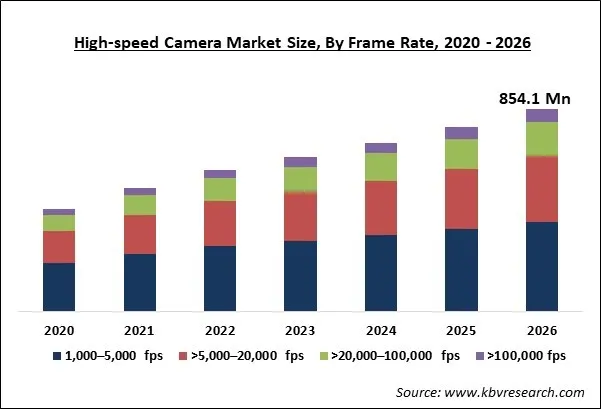
High speed imaging has developed from early experimental motion photography to a highly sophisticated digital imaging discipline. Advancements in imaging technology, including enhanced sensors, faster shutters, and electronic processing, allow the capture of motion at extremely high speeds with far greater accuracy. The advent of CCD and particularly CMOS sensors transformed high-speed cameras into compact, powerful systems having the capabilities of recording thousands to millions of frames per second. With maturing memory, sensor performance, and processing capabilities, high speed cameras moved beyond academic experimentation to become necessary tools across industrial diagnostics, scientific research, aerospace evaluation, media production, and manufacturing quality control.
The high-speed camera market is driven by expanding application areas, rapid technological innovation, and rising demand supported by R&D investment and automation. Key market trends include diversification into industries like defense, sports, entertainment, aerospace, and manufacturing, advancement of high-speed CMOS sensors, and broader adoption with reducing costs. Manufacturers are positioning themselves in the market through continued innovation, application-specific customization, product diversification, and strong after-sales support. The competitive landscape of the market is driven by well-established OEMs with R&D capabilities. With the developing technology, market opportunities are also developing for regional players in cost-sensitive applications.
Major strategies followed by the market participants are Product Launches as the key developmental strategy to keep pace with the changing demands of end users. For instance, In February 2025, iX Cameras Ltd. unveiled a new generation of ultra‑high‑speed video cameras featuring Full HD capture of up to 6,38 fps, peak 1 million fps, advanced AST CMOS sensors, up to 144 GB RAM, integrated SSD storage, synchronized lighting control, electromechanical shutter, and modular software—ideal for scientific, engineering, and R&D analyses.. Additionally, In January, 2025, Excelitas Technologies Corp. unveiled the first pco. Pico camera, a high-speed sCMOS device with photon-counting sensitivity. Designed for ultra-low-light imaging and precise scientific applications, it enhances performance in fluorescence microscopy and quantum research, advancing capabilities in the high-speed camera market through its improved sensitivity and frame rate.
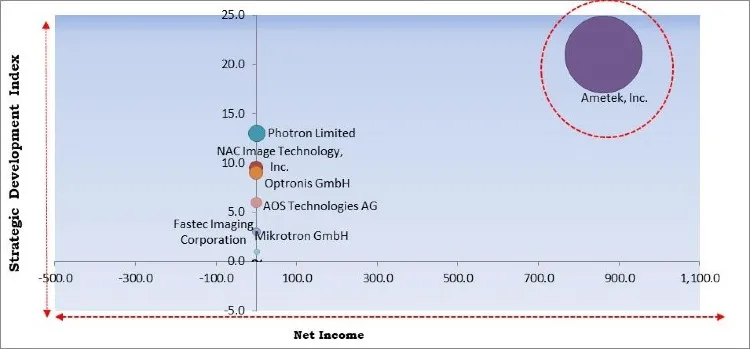
Based on the Analysis presented in the KBV Cardinal matrix; AMETEK, Inc. is the forerunner in the High-speed Camera Market. Companies such as SVS-VISTEK GmbH, Optronis GmbH, and Excelitas Technologies Corp. are some of the key innovators in High-speed Camera Market. In February, 2025, AMETEK, Inc. unveiled the Phantom KT series, a new line of ultra-high-speed cameras tailored for ballistic and explosive testing. With cutting-edge throughput, precise timing, and rugged design, the KT series expands the capabilities of high-speed imaging in defense, aerospace, and advanced research applications.
The COVID-19 pandemic hurt the high-speed camera market because factories had to close and supply chains were disrupted. There weren't enough sensors and optical parts, which slowed down production and raised costs. Demand fell because testing in the automotive, aerospace, and industrial sectors was put on hold. During lockdowns, a lot of companies put off making big investments in research and development. Budget cuts and lab closures made it harder for schools and research institutions to buy new equipment. Film, sports, and broadcasting activities were also stopped, which led to less use. Overall, a temporary slowdown in the market was caused by limited operations and fewer tests. Thus, the COVID-19 pandemic had a Negative impact on the market.

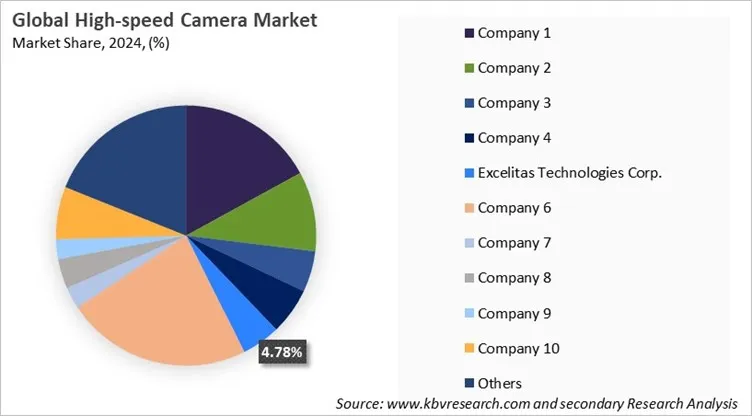
The leading players in the market are competing with diverse innovative offerings to remain competitive in the market. The above illustration shows the percentage of revenue shared by some of the leading companies in the market. The leading players of the market are adopting various strategies in order to cater demand coming from the different industries. The key developmental strategies in the market are Acquisitions, and Partnerships & Collaborations.
Free Valuable Insights: High-speed Camera Market size to reach USD 1.70 Billion by 2032
Based on component, the high-speed camera market is segmented into image sensors, memory, processors, lens, and others. The memory segment attained 22% revenue share in the market in 2024. Memory holds a crucial position within the high-speed camera ecosystem, acting as the central storage framework responsible for temporarily holding high-volume visual data generated during rapid capture. Since high-speed imaging produces enormous data streams within fractions of a second, memory functions as the buffer that enables uninterrupted recording without frame drops or data loss.
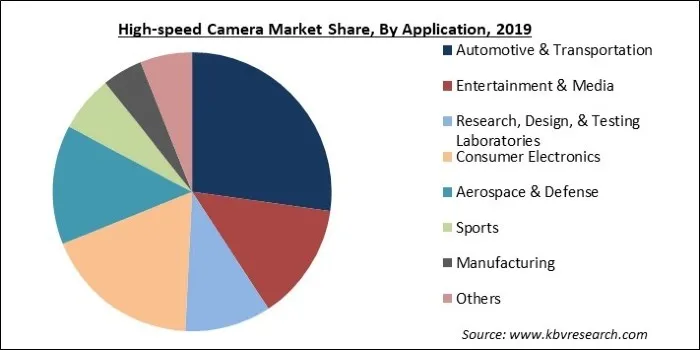
Based on Application, the High-speed Camera Market is segmented into Aerospace & Defense, Automotive & Transportation, Consumer Electronics, Media & Entertainment, Healthcare & Biomedical, and Other Application. The automotive & transportation segment attained 22% revenue share in the market in 2024. Automotive & Transportation forms another major application category, gaining prominence as vehicle manufacturers adopt high-speed imaging to enhance safety, improve design accuracy, and accelerate research cycles. Crash testing, impact simulation, airbag inflation analysis, and engine component visualization represent some of the core implementation zones for high-speed cameras in this space.
Region-wise, the market is analyzed across North America, Europe, Asia Pacific, and LAMEA. The North America segment recorded 37% revenue share in the market in 2024. The high-speed camera market is projected to capture prominent growth in the North America and Europe regions. The market demand is driven by elements including industrial R&D, automotive crash/airbag testing, and aerospace & defense applications. North America’s expansion is supported by high adoption of CMOS/CCD upgrades, strong spending on test & measurement, and a healthy rental/servicing ecosystem that reduces the entry barrier for labs and manufacturers. Moreover, Europe high speed camera market is growing steadily benefitting from its large automotive and aerospace clusters and from industrial automation investments. The market is competitive among instrument makers and specialist rental houses, which is supporting product innovation and application specific solutions.
In the Asia Pacific and LAMEA region, the high-speed camera market is estimated to experience significant growth during the upcoming years. The market’s expansion is supported by growing electronic, high-speed manufacturing lines, semiconductor fabs, and expanding academic/industrial research budgets. In addition to this, the adoption is also supported by stronger electronics exports and regional economic upgrades. Rising local OEMs and service providers are expanding their market reach, thereby offering substantial opportunities. Moreover, the LAMEA high-speed camera market is expanding substantially. The demand is rising due to mining, oil & gas, and defense procurement in parts of Latin America and the Middle East.
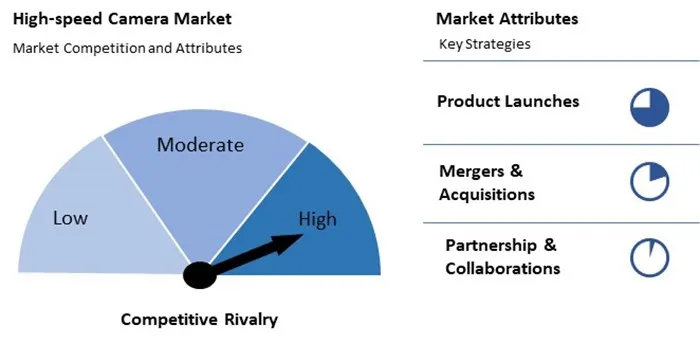
Competition in the high-speed camera market is intense, driven by continual demand for higher frame rates, enhanced resolution, and advanced imaging features. Vendors compete on technological innovation, image quality, sensor performance, and software capabilities, including analysis tools and ease of use. Price, reliability, and application-specific solutions also influence buyer decisions across industries such as automotive testing, manufacturing, sports, and scientific research. Rapid advancements in sensor technology and processing power further fuel competitive differentiation, while customization and customer support remain key factors.
| Report Attribute | Details |
|---|---|
| Market size value in 2025 | USD 765.22 Million |
| Market size forecast in 2032 | USD 1.70 Billion |
| Base Year | 2024 |
| Historical Period | 2021 to 2023 |
| Forecast Period | 2025 to 2032 |
| Revenue Growth Rate | CAGR of 12.2% from 2025 to 2032 |
| Number of Pages | 601 |
| Number of Tables | 514 |
| Report coverage | Market Trends, Revenue Estimation and Forecast, Segmentation Analysis, Regional and Country Breakdown, Competitive Landscape, Market Share Analysis, Porter’s 5 Forces Analysis, Company Profiling, Companies Strategic Developments, SWOT Analysis, Winning Imperatives |
| Segments covered | Component, Application, Frame Rate, Spectrum, Region |
| Country scope |
|
| Companies Included | Photron Limited (IMAGICA Group, Inc.), iX Cameras Ltd., NAC Image Technology, Inc., SVS-VISTEK GmbH (TKH Group NV), Excelitas Technologies Corp., AMETEK, Inc., P+S Technik Cine Optics GmbH, Optronis GmbH (Hensoldt AG), Motion Capture Technologies and DEL Imaging Systems, LLC |
By Component
By Application
By Frame Rate
By Spectrum
By Geography
This Market size is expected to reach USD 1.70 billion by 2032.
The high-speed camera market is projected to grow at a CAGR of 12.2% between 2025 and 2032.
Rising adoption across automotive testing and safety analysis, alongside growing demand in consumer electronics manufacturing and quality control.
Photron Limited (IMAGICA Group, Inc.), iX Cameras Ltd., NAC Image Technology, Inc., SVS-VISTEK GmbH (TKH Group NV), Excelitas Technologies Corp., AMETEK, Inc., P+S Technik Cine Optics GmbH, Optronis GmbH (Hensoldt AG), Motion Capture Technologies and DEL Imaging Systems, LLC
The Visible RGB segment dominated the Global High-speed Camera Market by Spectrum in 2024, thereby, achieving a market value of $1.01 billion by 2032.
The North America region dominated the Global High-speed Camera Market by Region in 2024, and would continue to be a dominant market till 2032; thereby, achieving a market value of $605.6 million by 2032.
Our team of dedicated experts can provide you with attractive expansion opportunities for your business.







 Unique Offerings