The sample copy of this report is available for access.
“Global Hearables Market to reach a market value of USD 102953.57 Million by 2033 growing at a CAGR of %”
The Global Hearables Market is expected to reach USD 102.9 billion by 2033, growing at a CAGR of 12.1% during (2026 - 2033).
Hearables are gaining strong market traction as users increasingly prefer wireless audio devices that combine personalized listening, hands-free communication, health tracking, voice assistance, and seamless device connectivity. Their use is expanding across consumer electronics, fitness, healthcare, gaming, enterprise communication, and assistive applications, where users rely on them for music, calls, hearing enhancement, biometric monitoring, noise cancellation, and smart-device control. Market momentum is being supported by true wireless earbuds, Bluetooth improvements, spatial audio, AI-based sound personalization, active noise cancellation, and the merging of consumer audio with hearing-health features.
Increasing adoption of smart wireless audio devices is expanding the hearables market beyond entertainment into healthcare, communication, productivity, gaming, fitness, and industrial use cases. Consumers are seeking devices that combine sound quality, comfort, active noise cancellation, long battery life, biometric functions, and seamless pairing across smartphones, computers, watches, and smart-home systems. AI is improving adaptive audio, real-time voice interaction, personalized sound profiles, and environmental awareness, while health-focused sensors are broadening the role of hearables as wellness companions. Hybrid work and virtual collaboration are raising demand for clear microphones, voice isolation, and multipoint connectivity.
Competition in the hearables market is innovation-led, with consumer electronics companies, audio specialists, hearing-aid manufacturers, and value-oriented TWS brands competing across premium, mass-market, healthcare, and professional segments. Companies differentiate through active noise cancellation, spatial audio, battery efficiency, voice assistants, biometric sensing, proprietary acoustic processing, and ecosystem integration. Premium players emphasize brand loyalty, device interoperability, and software-driven updates, while mass-market brands compete through affordability and feature accessibility. Hearing-care specialists are modernizing connected hearing aids with AI, Bluetooth streaming, rechargeable designs, and app-based personalization.
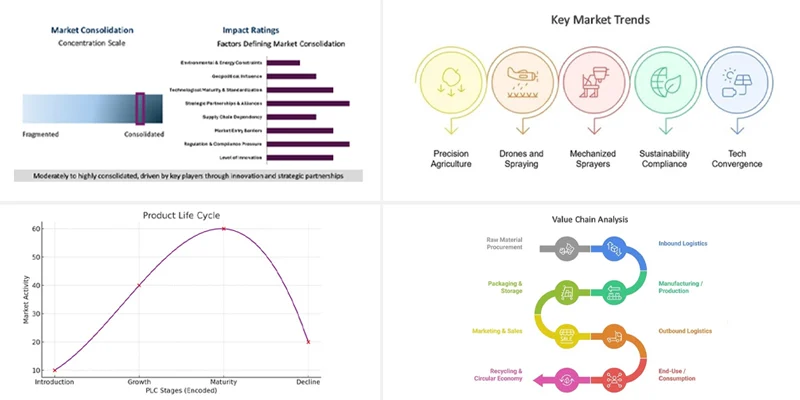

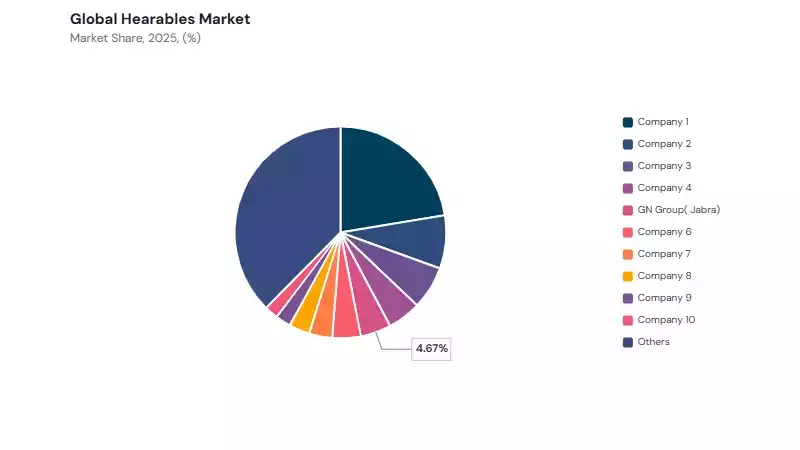
The global Hearables market is moderately concentrated, with leadership shaped by consumer electronics ecosystems, premium audio engineering, hearing-health expertise, and connected-device integration. Apple leads through AirPods and Beats, supported by strong device interoperability, spatial audio, active noise cancellation, and hearing-related functions. Samsung benefits from Galaxy ecosystem integration and HARMAN/JBL audio capabilities, while Sonova, WS Audiology, Demant, and Starkey compete through connected hearing-aid innovation. Sony, Bose, GN/Jabra, and Xiaomi address premium audio, professional communication, open-ear listening, and value-oriented TWS demand. Competition is increasingly shaped by AI-enabled audio, hearing assistance, health monitoring, spatial sound, battery performance, and the convergence of consumer earbuds with advanced hearing technologies.
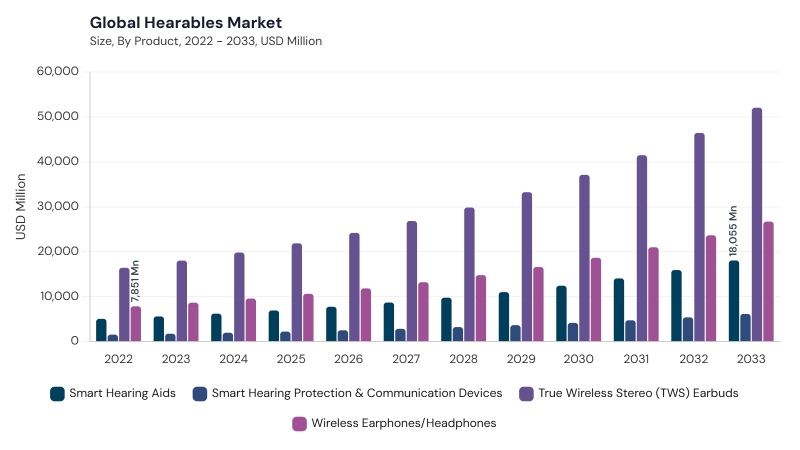
Based on product, the market is segmented into True Wireless Stereo (TWS) Earbuds, Wireless Earphones/Headphones, Smart Hearing Aids, and Smart Hearing Protection & Communication Devices. The True Wireless Stereo (TWS) Earbuds market dominated the Global Hearables Market by Product in 2025, and would continue to be a dominant market till 2033; thereby, achieving a market value of USD 52.0 billion by 2033, growing at a CAGR of 11.6 % during the forecast period. The Wireless Earphones/Headphones market is expected to witness a CAGR of 12.3% during (2026 - 2033). The Smart Hearing Protection & Communication Devices market is expected to witness a CAGR of 13.6% during (2026 - 2033).
True Wireless Stereo earbuds address mainstream consumer demand for compact, cable-free listening, smart assistant access, active noise cancellation, and seamless smartphone integration. Wireless earphones and headphones remain important for users prioritizing longer listening durations, larger drivers, comfort, and immersive audio across entertainment, work, and gaming use cases. Smart hearing aids serve users requiring personalized amplification, digital signal processing, app-based control, and wireless connectivity for daily hearing support. Smart hearing protection and communication devices focus on industrial, construction, military, and professional settings where noise exposure management, situational awareness, and hands-free communication are critical. Together, these product groups reflect the market’s movement from simple audio accessories toward intelligent, connected, and use-case-specific ear-worn devices.
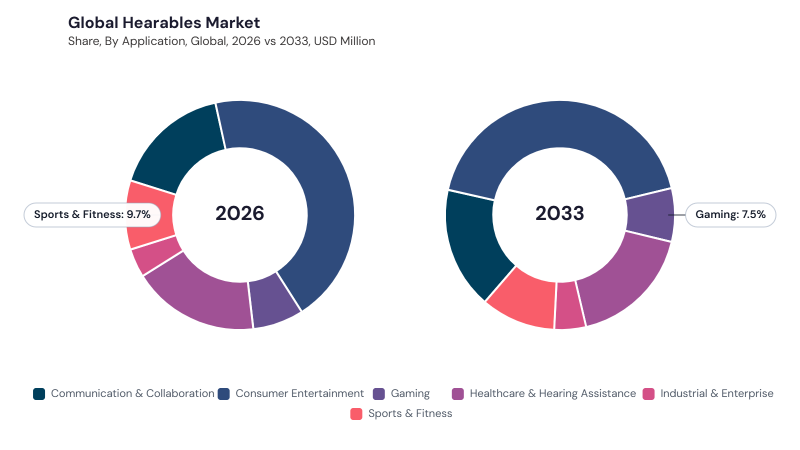
Based on application, the market is segmented into Consumer Entertainment, Healthcare & Hearing Assistance, Communication & Collaboration, Sports & Fitness, Gaming, and Industrial & Enterprise. The Consumer Entertainment market dominated the Global Hearables Market by Application in 2025, and would continue to be a dominant market till 2033; thereby, achieving a market value of USD 43.9 billion by 2033, growing at a CAGR of 11.5 % during the forecast period. The Healthcare & Hearing Assistance market is expected to witness a CAGR of 11.8% during (2026 - 2033). Additionally, The Communication & Collaboration market is expected to witness highest CAGR of 12.5% during (2026 - 2033).
Consumer entertainment centers on music, podcasts, video streaming, immersive sound, and mobile audio experiences, making sound quality, comfort, and design key purchase factors. Healthcare and hearing assistance focuses on hearing support, biosensing, connected care, and personalized sound processing for users with hearing or wellness needs. Communication and collaboration demand clear microphones, noise suppression, conferencing compatibility, and stable connectivity for hybrid work and mobile communication. Sports and fitness applications emphasize secure fit, sweat resistance, biometric tracking, and audio coaching. Gaming requires low latency, spatial sound, and voice communication, while industrial and enterprise applications prioritize hearing protection, workforce coordination, hands-free workflows, and dependable use in demanding environments.
Based on distribution channel, the market is segmented into Offline and Online. The Offline market dominated the Global Hearables Market by Distribution Channel in 2025, and would continue to be a dominant market till 2033; thereby, achieving a market value of USD 61.9 billion by 2033, growing at a CAGR of 11.8 % during the forecast period. Additionally, The Online market is expected to witness highest CAGR of 12.6% during (2026 - 2033).
Offline channels include electronics retailers, specialty audio outlets, hearing-care clinics, brand stores, and other physical points of sale where users can evaluate sound quality, comfort, fit, device features, and professional support before purchase. This channel remains important for premium devices and hearing-related products where personal fitting and guided consultation influence buying decisions. Online channels include brand websites, e-commerce platforms, and digital marketplaces that provide broad product variety, price comparison, customer reviews, and convenient access to launches and promotions. Digital distribution is also strengthening direct-to-consumer strategies, targeted marketing, and wider reach into emerging and urban markets. Both channels remain important as hearables combine consumer electronics convenience with personal-fit and hearing-support requirements.
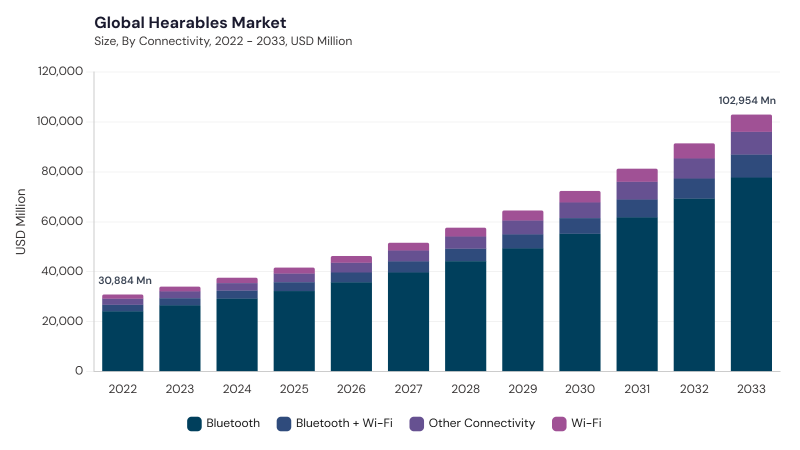
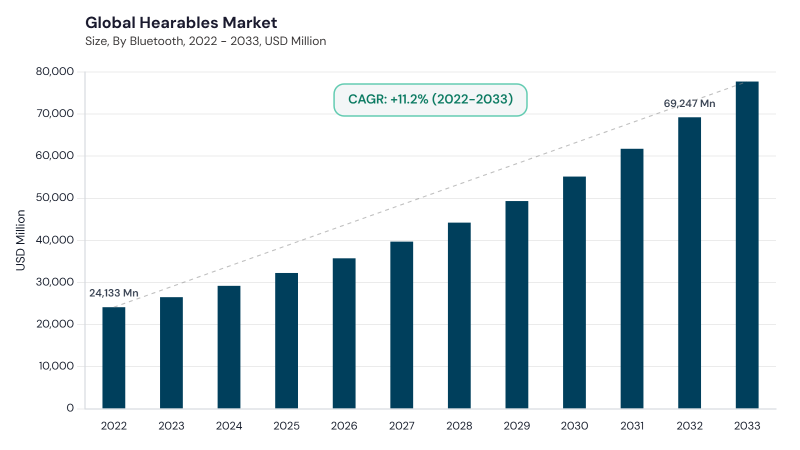
Based on connectivity, the market is segmented into Bluetooth, Bluetooth + Wi-Fi, Wi-Fi, and Other Connectivity. The Bluetooth market dominated the Global Hearables Market by Connectivity in 2025, and would continue to be a dominant market till 2033; thereby, achieving a market value of USD 77.7 billion by 2033, growing at a CAGR of 11.7 % during the forecast period. The Bluetooth + Wi-Fi market is expected to witness a CAGR of 12.8% during (2026 - 2033). Additionally, The Wi-Fi market is expected to witness highest CAGR of 14.1% during (2026 - 2033).
Bluetooth remains the foundational connectivity mode for hearables because it supports wireless audio streaming, calls, voice assistant access, device pairing, and interoperability across smartphones, tablets, computers, televisions, and wearable devices. Bluetooth + Wi-Fi expands functionality through cloud-enabled services, direct internet access, firmware updates, real-time translation, smart-home integration, and more advanced connected experiences. Wi-Fi supports niche applications requiring network-based audio transmission, persistent connectivity, enterprise use, clinical monitoring, or smart-environment integration. Other connectivity includes proprietary protocols, NFC, UWB, RF-based solutions, and emerging options that address specialized professional, assistive, spatial audio, authentication, and immersive-use requirements. Connectivity choices influence battery life, latency, range, compatibility, and the level of intelligence a hearable can deliver.
Free Valuable Insights: Hearables Market Size to reach $102.9 Billion by 2033
Region-wise, the Hearables Market is analyzed across North America, Europe, Asia Pacific, and LAMEA. The Asia Pacific market dominated the Global Hearables Market by Region in 2025, and would continue to be a dominant market till 2033; thereby, achieving a market value of USD 41.2 billion by 2033, growing at a CAGR of 12.5 % during the forecast period. The North America market is expected to witness a CAGR of 11.4% during (2026 - 2033). Additionally, The Europe market is expected to witness a CAGR of 11.9% during (2026 - 2033).
North America benefits from high adoption of smart consumer electronics, hybrid work tools, premium audio devices, hearing support technologies, and AI-enabled wearables. Europe is shaped by acoustic-quality expectations, hearing-care infrastructure, regulatory focus, connected health adoption, and demand for comfortable, privacy-conscious devices. Asia Pacific reflects strong smartphone penetration, large-scale electronics consumption, e-commerce expansion, price-tier diversity, and rapid uptake of TWS earbuds across young and urban consumers. LAMEA is gaining traction through growing digital adoption, smartphone use, online retail, workplace communication needs, and rising awareness of hearing and wellness technologies. Across all regions, affordability, connectivity reliability, data privacy, battery life, and after-sales support influence adoption patterns.
| Report Attribute | Details |
|---|---|
| Market size value in 2026 | USD 46.3 billion |
| Market size forecast in 2033 | USD 102.9 billion |
| Base Year | 2025 |
| Historical Period | 2022 to 2024 |
| Forecast Period | 2026 to 2033 |
| Revenue Growth Rate | CAGR of 12.1% from 2026 to 2033 |
| Number of Pages | XX |
| Tables | XX |
| Report Coverage | Market Trends, Revenue Estimation and Forecast, Segmentation Analysis, Regional and Country Breakdown, Competitive Landscape, Market Share Analysis, Company Profiling, Companies Strategic Developments, SWOT Analysis, Product Life Cycle Analysis, Value Chain Analysis, Market Consolidation Analysis, Key Customer Criteria, Pandemic Impact Analysis, and Winning Imperatives |
| Segments Covered | Product, Application, Distribution Channel, Connectivity, and Geography |
| Country Scope |
|
| Companies Included | Apple Inc.; Samsung; Sonova; Sony Group Corporation; GN Group; WS Audiology; Demant; Bose Corporation; Xiaomi Corporation; Starkey |
By Product
By Application
By Distribution Channel
By Connectivity
By Geography
The market size is USD 46.3 billion in 2026.
True Wireless Stereo Earbuds lead, projected to reach USD 52.0 billion by 2033.
Apple Inc., Samsung, Sonova, Sony Group Corporation, GN Group, WS Audiology, Demant, Bose Corporation, Xiaomi Corporation, Starkey.
Asia Pacific leads, expected to reach USD 41.2 billion by 2033.
Advancements in IoT capabilities and demand for smart hearing solutions propel market growth.
Bluetooth segment leads, projected to reach USD 77.7 billion by 2033.
Our team of dedicated experts can provide you with attractive expansion opportunities for your business.






 Unique Offerings
