“Global Healthcare Payer Network Management Market to reach a market value of USD 8,163.1 Million by 2033 growing at a CAGR of 8.5%”
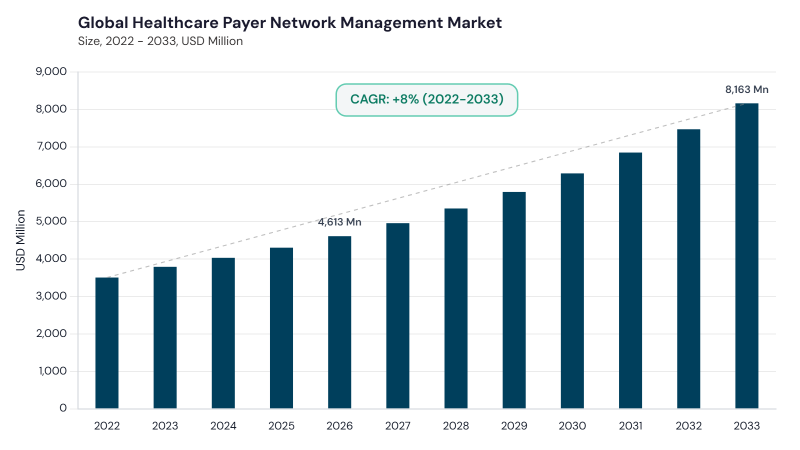
The Global Healthcare Payer Network Management Market size is expected to reach USD 8,163.1 Million by 2033, rising at a market growth of 8.5% CAGR during the forecast period 2026-2033.
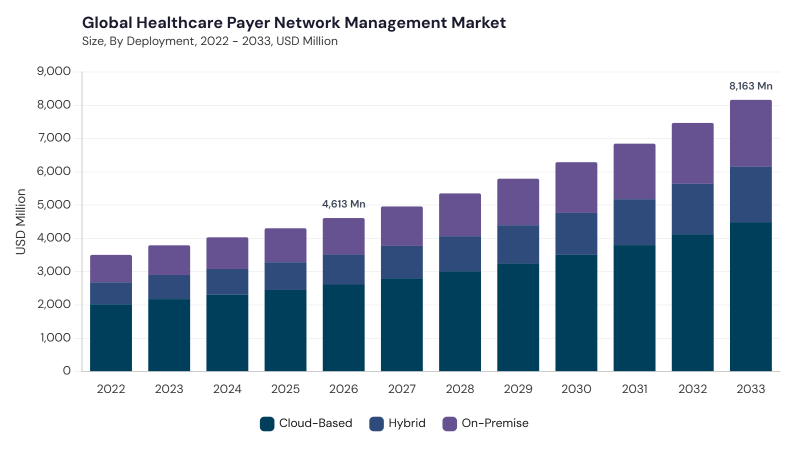
Growth in the market is driven by increasing emphasis on value-based care models, rising adoption of AI-powered analytics for provider network optimization, and expanding healthcare interoperability requirements across payer ecosystems. Growing pressure to improve network efficiency, reduce administrative burdens, strengthen provider collaboration, and enhance patient outcomes is accelerating investments in advanced healthcare payer network management solutions globally.
Over time, increasing healthcare complexity, regulatory mandates, and rising operational costs accelerated the transition toward integrated digital payer network platforms. The shift from fee-for-service reimbursement toward value-based care fundamentally transformed payer priorities, requiring more dynamic provider performance monitoring, risk management, and contract optimization capabilities. This transition drove strong adoption of analytics-driven network management systems capable of improving transparency, efficiency, and member engagement.
Today, artificial intelligence, machine learning, cloud computing, and predictive analytics are reshaping the Healthcare Payer Network Management landscape. Payers increasingly leverage intelligent analytics platforms to improve provider credentialing, optimize network design, streamline claims processing, and support real-time care coordination. The market is also witnessing rising integration of social determinants of health, interoperability frameworks, and patient engagement technologies to improve network performance and healthcare accessibility. Consequently, Healthcare Payer Network Management has evolved into a highly intelligent, compliance-driven, and data-centric ecosystem supporting modern healthcare delivery and payer operational transformation globally.
Healthcare payers are increasingly investing in intelligent network management solutions to improve provider engagement, reduce administrative inefficiencies, support value-based reimbursement models, and optimize operational workflows. Expanding adoption of AI-driven analytics, predictive healthcare intelligence, and cloud-based network management systems is enabling organizations to streamline claims administration, provider credentialing, care coordination, and network performance optimization.
In addition, strategic collaborations between healthcare payers, provider organizations, technology vendors, interoperability solution providers, and healthcare analytics firms are accelerating market innovation. Vendors are increasingly focusing on AI-enabled automation, cloud-native infrastructure, real-time healthcare analytics, and integrated provider management platforms to strengthen operational efficiency and improve member experiences across healthcare ecosystems globally.

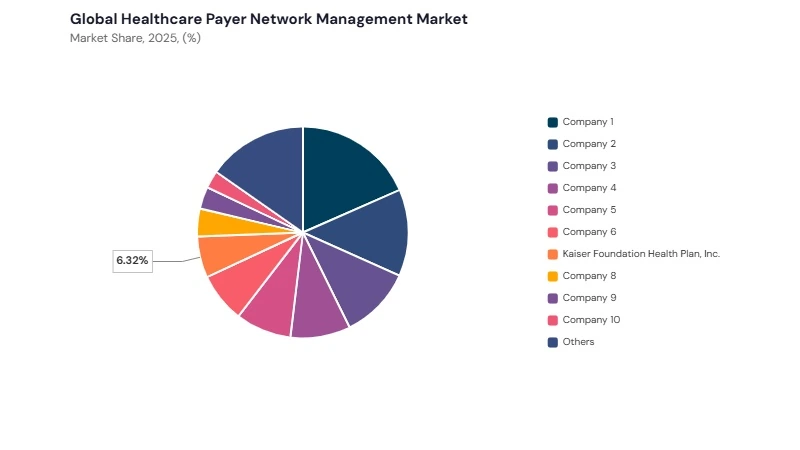
The global Healthcare Payer Network Management Market exhibits a moderately consolidated competitive landscape characterized by the strong presence of major healthcare payers, managed care organizations, healthcare analytics providers, and provider network management solution vendors. UnitedHealth Group emerged as the leading player in the market with approximately 18.41% market share supported by its extensive payer ecosystem, advanced healthcare analytics capabilities, integrated provider management infrastructure, and large-scale care coordination systems. Aetna/CVS Health, Cigna, Humana, Blue Cross Blue Shield Association, Centene, Kaiser Foundation Health Plan, Wellcare, LexisNexis Risk Solutions, and HealthStream also maintain strong positions through integrated healthcare network platforms, provider credentialing capabilities, AI-driven payer analytics, and value-based care infrastructure. Increasing adoption of AI-powered provider analytics, cloud-native payer platforms, healthcare interoperability technologies, predictive healthcare intelligence, and automated credentialing systems is intensifying competition across the industry globally.
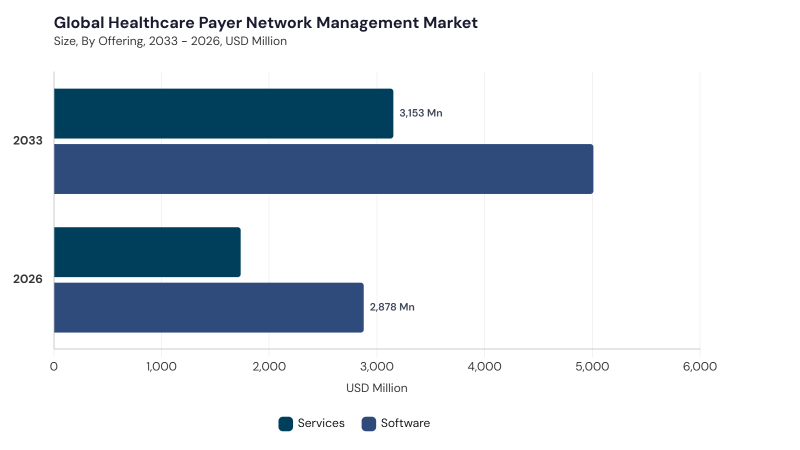
Based on Offering, the Healthcare Payer Network Management Market is segmented into Software and Services. The Software segment dominated the Global Healthcare Payer Network Management Market by Offering in 2025 and would continue to be a dominant segment till 2033; thereby, achieving a market value of USD 5,010.3 Million by 2033, growing at a CAGR of 8.2% during the forecast period. Meanwhile, the Services segment accounted for 37.48% revenue share in 2025 owing to rising demand for consulting, implementation, integration, and provider network optimization support services across healthcare payer organizations.
Based on Deployment, the market is segmented into Cloud-Based, On-Premise, and Hybrid. The Cloud-Based segment acquired the highest revenue share of 56.95% in 2025 driven by increasing migration toward scalable healthcare IT infrastructure and AI-enabled payer analytics ecosystems. The Hybrid segment is projected to witness a CAGR of 9.1% during 2026-2033 owing to rising preference for flexible deployment environments balancing cloud scalability and data control capabilities. Additionally, the On-Premise segment is expected to attain a market value of USD 2,007.87 Million by 2033 supported by organizations prioritizing regulatory compliance and infrastructure security.
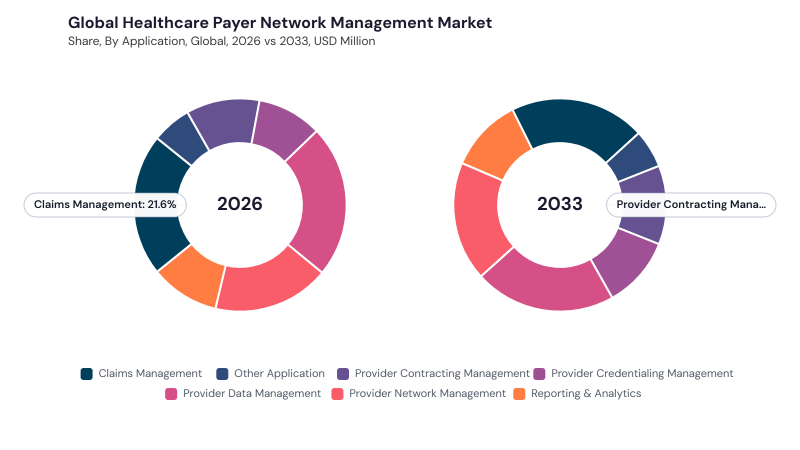
By Application, the market is segmented into Provider Data Management, Claims Management, Provider Network Management, Provider Contracting Management, Provider Credentialing Management, Reporting & Analytics, and Other Application. The Provider Data Management segment accounted for the highest revenue share of 23.42% in 2025 due to increasing demand for accurate provider information management and network operational efficiency. The Claims Management segment is expected to reach a market value of USD 1,680.57 Million by 2033 supported by rising focus on streamlining claims adjudication and reducing administrative inefficiencies. Furthermore, the Reporting & Analytics segment is anticipated to witness a CAGR of 9.5% during the forecast period driven by expanding adoption of AI-powered payer analytics platforms.
Free Valuable Insights: Healthcare Payer Network Management Market Size to reach $8,163.1 Million by 2033
Region-wise, the Healthcare Payer Network Management Market is analyzed across North America, Europe, Asia Pacific, and LAMEA. North America dominated the market in 2025 with a 40.62% revenue share owing to advanced healthcare IT infrastructure, strong payer digitization initiatives, and extensive adoption of value-based care models. The Europe market is projected to achieve a market value of USD 2,232.90 Million by 2033 supported by increasing healthcare modernization programs and interoperability initiatives. Meanwhile, the Asia Pacific market is expected to witness the fastest CAGR of 9.4% during 2026-2033 driven by expanding healthcare infrastructure, payer digitization, and rising adoption of cloud-based healthcare technologies.
The Healthcare Payer Network Management Market is highly competitive and innovation-driven, characterized by increasing adoption of AI-enabled analytics, predictive healthcare intelligence, interoperability platforms, and automated provider management systems. Competition increasingly centres around provider network optimization, claims processing efficiency, healthcare interoperability, real-time analytics capabilities, and value-based care enablement. Vendors differentiate themselves through advanced AI integration, cloud-native payer platforms, provider credentialing automation, and healthcare analytics sophistication.
Strategic collaborations between healthcare payers, provider organizations, healthcare technology vendors, and interoperability solution providers continue to shape the competitive landscape. Companies are increasingly investing in predictive analytics, automated workflow optimization, cloud infrastructure, and member-centric healthcare engagement platforms to strengthen market positioning. Rising focus on healthcare cost optimization, operational transparency, and intelligent care coordination is expected to intensify competition during the forecast period.
Healthcare Payer Network Management Market Coverage:
| Report Attribute | Details |
|---|---|
| Market size value in 2026 | USD 4,612.9 Million |
| Market size forecast in 2033 | USD 8,163.1 Million |
| Base Year | 2025 |
| Historical period | 2022 to 2024 |
| Forecast Period | 2026 to 2033 |
| Revenue Growth Rate | CAGR of 8.5% from 2026 to 2033 |
| Number of Pages | 606 |
| Tables | 720 |
| Report Coverage | Market Trends, Revenue Estimation and Forecast, Segmentation Analysis, Regional and Country Breakdown, Competitive Landscape, Market Share Analysis, Company Profiling, Companies Strategic Developments, SWOT Analysis, Winning Imperatives |
| Segments Covered | Offering, Deployment, Application, Region |
| Country Scope |
|
| Companies Included | UnitedHealth Group, Aetna/CVS Health, Cigna, Humana, Blue Cross Blue Shield Association, Centene, Kaiser Foundation Health Plan, Wellcare, LexisNexis Risk Solutions, HealthStream |
By Offering
By Deployment
By Application
By Geography
Expected to reach USD 8,163.1 million by 2033, growing at 8.5% CAGR during 2026-2033.
North America dominated in 2025 due to advanced healthcare IT infrastructure and payer digitization.
UnitedHealth Group, Aetna/CVS Health, Cigna, Humana, Blue Cross Blue Shield Association are key players.
Europe is projected to achieve a market value of USD 2,232.90 million by 2033.
The market is growing at 8.5% CAGR during the forecast period (2026-2033).
Advanced healthcare IT infrastructure and extensive adoption of value-based care models drive dominance.
Our team of dedicated experts can provide you with attractive expansion opportunities for your business.








 Unique Offerings