
“Global Food Processing Equipment Market to reach a market value of USD 94671.73 Million by 2033 growing at a CAGR of 5.8%”
The Global Food Processing Equipment Market is expected to reach USD 94.7 billion by 2033, growing at a CAGR of 5.8% during 2026–2033. The report examines market size, growth trends, and opportunities by equipment type, mode of operation, equipment function, application, and geography.

Food processing equipment is machinery used to prepare raw ingredients and transform them into food and beverage products. Equipment for food processing supports operations such as cleaning, sorting, cutting, mixing, grinding, heating, cooling, homogenization, and separation. Industrial food processing equipment serves specialist processors and large manufacturers through individual machines or coordinated production lines. Purchasing decisions depend on product characteristics, usable throughput, sanitation, operating costs, and integration with existing systems. This report centers on food preparation and production; packaging machinery requires separate treatment unless explicitly included in an integrated processing solution.
Food manufacturers require equipment that can reproduce specified product characteristics over repeated batches or continuous production runs. Differences in ingredient handling, particle size, mixing, and thermal processing can affect the finished product. Tetra Pak’s processing portfolio includes mixing, heat treatment, homogenization, and filtration, illustrating the range of operations involved in achieving a defined output. Demand for equipment follows manufacturers’ need to maintain consistency while supplying their target markets at a practical cost. Commercial value comes from saleable production rather than machine speed alone. Suppliers that understand the relationship between raw materials, process settings, and final quality can support both new capacity and upgrades to existing operations.
Processors invest in automation to coordinate repeated tasks and make production more consistent where the application supports it. JBT Marel describes equipment, software, and services designed to connect processing operations and production data. This creates demand for controls, handling systems, and integrated machinery that reduce unnecessary manual intervention. The purchasing case depends on the actual constraint in the plant: labor availability, variable cycle times, material flow, or process control may matter more than nominal line speed. Suppliers must show how automation improves usable throughput without introducing difficult maintenance or changeover requirements. Benefits are strongest when individual machines and operating procedures function as a coordinated production system.

Based on Equipment Type, the market is segmented into Processing Equipment, Pre-processing Equipment. Processing Equipment dominated in 2025 and is projected to reach USD 46.6 billion by 2033, growing at a CAGR of 4.5%. Pre-processing Equipment is expected to record the highest CAGR of 7.2% during the forecast period.
Pre-processing equipment prepares incoming ingredients for subsequent operations through tasks such as cleaning, sorting, and initial size reduction. Processing equipment performs the operations that transform prepared inputs into the required food or beverage product. The boundary depends on the production sequence and the report’s classification of each machine. Buyers need to match equipment capacity and material handling across both stages, because an upstream bottleneck or inconsistent input can limit the performance of an otherwise capable processing line.
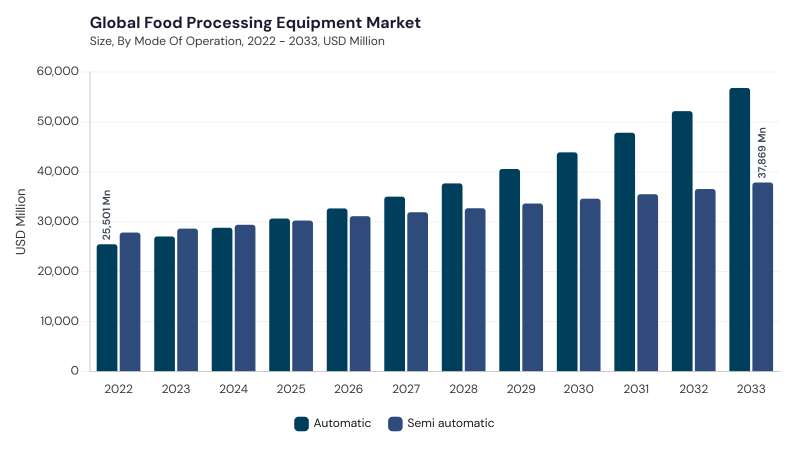
Based on Mode Of Operation, the market is segmented into Automatic, Semi-automatic. Automatic dominated in 2025 and is projected to reach USD 56.8 billion by 2033, growing at a CAGR of 8.2%. Automatic is expected to record the highest CAGR of 8.2% during the forecast period.
Automatic food processing equipment coordinates repeated tasks through controls, handling systems, and programmed operating sequences. Semi-automatic equipment combines machine operations with operator involvement at selected stages. The appropriate level of automation depends on production volumes, recipe changes, labor availability, and maintenance capabilities. For commercial food processing equipment buyers, higher automation needs to be assessed against usable output, staff training, changeover requirements, and compatibility with installed machines. A coordinated line can be more valuable than isolated increases in nominal machine speed.
Based on Equipment Function, the market is segmented into Cutting & Slicing, Mixing & Blending, Grinding & Milling, Heating & Cooking, Cooling & Freezing, Homogenization & Separation, Other Equipment Function. Heating & Cooking dominated in 2025 and is projected to reach USD 17.7 billion by 2033, growing at a CAGR of 4.8%. Homogenization & Separation is expected to record the highest CAGR of 9.0% during the forecast period.
Equipment used in food processing varies with the required transformation. Cutting and slicing establish dimensions, while grinding and milling reduce particle size. Mixing and blending distribute ingredients, and heating, cooking, cooling, and freezing manage thermal stages in production. Homogenization and separation address product structure or component streams in suitable applications. Selecting food processing tools and equipment therefore requires more than a capacity comparison: processors must consider raw-material properties, target product specifications, cleaning access, and how each operation connects to the next.
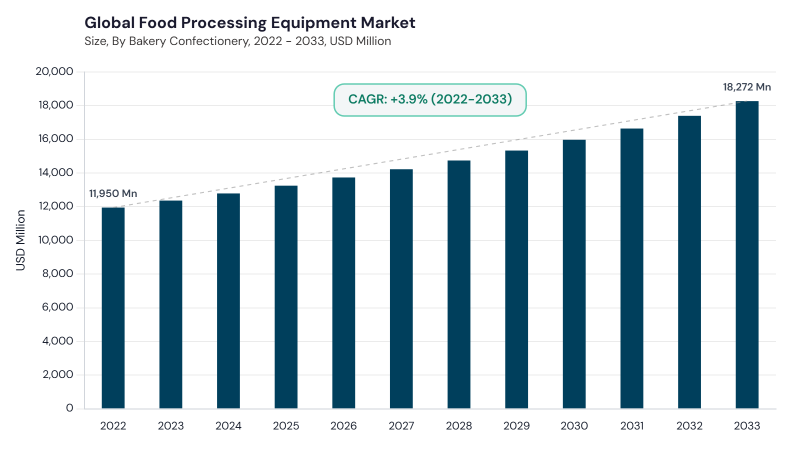
Based on Application, the market is segmented into Bakery & Confectionery, Meat and Poultry & Seafood, Dairy Products, Beverages, Fruits and Vegetables & Nuts, Convenience & Prepared Foods, Other Application. Bakery & Confectionery dominated in 2025 and is projected to reach USD 18.3 billion by 2033, growing at a CAGR of 4.2%. Convenience & Prepared Foods is expected to record the highest CAGR of 8.9% during the forecast period.
Bakery and confectionery production requires equipment suited to ingredient preparation, mixing, and thermal processing. Meat, poultry, seafood, dairy, and beverage applications have different handling and process-control requirements. Fruits, vegetables, and nuts can require careful sorting and preparation before further transformation. Convenience and prepared foods often combine several operations, making recipe flexibility and coordination across the line relevant purchasing criteria. Application-specific testing can help buyers assess whether a proposed machine can process their actual ingredients and production mix.
Free Valuable Insights: Food Processing Equipment Market Size to reach $94.7 Billion by 2033
Region-wise, the Food Processing Equipment Market is analyzed across North America, Europe, Asia Pacific, LAMEA. Europe led in 2025 and is projected to reach USD 27.5 billion by 2033, growing at a CAGR of 3.7%. North America is projected to grow at a CAGR of 4.5%. Asia Pacific is projected to grow at a CAGR of 8.0%. LAMEA is projected to grow at a CAGR of 8.2%.
Regional food processing equipment investment reflects the scale of local food manufacturing, available infrastructure, labor conditions, and access to technical support. Across Europe, North America, Asia Pacific, and LAMEA, buyers need to assess machine costs alongside electricity, water, maintenance, and spare-parts availability. Local raw materials and product preferences also influence equipment selection. Retrofit projects and new production facilities create different requirements for integration and commissioning. Regional opportunities therefore depend on both capacity needs and the ability to operate installed machinery reliably.
By Equipment Type
By Mode Of Operation
By Equipment Function
By Application
By Geography
| Report Attribute | Details |
|---|---|
| Market size value in 2026 | USD 63.8 billion |
| Market size forecast in 2033 | USD 94.7 billion |
| Base Year | 2025 |
| Historical Period | 2022 to 2024 |
| Forecast Period | 2026 to 2033 |
| Revenue Growth Rate | CAGR of 5.8% from 2026 to 2033 |
| Number of Tables | 690 |
| Number of Figures | 115 |
| Report Coverage | Market Trends, Revenue Estimation and Forecast, Segmentation Analysis, Regional and Country Breakdown, Competitive Landscape |
| Segments Covered | Equipment Type, Mode Of Operation, Equipment Function, Application and Geography |
| Country Scope |
|
By Geography
The market is expected to reach USD 94.7 billion by 2033.
Processing Equipment leads, projected to hit USD 46.6 billion by 2033.
Top companies include Tetra Laval, GEA Group, Bühler, and Alfa Laval.
The Automatic segment leads, projected to reach USD 56.8 billion by 2033.
Europe leads with a market value of USD 27.5 billion by 2033.
The market grows at 5.8% CAGR during the forecast period (2026-2033).
Our team of dedicated experts can provide you with attractive expansion opportunities for your business.




