“Global Feminine Hygiene Products Market to reach a market value of USD 72.11 Billion by 2032 growing at a CAGR of 6.9%”
The Global Feminine Hygiene Products Market size is expected to reach USD 72.11 billion by 2032, rising at a market growth of 6.9% CAGR during the forecast period.
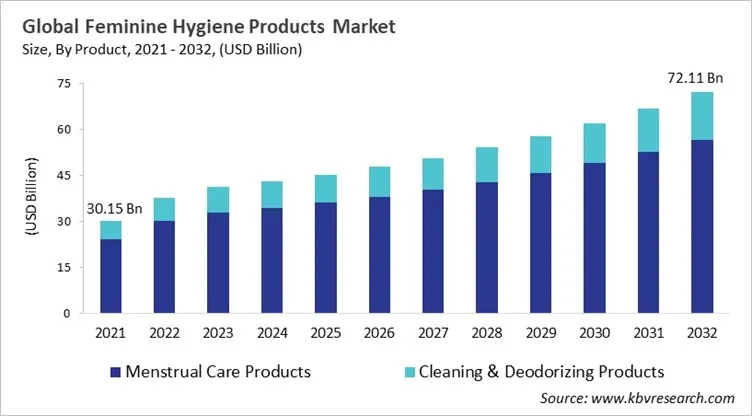
Modern feminine hygiene industry has developed from a utilitarian segment into a socially, mature, and technologically dynamic market. Industrial advances that allow single-use products like sanitary pads and tampons, mass production of absorbent, which replaced advanced materials and established hygiene products as consumer staples. With time, menstrual care diversified into panty liners, tampons, pads, period underwear, and menstrual cups, shaped by global retail expansion, technological innovation, and developing cultural attitudes toward menstruation. Product standardization, public-health discourse, and safety regulations further legalized menstrual hygiene as a matter of rights and health. The feminine hygiene products market has expanded to encompass sustainability, inclusion, and education-surged by NGO advocacy, public policies, rising awareness of environmental responsibility, and menstrual equity.
The feminine hygiene market is driven by elements including digital diversification, sustainability, and policy-driven access. Consumers-particularly younger and urban population is raising demand for reusable, biodegradable, and low-waste products, encouraging both established and developing brands to prioritize circular design and eco-friendly materials. Institutions and governments largely address “period poverty” through subsidies, tax exemptions, and free product distribution, normalizing menstrual care. In addition, digitalization has segmented the market into specialized niches served by subscription and e-commerce models, allowing agile startups to challenge well-established organizations. Major global brands are using multi-pronged strategies that combine educational outreach, R&D innovation, hybrid retail-digital distribution, and partnerships with NGOs. The growth majorly depends upon visible commitments to inclusivity, sustainability, and social impact.
The COVID-19 pandemic caused a lot of problems for the global feminine hygiene products market. Lockdowns, factory closures, and supply chain breakdowns all caused shortages of products and delays in getting them to stores. At first, panic buying increased demand, but income losses and long-term restrictions made people spend less, making period poverty worse in low-income areas. Programs to raise awareness and distribute menstrual hygiene products stopped when schools and workplaces closed, making it harder to learn about and get them. Manufacturers had trouble with shortages of raw materials, rising shipping costs, and lower production capacity, which hurt their profits. Sales dropped even more when offline stores closed, and while e-commerce grew, limited access in developing areas made it harder for the market to recover, leading to a general market contraction during the pandemic. Thus, the COVID -19 pandemic had a Negative impact on the market.

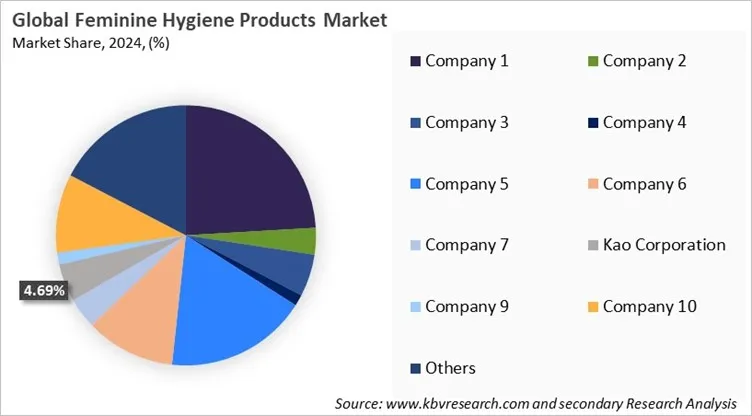
The leading players in the market are competing with diverse innovative offerings to remain competitive in the market. The above illustration shows the percentage of revenue shared by some of the leading companies in the market. The leading players of the market are adopting various strategies in order to cater to demand coming from the different industries. The key developmental strategies in the market are Acquisitions, and Partnerships & Collaborations.
Based on Product, the Feminine Hygiene Products Market is segmented into Menstrual Care Products, and Cleaning & Deodorizing Products. The Cleaning & Deodorizing Products segment acquired 20% revenue share in the market in 2024. This segment comprises intimate washes, wipes, sprays, and related hygiene solutions designed to maintain cleanliness and freshness beyond the menstrual cycle. This segment has gained momentum as consumers increasingly recognize the importance of daily intimate hygiene as part of overall wellness.
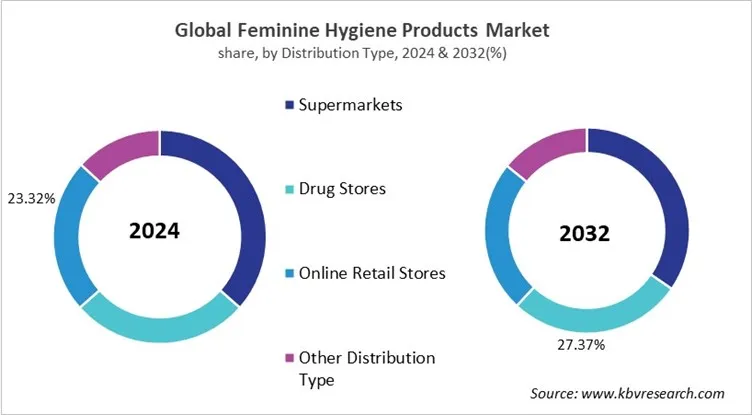
Based on Distribution Type, the Feminine Hygiene Products Market is segmented into Supermarkets, Drug Stores, Online Retail Stores, and Other Distribution Type. The Drug Stores segment attained 27% revenue share in the market in 2024. This segment plays a vital role in distributing feminine hygiene products, particularly due to its association with health and wellness. Many consumers prefer purchasing menstrual and intimate hygiene items from drug stores because of the trust and credibility these outlets hold. Drug stores also provide personalized assistance and recommendations from pharmacists, which can influence purchasing behavior, especially for new or specialized products like menstrual cups and intimate washes.
Free Valuable Insights: Global Feminine Hygiene Products Market size to reach USD 72.11 Billion by 2032
Region-wise, the Feminine Hygiene Products Market is analyzed across North America, Europe, Asia Pacific, and LAMEA. The Asia Pacific segment recorded 36% revenue share in the market in 2024. The female hygiene products market is predicted to grow at a significant rate in the North America and Europe region. The market is driven by elements including strong retail and online infrastructure, high per-woman usage, and a shift towards sustainable, reusable, and premium products. Further, the demand is largely driven by increased health awareness, eco-friendly innovations such as menstrual cups, biodegradable packaging, and organic pads, and a well-established channel of supermarkets, e-commerce, and pharmacies. Moreover, Europe market is expanding backed by sustainable products, regulatory and educational efforts around menstrual health, and product differentiation. Also, in both regions, innovation and niche segmentation are key elements for the expansion of the feminine hygiene products market.
In the Asia Pacific and LAMEA regions, the feminine hygiene products market is witnessing substantial expansion. The expansion is supported by increasing female workforce participation, rising hygiene awareness and urbanization, enhanced retail/accessibility in rural and semi-urban markets, and large populations in the regional nations (particularly, China and India). Furthermore, the LAMEA female hygiene products market is predicted to procure prominent growth supported by factors such as increasing spendable incomes, government and NGO supported menstrual-hygiene initiatives (particularly in less-served markets), improving distribution infrastructure, and cultural shifts reducing stigma.
| Report Attribute | Details |
|---|---|
| Market size value in 2025 | USD 45.26 Billion |
| Market size forecast in 2032 | USD 72.11 Billion |
| Base Year | 2024 |
| Historical Period | 2021 to 2023 |
| Forecast Period | 2025 to 2032 |
| Revenue Growth Rate | CAGR of 6.9% from 2025 to 2032 |
| Number of Pages | 567 |
| Number of Tables | 441 |
| Report coverage | Market Trends, Revenue Estimation and Forecast, Segmentation Analysis, Regional and Country Breakdown, Market Share Analysis, Porter’s 5 Forces Analysis, Company Profiling, Companies Strategic Developments, SWOT Analysis, Winning Imperatives |
| Segments covered | Product, Distribution Type, Region |
| Country scope |
|
| Companies Included | The Procter & Gamble Company, Edgewell Personal Care, Unilever PLC, Diva International Inc., Unicharm Corporation, Kimberly-Clark Corporation, Ontex BV, Kao Corporation, Prestige Consumer Healthcare, Inc., Essity Aktiebolag (publ) |
By Product
By Distribution Type
By Geography
The market size is projected to reach USD 72.11 billion by 2032.
The feminine hygiene products market is projected to grow at a CAGR of 6.9% between 2025 and 2032.
Growing focus on women’s health and wellness is supported by urbanization and rising disposable income among women.
The Procter & Gamble Company, Edgewell Personal Care, Unilever PLC, Diva International Inc., Unicharm Corporation, Kimberly-Clark Corporation, Ontex BV, Kao Corporation, Prestige Consumer Healthcare, Inc., Essity Aktiebolag (publ)
The Supermarkets segment is generating maximum revenue share in the Global Feminine Hygiene Products Market by Distribution Type in 2024, growing at a CAGR of 6.2 % during the forecast period.
The Asia Pacific region dominated the Global Feminine Hygiene Products Market by Region in 2024, and would continue to be a dominant market till 2032; thereby, achieving a market value of $26.59 billion by 2032.
Our team of dedicated experts can provide you with attractive expansion opportunities for your business.







 Unique Offerings