“Global Eyewear Frames Market to reach a market value of USD 61201.79 Million by 2033 growing at a CAGR of %”
The Global Eyewear Frames Market is expected to reach USD 61.2 billion by 2033, growing at a CAGR of 6.2% during (2026 - 2033).
The global eyewear frames market includes frames intended for prescription spectacles and fashion-oriented optical eyewear. Its demand profile combines essential vision correction with lifestyle spending, brand preferences and replacement cycles. Frames are evaluated not simply as accessories but as wearable products that must accommodate lens prescriptions, facial geometry, comfort and daily use. As a result, optical expertise and fashion merchandising both influence commercial performance.
The continuing need to correct refractive errors and age-related near-vision difficulties sustains demand for prescription eyewear frames. Consumers commonly require a new frame when their prescription changes, when an existing product becomes damaged, or when they seek a different fit for updated lenses. Vision screening and optical access initiatives can bring additional buyers into the formal eyewear market. This structural requirement supports broad demand across price bands and gives retailers recurring opportunities to maintain customer relationships through eye examinations and replacement reminders. It is particularly significant for everyday full-rim designs, which can accommodate a wide range of lens needs. Nevertheless, improved clinical access does not guarantee premium-frame spending: cost-sensitive consumers
Commercially, this factor changes the balance between entry-level frames, mid-market branded products and premium collections. Manufacturers must align design, production volumes and channel economics with the customers most exposed to this influence. Optical retailers, meanwhile, need to translate the underlying need into a credible proposition through fitting support, assortment planning, transparent prices and dependable after-sales service. The strongest operators are likely to be those that respond to the structural force without sacrificing comfort, quality control or customer trust.

Based on Material, the market is segmented into Plastic / Acetate, Metal, Other Materials. Plastic / Acetate dominated in 2025 and is projected to reach USD 33.4 billion by 2033, growing at a CAGR of 5.8%. Metal is expected to record the highest CAGR of 6.8% during the forecast period.
Offline remains the principal distribution channel for eyewear frames, reflecting the importance of physical assessment in a purchase that must satisfy both optical and aesthetic requirements. Independent opticians, optical chains, branded boutiques and department-store counters allow consumers to compare frame width, bridge fit, temple pressure, weight and facial appearance before committing to a purchase. Professional assistance is particularly valuable when frames must accommodate progressive lenses, high prescriptions or frequent adjustments. Retailers also benefit from bundling frame selection with eye examinations, lens dispensing, repairs and after-sales fitting, which can support customer retention beyond a single transaction.
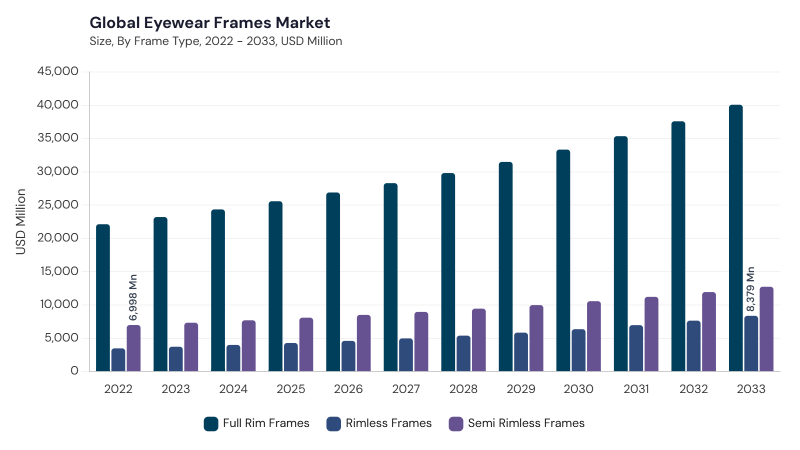
Based on Frame Type, the market is segmented into Full-Rim Frames, Semi-Rimless Frames, Rimless Frames. Full-Rim Frames dominated in 2025 and is projected to reach USD 40.1 billion by 2033, growing at a CAGR of 5.9%. Rimless Frames is expected to record the highest CAGR of 8.9% during the forecast period.
Offline remains the principal distribution channel for eyewear frames, reflecting the importance of physical assessment in a purchase that must satisfy both optical and aesthetic requirements. Independent opticians, optical chains, branded boutiques and department-store counters allow consumers to compare frame width, bridge fit, temple pressure, weight and facial appearance before committing to a purchase. Professional assistance is particularly valuable when frames must accommodate progressive lenses, high prescriptions or frequent adjustments. Retailers also benefit from bundling frame selection with eye examinations, lens dispensing, repairs and after-sales fitting, which can support customer retention beyond a single transaction.
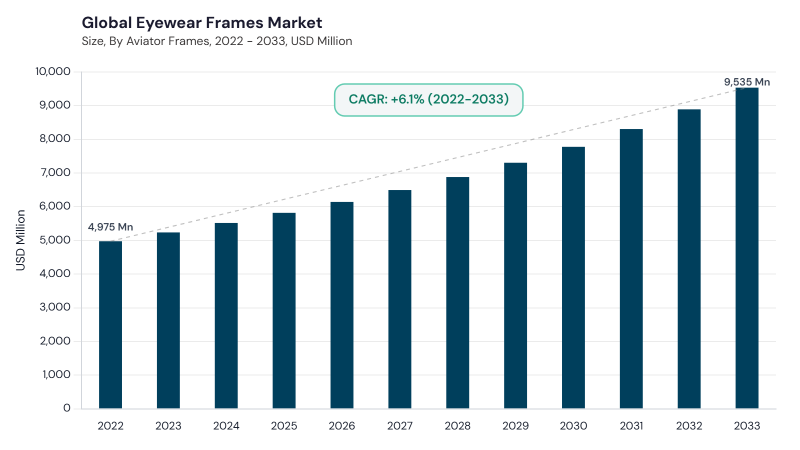
Based on Frame Shape, the market is segmented into Square / Rectangular Frames, Oval & Round Frames, Aviator Frames, Cat-Eye Frames, Other Frame Shapes. Square / Rectangular Frames dominated in 2025 and is projected to reach USD 23.0 billion by 2033, growing at a CAGR of 5.6%. Cat-Eye Frames is expected to record the highest CAGR of 7.6% during the forecast period.
Offline remains the principal distribution channel for eyewear frames, reflecting the importance of physical assessment in a purchase that must satisfy both optical and aesthetic requirements. Independent opticians, optical chains, branded boutiques and department-store counters allow consumers to compare frame width, bridge fit, temple pressure, weight and facial appearance before committing to a purchase. Professional assistance is particularly valuable when frames must accommodate progressive lenses, high prescriptions or frequent adjustments. Retailers also benefit from bundling frame selection with eye examinations, lens dispensing, repairs and after-sales fitting, which can support customer retention beyond a single transaction.
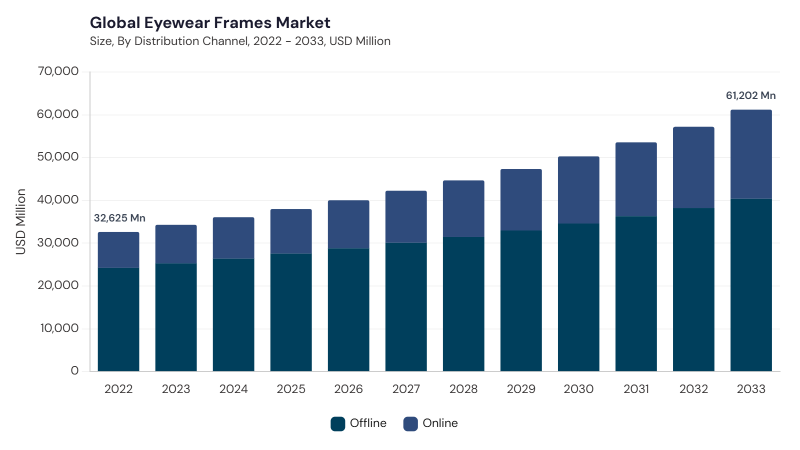
Based on Distribution Channel, the market is segmented into Offline, Online. Offline dominated in 2025 and is projected to reach USD 40.4 billion by 2033, growing at a CAGR of 4.9%. Online is expected to record the highest CAGR of 9.2% during the forecast period.
Offline remains the principal distribution channel for eyewear frames, reflecting the importance of physical assessment in a purchase that must satisfy both optical and aesthetic requirements. Independent opticians, optical chains, branded boutiques and department-store counters allow consumers to compare frame width, bridge fit, temple pressure, weight and facial appearance before committing to a purchase. Professional assistance is particularly valuable when frames must accommodate progressive lenses, high prescriptions or frequent adjustments. Retailers also benefit from bundling frame selection with eye examinations, lens dispensing, repairs and after-sales fitting, which can support customer retention beyond a single transaction.
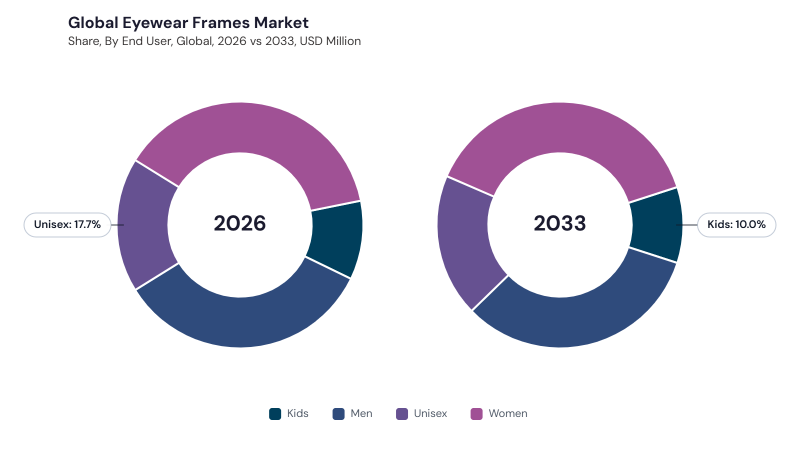
Based on End User, the market is segmented into Men, Women, Unisex, Kids. Women dominated in 2025 and is projected to reach USD 23.6 billion by 2033, growing at a CAGR of 6.5%. Unisex is expected to record the highest CAGR of 7.2% during the forecast period.
Offline remains the principal distribution channel for eyewear frames, reflecting the importance of physical assessment in a purchase that must satisfy both optical and aesthetic requirements. Independent opticians, optical chains, branded boutiques and department-store counters allow consumers to compare frame width, bridge fit, temple pressure, weight and facial appearance before committing to a purchase. Professional assistance is particularly valuable when frames must accommodate progressive lenses, high prescriptions or frequent adjustments. Retailers also benefit from bundling frame selection with eye examinations, lens dispensing, repairs and after-sales fitting, which can support customer retention beyond a single transaction.
Based on Price Category, the market is segmented into Mass Market, Premium. Mass Market dominated in 2025 and is projected to reach USD 39.9 billion by 2033, growing at a CAGR of 5.6%. Premium is expected to record the highest CAGR of 7.7% during the forecast period.
Offline remains the principal distribution channel for eyewear frames, reflecting the importance of physical assessment in a purchase that must satisfy both optical and aesthetic requirements. Independent opticians, optical chains, branded boutiques and department-store counters allow consumers to compare frame width, bridge fit, temple pressure, weight and facial appearance before committing to a purchase. Professional assistance is particularly valuable when frames must accommodate progressive lenses, high prescriptions or frequent adjustments. Retailers also benefit from bundling frame selection with eye examinations, lens dispensing, repairs and after-sales fitting, which can support customer retention beyond a single transaction.
Region-wise, the Eyewear Frames Market is analyzed across North America, Europe, Asia Pacific, LAMEA. Europe led in 2025 and is projected to reach USD 18.6 billion by 2033, growing at a CAGR of 5.8%. North America is projected to grow at a CAGR of 5.9%. Asia Pacific is projected to grow at a CAGR of 7.0%. LAMEA is projected to grow at a CAGR of 6.3%.
| Report Attribute | Details |
|---|---|
| Market size value in 2026 | USD 40.0 billion |
| Market size forecast in 2033 | USD 61.2 billion |
| Base Year | 2025 |
| Historical Period | 2022 to 2024 |
| Forecast Period | 2026 to 2033 |
| Revenue Growth Rate | CAGR of 6.2% from 2026 to 2033 |
| Number of Tables | 780 |
| Number of Figures | 130 |
| Report Coverage | Market Overview, Key Influencing Factors, Revenue Estimation and Forecast, Segmentation Analysis, Regional and Country Breakdown, Competitive Landscape |
| Segments Covered | Material, Frame Type, Frame Shape, Distribution Channel, End User, Price Category and Geography |
| Country Scope | North America: United States, Canada, Mexico, Rest of North America; Europe: Germany, United Kingdom, France, Russia, Spain, Italy, Rest of Europe; Asia Pacific: China, Japan, India, South Korea, Singapore, Malaysia, Rest of Asia Pacific; LAMEA: Brazil, Argentina, United Arab Emirates, Saudi Arabia, South Africa, Nigeria, Rest of LAMEA |
By Geography
Expected to reach USD 61,201.8 million by 2033, with a 6.3% CAGR during 2026–2033.
Rimless Frames are among the faster-growing segments, driven by increasing demand for lightweight, minimalist, and comfortable eyewear designs.
EssilorLuxottica, Safilo Group, Kering Eyewear, Marcolin, Marchon Eyewear, De Rigo, and Warby Parker.
Europe is expected to maintain a leading position by 2033.
Increasing demand for prescription vision correction and growing consumer preference for fashionable, personalized, and comfortable eyewear.
The market size is projected to reach USD 61,201.8 million by 2033.
Our team of dedicated experts can provide you with attractive expansion opportunities for your business.






 Unique Offerings
