The sample copy of this report is available for access.
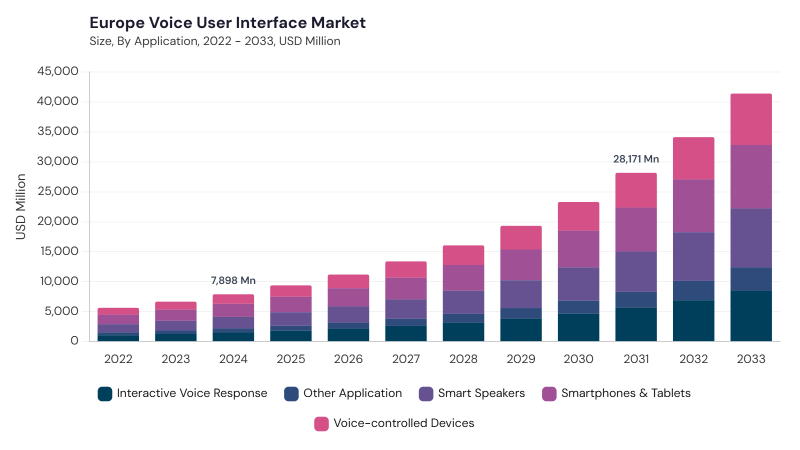
The Europe Voice User Interface Market is expected to reach USD 28.1 billion by 2031, growing at a CAGR of 20.5% during (2026 – 2033).
The Europe Voice User Interface Market developed from early speech recognition systems that supported limited voice commands in telecommunication, industrial, and customer service environments. Early adoption was restrained by basic natural language processing capabilities, limited contextual understanding, and inconsistent speech accuracy across languages and accents. Over time, advances in artificial intelligence, machine learning, cloud computing, and voice recognition models improved the ability of systems to process natural speech and support more conversational experiences. The rise of localized virtual assistants helped voice interfaces expand from niche digital tools into consumer electronics, automotive systems, healthcare workflows, and customer support platforms.
The Europe Voice User Interface Market is being shaped by multilingual voice demand, privacy-first architecture, smart home adoption, automotive voice integration, enterprise automation, and rising use of conversational AI. Organizations are using VUI solutions to improve customer service, enable hands-free device control, support voice commerce, simplify clinical documentation, automate call handling, and enhance connected vehicle experiences. Demand is supported by Europe’s digital transformation agenda, strong consumer electronics adoption, smart mobility development, healthcare modernization, and increasing preference for natural user interaction. Vendors are focusing on accurate speech recognition, contextual understanding, on-device processing, secure voice data handling, language localization, and integration with IoT ecosystems.
Based on Offering, the market is segmented into Solutions and Services. The Solution market dominated the Europe Voice User Interface Market by Offering in 2025, and would continue to be a dominant market till 2033; thereby, achieving a market value of USD 21.2 billion by 2031, growing at a CAGR of 20.2 % during the forecast period. The Services market is expected to witness a CAGR of 21.5% during (2026 - 2033).
Solutions lead due to increasing deployment of speech recognition software, natural language understanding platforms, voice biometrics, embedded voice assistants, and conversational AI engines across consumer and enterprise environments. These solutions support voice search, smart device control, customer service automation, in-vehicle infotainment, banking authentication, healthcare documentation, and enterprise workflow interaction. Services remain important as organizations require consulting, implementation, customization, language model training, system integration, and post-deployment support. Service providers also help enterprises adapt VUI platforms to GDPR requirements, regional accents, sector-specific vocabularies, legacy systems, and evolving user experience expectations.
Based on Application, the market is segmented into Smartphones & Tablets, Smart Speakers, Voice-controlled Devices, Interactive Voice Response, and Other Application. The Smartphones & Tablets market dominated the Europe Voice User Interface Market by Application in 2025, and would continue to be a dominant market till 2033; thereby, achieving a market value of USD 7.3 billion by 2031, growing at a CAGR of 19.4 % during the forecast period. The Smart Speakers market is expected to witness a CAGR of 20.3% during (2026 - 2033). Additionally, The Voice-controlled Devices market is expected to witness highest CAGR of 20.9% during (2026 - 2033).
Smartphones & Tablets lead due to widespread use of voice assistants, voice search, dictation, accessibility tools, messaging support, navigation, and hands-free mobile control. These devices remain the most common daily access point for voice interaction across Europe’s multilingual consumer base. Smart Speakers continue to gain demand as households use voice-enabled hubs for smart home control, entertainment, information access, energy management, and daily task automation. Voice-controlled Devices, Interactive Voice Response, and Other Application areas add demand through wearables, automotive interfaces, industrial equipment, AI-powered call automation, healthcare voice tools, education platforms, public service kiosks, and specialized enterprise voice applications.
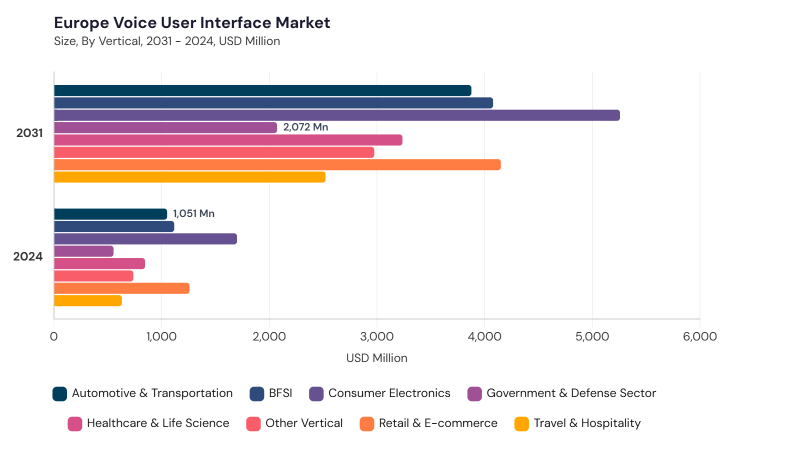
Based on Vertical, the market is segmented into Consumer Electronics, Retail & E-commerce, BFSI, Automotive & Transportation, Healthcare & Life Science, Travel & Hospitality, Government & Defense Sector, and Other Vertical. Consumer Electronics leads due to growing integration of voice assistants into smartphones, smart speakers, wearables, televisions, smart appliances, and home automation devices. Retail & E-commerce uses VUI for voice search, voice commerce, personalized recommendations, customer support, order placement, and omnichannel engagement.
BFSI applies voice interfaces for virtual banking assistants, secure voice biometrics, transaction support, and customer service automation. Automotive & Transportation, Healthcare & Life Science, Travel & Hospitality, Government & Defense Sector, and Other Vertical areas add demand through hands-free vehicle control, clinical documentation, telehealth, concierge services, citizen service portals, emergency response, interactive learning, and voice-enabled industrial operations.
Free Valuable Insights: The Worldwide Voice User Interface Market is projected to reach USD 164.1 Billion billion by 2033, at a CAGR of 20.8%
Based on Country, the market is segmented into Germany, UK, France, Russia, Spain, Italy, and Rest of Europe. The UK market dominated the Europe Voice User Interface Market by Country in 2025, and would continue to be a dominant market till 2033; thereby, achieving a market value of USD 5.5 billion by 2031, growing at a CAGR of 18.8 % during the forecast period. The Germany market is expected to witness a CAGR of 19.5% during (2026 - 2033). Additionally, The France market is expected to witness a CAGR of 21.4% during (2026 - 2033).
Germany leads due to strong automotive integration, smart home adoption, privacy-focused voice processing, multilingual capability development, and AI-driven voice innovation across industrial and consumer environments. The UK supports market growth through advanced conversational AI, accent-aware voice platforms, voice biometrics, localization, and enterprise deployment across customer service and digital applications. France contributes through SMB adoption of voice AI, healthcare and banking applications, French-language model development, and AI-first conversational interfaces. Russia, Spain, and Italy add demand through localized voice assistants, dialect support, smart home integration, mobile voice usage, privacy-driven architecture, and enterprise automation, while Rest of Europe benefits from multilingual voice systems, IoT integration, smart devices, and privacy-compliant voice computing.

By Offering
By Application
By Vertical
By Country
Set to reach $28.1 Billion by 2031, growing at 20.5% CAGR during 2026-2033.
The UK leads with a market value of $5.5 billion by 2031, growing at 18.8% CAGR during the forecast period.
Smartphones & Tablets segment will achieve $7.3 billion by 2031, growing at 19.4% CAGR during the forecast period.
Services segment is expected to witness a 21.5% CAGR during 2026-2033.
The France market is expected to witness a CAGR of 21.4% during 2026-2033.
Voice-controlled Devices segment is expected to witness the highest CAGR of 20.9% during 2026-2033.
Our team of dedicated experts can provide you with attractive expansion opportunities for your business.




 Unique Offerings