The sample copy of this report is available for access.
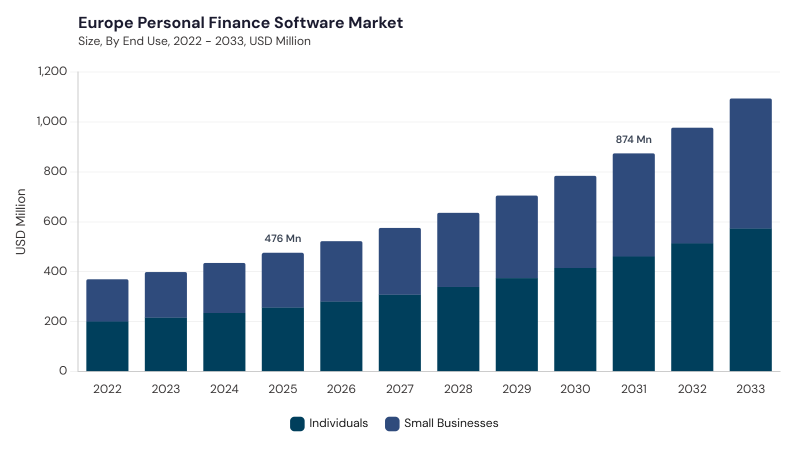
The Europe Personal Finance Software Market is expected to reach USD 874.0 million by 2031, growing at a CAGR of 11.1% during (2026 - 2033).
The Europe Personal Finance Software Market evolved from desktop-based budgeting and expense-tracking applications into cloud-enabled and mobile-accessible financial management platforms. Early solutions relied heavily on manual data entry and limited banking integration, while internet connectivity, cloud computing, smartphones, and open banking substantially expanded functionality. Regulatory developments encouraged secure data sharing between banks and third-party platforms, enabling automated account aggregation and real-time synchronization. The market now includes SaaS-based ecosystems combining budgeting, investment tracking, credit monitoring, financial planning, and AI-enhanced insights within stringent European data-protection frameworks.
AI-driven personalization, open banking, data privacy, cloud delivery, and digital financial literacy are shaping current market development. Machine learning increasingly supports predictive budgeting, spending forecasts, investment recommendations, and automated financial insights, while open banking APIs improve interoperability across banks and financial platforms. GDPR- and PSD2-aligned security practices are strengthening user trust through enhanced encryption, authentication, consent management, and transparent data handling. Growing demand for ESG functionality, cross-border financial management, multi-currency support, mobile-first access, and integrated financial ecosystems is further expanding the scope of personal finance software across Europe.
Based on Type, the market is segmented into Desktop-based and Mobile-based. The Desktop-based market dominated the Europe Personal Finance Software Market by Type in 2025, and would continue to be a dominant market till 2033; thereby, achieving a market value of USD 487.8 million by 2031, growing at a CAGR of 10.8 % during the forecast period. The Mobile-based market is expected to witness a CAGR of 11.6% during (2026 - 2033).
Desktop-based software supports detailed budgeting, reporting, investment tracking, financial planning, tax-related functions, and management of larger financial datasets, making it relevant for users seeking greater depth, customization, offline accessibility, and local data control. Cloud backup and API integration increasingly extend desktop functionality while preserving advanced analytical capabilities. Mobile-based software emphasizes instant access, spending notifications, real-time account synchronization, financial goal tracking, and open banking connectivity. AI-based coaching, gamification, secure authentication, and intuitive interfaces are strengthening adoption among users seeking convenient, continuously accessible financial management.
Based on Deployment, the market is segmented into Cloud and On-premise. The Cloud market dominated the Europe Personal Finance Software Market by Deployment in 2025, and would continue to be a dominant market till 2033; thereby, achieving a market value of USD 505.1 million by 2031, growing at a CAGR of 11.4 % during the forecast period. The On-premise market is expected to witness a CAGR of 10.8% during (2026 - 2033).
Cloud deployment enables real-time synchronization, multi-device access, automatic updates, scalable storage, third-party financial integrations, and AI-powered analytics without extensive local infrastructure. It is particularly relevant for digitally active consumers and small businesses seeking flexible and continuously updated solutions. On-premise deployment provides direct control over financial data, offline access, local storage, configurable installations, and closer alignment with specific internal security or privacy preferences. This model remains relevant among privacy-conscious users and organizations seeking tighter oversight of sensitive records, although higher maintenance requirements and lower mobility constrain wider adoption.
Based on End Use, the market is segmented into Individuals and Small Businesses. Individuals use personal finance software for budgeting, savings management, debt monitoring, investment tracking, recurring-payment visibility, retirement planning, and consolidated financial oversight. AI-generated insights, open banking connectivity, mobile access, and strong privacy controls are increasing engagement across varied user groups.
Small Businesses use these platforms for expense administration, invoicing, cash-flow planning, tax organization, payroll-related functions, and simplified financial reporting. Cloud delivery, automation, modular features, and connectivity with banking and reporting systems are improving accessibility for sole traders, freelancers, and smaller enterprises.
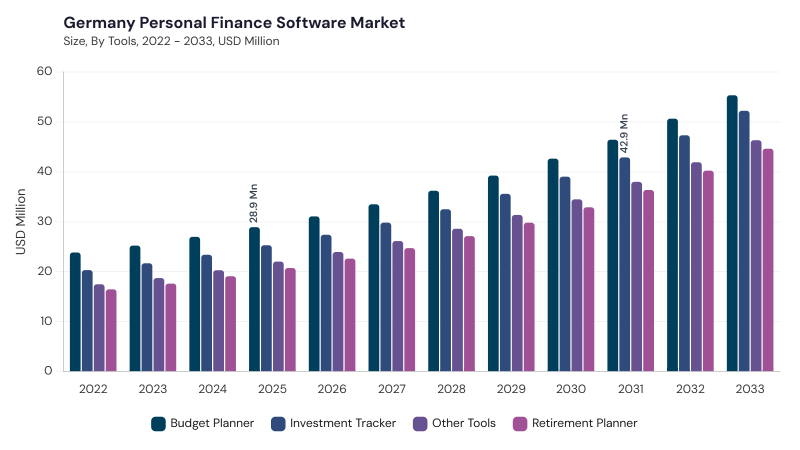
Based on Tools, the market is segmented into Budget Planner, Investment Tracker, Retirement Planner, and Other Tools. Budget Planner tools help users track income, categorize expenses, manage recurring payments, set savings objectives, and improve day-to-day financial discipline. Investment Tracker tools provide portfolio monitoring, asset-performance visibility, risk assessment, market information, and analytical support for increasingly active retail investors.
Retirement Planner tools support long-term scenario analysis, pension planning, income projections, contribution assessments, and retirement-readiness evaluation. Other Tools include debt-management functions, mortgage calculators, tax utilities, expense forecasting, net-worth monitoring, credit-related features, and savings-goal tools that broaden overall financial management capabilities.
Free Valuable Insights: The Worldwide Personal Finance Software Market is projected to reach USD 4383.8 Million billion by 2033, at a CAGR of 11.6%
Based on Country, the market is segmented into Germany, UK, France, Russia, Spain, Italy, and Rest of Europe. The Germany market dominated the Europe Personal Finance Software Market by Country in 2025, and would continue to be a dominant market till 2033; thereby, achieving a market value of USD 163.7 million by 2031, growing at a CAGR of 9.5 % during the forecast period. The UK market is expected to witness a CAGR of 10.1% during (2026 - 2033). Additionally, The France market is expected to witness a CAGR of 12% during (2026 - 2033).
Across Europe, personal finance software adoption is being shaped by AI-driven personalization, open banking, mobile access, cybersecurity, localization, and regulatory compliance. Germany emphasizes predictive financial tools, open banking integration, privacy-focused software design, localization, and cloud infrastructure, while the UK focuses on AI-powered financial coaching, cybersecurity, open banking connectivity, and highly integrated digital finance platforms. France is advancing mobile-first tools, predictive analytics, privacy compliance, open banking, and tailored financial guidance, whereas Russia emphasizes localized features, RegTech, mobile finance management, domestic financial integrations, and AI-based insights. Spain focuses on AI-enabled forecasting, secure banking aggregation, open banking, mobile interfaces, and privacy-centered architecture, while Italy emphasizes AI analytics, digital banking integration, cybersecurity, cloud services, and wider financial ecosystem connectivity. Rest of Europe continues to expand AI personalization, embedded finance, interoperable banking connections, localized functionality, and privacy-compliant digital financial management.

By Type
By Deployment
By End Use
By Tools
By Country
Set to reach $874.0 Million by 2031, growing at 11.1% CAGR during 2026-2033.
Germany leads with a market value of USD 163.7 million by 2031, growing at a CAGR of 9.5% during the forecast period.
The Cloud deployment segment dominates, achieving a market value of USD 505.1 million by 2031, growing at 11.4% CAGR.
Desktop-based segment will reach USD 487.8 million by 2031, growing at a CAGR of 10.8% during the forecast period.
The UK market is expected to witness a CAGR of 10.1% during 2026-2033.
Mobile-based segment is expected to witness a CAGR of 11.6% during 2026-2033.
Our team of dedicated experts can provide you with attractive expansion opportunities for your business.




 Unique Offerings