The Europe Healthcare Interoperability Solutions Market would witness market growth of 13.3% CAGR during the forecast period (2025-2032).
The Germany market dominated the Europe Healthcare Interoperability Solutions Market by Country in 2024, and would continue to be a dominant market till 2032; thereby, achieving a market value of $689.1 million by 2032. The UK market is exhibiting a CAGR of 12.3% during (2025 - 2032). Additionally, The France market would experience a CAGR of 14.1% during (2025 - 2032). The Germany and UK led the Europe Healthcare Interoperability Solutions Market by Country with a market share of 23.3% and 18.8% in 2024.The Italy market is expected to witness a CAGR of 13.8% during throughout the forecast period.
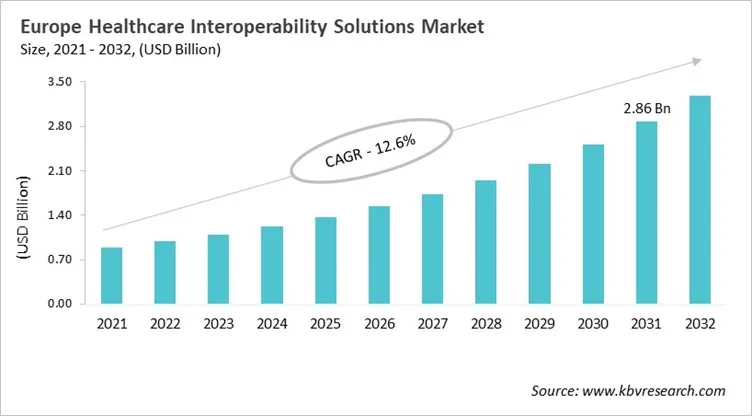
In Europe, healthcare interoperability has changed from separate national digital health projects to a coordinated, policy-driven system that supports patient-centered and cross-border care. As eHealth becomes more advanced across the EU, thanks to strong public healthcare spending, there is a growing need for standardized data exchange and integrated health IT systems. The European Interoperability Framework and eHealth Digital Service Infrastructure are examples of foundational frameworks that made it possible to share data safely across borders. The European Health Data Space (EHDS) is a big step forward because it sets common technical and governance standards for sharing health data. These projects work together to make sure that care continues, cut down on data silos, and make the system more efficient. Interoperability is now at the heart of value-based care, public health planning, and digital innovation in Europe. Increasing healthcare costs make interoperability an even more important strategic goal for getting the best results and being more efficient.
The interoperability market in Europe is currently focused on aligning regulations, allowing data to flow across borders, and integrating advanced technology. MyHealth@EU and other programs are making it easier to safely share patient summaries and ePrescriptions across borders, which improves continuity of care. Open standards, cloud-native platforms, and federated data models are becoming more important, thanks to data-infrastructure projects that protect privacy and sovereignty. Increasingly, interoperability solutions use analytics and AI to improve clinical workflows and decision-making. Market leaders focus on following EU-wide rules, working together with others, and partnering with national health programs. This coming together of policy, technology, and cooperation is making a European digital health ecosystem that is strong, flexible, and connected.
Based on Type, the market is segmented into Services and Software. With a compound annual growth rate (CAGR) of 11.6% over the projection period, the Services Market, dominate the Germany Healthcare Interoperability Solutions Market by Type in 2024 and would be a prominent market until 2032. The Software market is expected to witness a CAGR of 12.1% during (2025 - 2032).
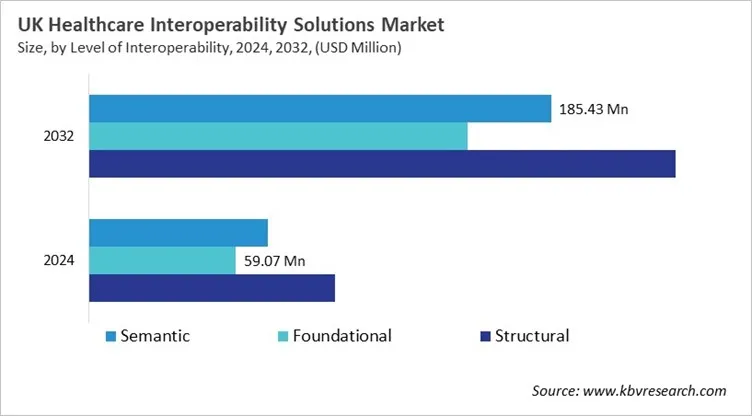
Based on Level of Interoperability, the market is segmented into Structural, Foundational and Semantic. Among various UK Healthcare Interoperability Solutions Market by Level of Interoperability; The Structural market achieved a market size of USD $98.7 Million in 2024 and is expected to grow at a CAGR of 11.6 % during the forecast period. The Semantic market is predicted to experience a CAGR of 12.8% throughout the forecast period from (2025 - 2032).
Based on End User, the market is segmented into Healthcare Providers, Healthcare Payers and Pharmacies. The Healthcare Providers market segment dominated the France Healthcare Interoperability Solutions Market by End User is expected to grow at a CAGR of 13.6 % during the forecast period thereby continuing its dominance until 2032. Also, The Pharmacies market is anticipated to grow as a CAGR of 14.9 % during the forecast period during (2025 - 2032).
Free Valuable Insights: The Global Healthcare Interoperability Solutions Market will Hit USD 11.22 Billion by 2032, at a CAGR of 13.5%
Germany's healthcare interoperability market is very structured and regulated because of a mandatory insurance system and federal government. The Digital Healthcare Act is the main law that sets the rules for national digital health reforms. It requires all providers, insurers, and pharmacies to share data in a standard way and connect to each other. The digital health agency, which is backed by the government, makes sure that different systems can work together by using secure telematics infrastructure and electronic health cards. Strict laws about data protection stress getting permission from patients and not letting one person control all the data. This makes people want secure, compliant interoperability platforms. Updating old systems by adding Electronic Patient Records and using HL7 FHIR standards. Interoperability is becoming more common across hospitals, outpatient care, and diagnostic systems, thanks to funding for public digitalization. Price isn't the most important thing in competition. Instead, it's about following the rules, being able to grow, and being in line with national infrastructure.

By Type
By Interoperability
By End User
By Country
Our team of dedicated experts can provide you with attractive expansion opportunities for your business.





 Unique Offerings