The Europe Digital Inspection Market would witness market growth of 5.9% CAGR during the forecast period (2025-2032).
The Germany market dominated the Europe Digital Inspection Market by Country in 2024, and would continue to be a dominant market till 2032; thereby, achieving a market value of $2,078.8 million by 2032. The UK market is exhibiting a CAGR of 4.8% during (2025 - 2032). Additionally, The France market would experience a CAGR of 6.7% during (2025 - 2032). The Germany and UK led the Europe Digital Inspection Market by Country with a market share of 24.8% and 17.1% in 2024. The Italy market is expected to witness a CAGR of 6.8% during throughout the forecast period.
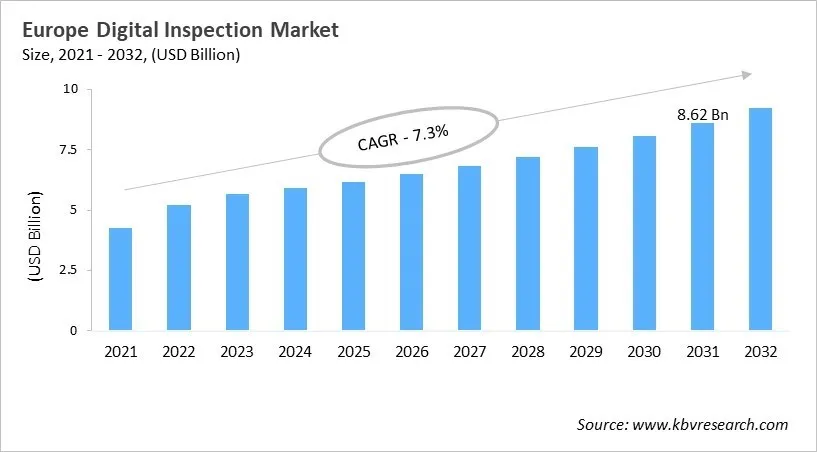
The European Digital Inspection Market has changed a lot as a key part of the digital transformation of industry. It has replaced manual and paper-based inspection methods with automated, data-driven technologies like machine vision, AI, robotics, non-destructive testing, and advanced analytics. Digital inspection is made possible by Industry 4.0 initiatives, strict regulatory requirements, and EU-level digitalization policies. It improves accuracy, efficiency, traceability, and compliance in the manufacturing, aerospace, automotive, energy, construction, and transportation sectors. These systems help organizations improve quality, safety, and asset integrity while getting a competitive edge by allowing them to monitor conditions in real time, do predictive maintenance, and report in a standard way. The market has grown into a connected ecosystem where inspection data is used in larger workflows for managing operations and quality.
In Europe, the digital inspection market is moderately consolidated, with both global industrial technology leaders and specialized regional innovators working together. Top companies focus on being the best in technology, integrating systems, following the rules, and putting customers first. Strategic partnerships and ecosystem integration also make solutions more valuable. More and more, differentiation depends on software intelligence, cloud connectivity, AI-driven analytics, and interoperability instead of just hardware. Strong manufacturing bases in Germany, France, and the UK, along with more and more people in smaller EU countries using the products, help the market keep growing. Overall, the market shows a move toward smart, automated inspection platforms that support long-term industrial resilience, compliance, and efficiency across Europe.
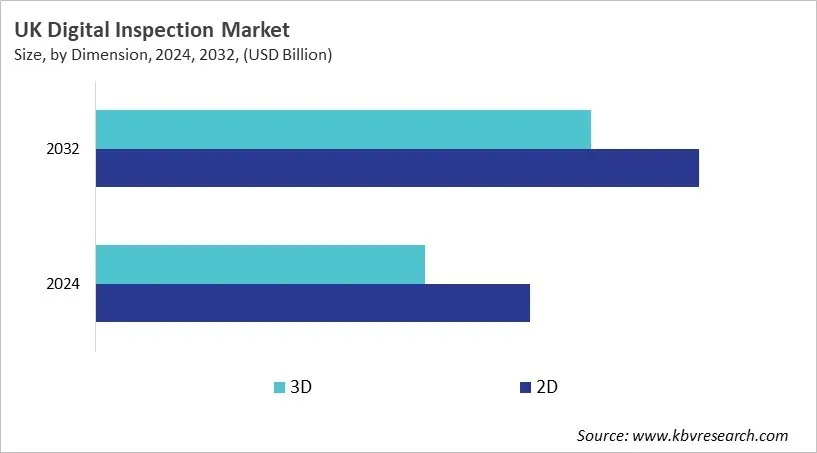
Based on Dimension, the market is segmented into 2D, and 3D. Among various UK Digital Inspection Market by Dimension; The 2D market achieved a market size of USD $576.6 Million in 2024 and is expected to grow at a CAGR of 4.4 % during the forecast period. The 3D market is predicted to experience a CAGR of 5.4% throughout the forecast period from (2025 - 2032).
Based on Technology, the market is segmented into Machine Vision, Metrology, and NDT (Non-Destructive Testing). The Machine Vision market segment dominated the Germany Digital Inspection Market by Technology is expected to grow at a CAGR of 4 % during the forecast period thereby continuing its dominance until 2032. Also, The NDT (Non-Destructive Testing) market is anticipated to grow as a CAGR of 5.3 % during the forecast period during (2025 - 2032).
Free Valuable Insights: The Global Digital Inspection Market will Hit USD 36.15 Billion by 2032, at a CAGR of 6.3%
Germany's digital inspection market is strong because it has a strong industrial base, a long history of advanced engineering, and an early adoption of automation through the Industrie 4.0 initiative, which has made digital quality assurance a part of modern manufacturing. Automated vision, sensors, real-time monitoring, and data analytics are now key parts of quality control and operational efficiency in the automotive, machinery, electronics, and chemical industries. Machine vision, AI-enabled inspection, and non-destructive testing are still in high demand in high-precision fields, especially in the automotive industry, where they are used to make sure that production is defect-free and high-throughput. The ongoing integration of AI, 3D metrology, and connected factory systems like MES and predictive maintenance platforms is part of a larger trend toward smart manufacturing. The market is still very competitive, with customization, system integration, and advanced analytics being the main things that set it apart. This is because there is a strong ecosystem of engineering expertise and technology innovation.

By Dimension
By Technology
By Component
By Vertical
By Country
Our team of dedicated experts can provide you with attractive expansion opportunities for your business.








 Unique Offerings