The sample copy of this report is available for access.
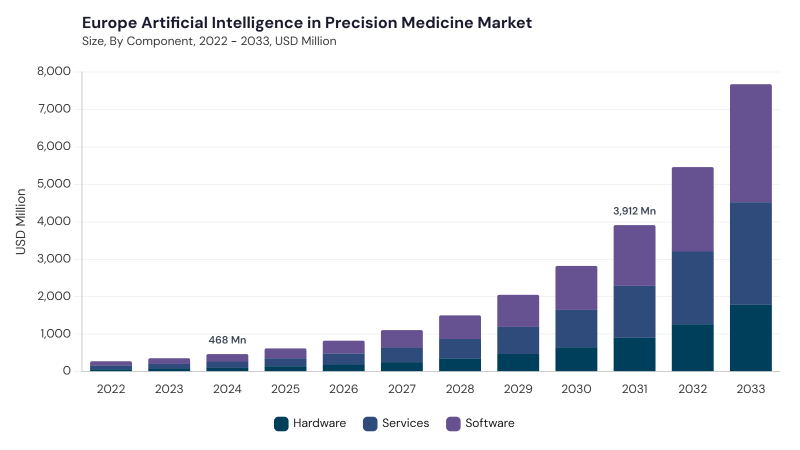
The Europe Artificial Intelligence In Precision Medicine Market is expected to reach USD 3.9 billion by 2031, growing at a CAGR of 37.5% during (2026 - 2033).
The Europe Artificial Intelligence In Precision Medicine Market evolved from early machine-learning applications in genetic and clinical data toward sophisticated AI platforms supporting personalized diagnostics, drug development, biomarker discovery, and treatment planning. Advances in high-throughput sequencing, medical imaging, multi-omics analytics, and healthcare data infrastructure expanded the volume and complexity of information available for AI interpretation. In-silico clinical trials, real-world evidence, and clinically integrated decision-support systems further strengthened commercialization. Regulatory frameworks emphasizing transparency, cybersecurity, data protection, and quality management are now shaping a structured ecosystem where AI increasingly supports precision oncology, hematology, rare diseases, and other personalized healthcare applications.
Multimodal AI, regulatory harmonization, collaborative data ecosystems, and AI-enabled drug development are shaping current market development. Healthcare organizations increasingly combine genomic, proteomic, imaging, clinical, and real-world datasets to improve patient stratification and treatment selection. Explainable AI, federated learning, privacy-preserving analytics, and compliant-by-design platforms are gaining importance as European regulations strengthen accountability and patient-data protection. Pharmaceutical companies are also applying AI to biomarker discovery, drug repurposing, clinical-trial design, and personalized therapeutics, while investments in interoperable data infrastructure and cross-institutional partnerships support wider clinical adoption.
Based on Component, the market is segmented into Software, Services, and Hardware. The Software market dominated the Europe Artificial Intelligence In Precision Medicine Market by Component in 2025, and would continue to be a dominant market till 2033; thereby, achieving a market value of USD 1.6 billion by 2031, growing at a CAGR of 36.9 % during the forecast period. The Services market is expected to witness a CAGR of 38% during (2026 - 2033). The Hardware market is expected to witness a CAGR of 37.9% during (2026 - 2033).
Software includes machine-learning models, data analytics platforms, clinical decision-support systems, biomarker discovery tools, treatment-response prediction, and patient-stratification applications designed to process complex biomedical and multi-omics datasets. Services include consulting, system integration, customization, data curation, regulatory support, validation, training, and post-deployment monitoring required to translate AI into clinical workflows. Hardware comprises GPUs, AI-specific processors, data-storage infrastructure, edge-computing systems, and AI-enabled medical imaging equipment that provide the computational capacity needed for secure, high-volume precision-medicine analytics.
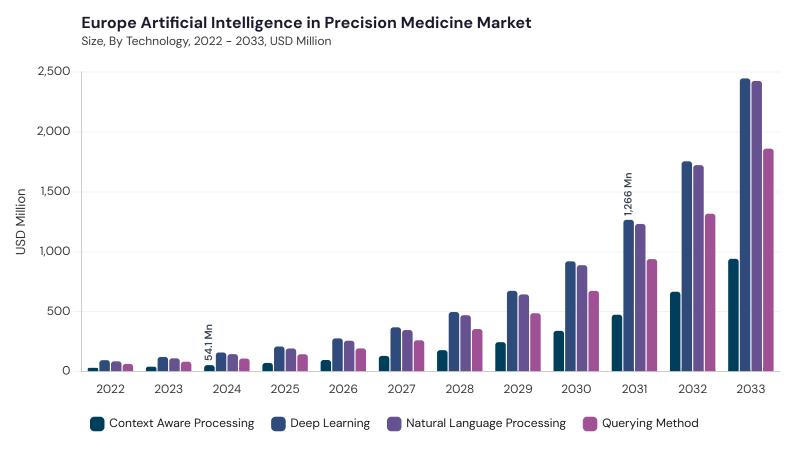
Based on Technology, the market is segmented into Deep Learning, Natural Language Processing, Querying Method, and Context Aware Processing. The Deep Learning market dominated the Europe Artificial Intelligence In Precision Medicine Market by Technology in 2025, and would continue to be a dominant market till 2033; thereby, achieving a market value of USD 1.2 billion by 2031, growing at a CAGR of 36.5 % during the forecast period. The Natural Language Processing market is expected to witness a CAGR of 37.8% during (2026 - 2033). Additionally, The Querying Method market is expected to witness highest CAGR of 38.2% during (2026 - 2033).
Deep Learning enables advanced analysis of medical imaging, genomics, pathology, and other high-dimensional biomedical datasets for disease classification, biomarker identification, and therapeutic prediction. Natural Language Processing converts unstructured clinical notes, pathology reports, electronic health records, and biomedical literature into structured insights supporting personalized care. Querying Method facilitates efficient retrieval and analysis of genomic, clinical, and therapeutic information from distributed biomedical repositories. Context Aware Processing incorporates real-time clinical status, treatment history, environmental information, and patient-specific variables to generate adaptive precision-medicine recommendations.
Based on Therapeutic Application, the market is segmented into Oncology, Cardiology, Neurology, Respiratory, and Other Therapeutic Application. Oncology represents the foremost therapeutic application within the Europe Artificial Intelligence In Precision Medicine Market, supported by extensive use of genomic, proteomic, histopathological, and imaging data for cancer detection, molecular classification, biomarker identification, and treatment-response prediction.
Cardiology applies AI to cardiovascular imaging, risk stratification, wearable monitoring, and personalized disease management, while Neurology uses multimodal analytics for early diagnosis, disease-progression assessment, and treatment planning. Respiratory applications include imaging analysis, phenotype identification, exacerbation prediction, and remote monitoring. Other Therapeutic Application includes immunology, infectious diseases, rare diseases, metabolic disorders, and other emerging precision-medicine fields.
Free Valuable Insights: The Worldwide Artificial Intelligence In Precision Medicine Market is projected to reach USD 31628.6 Million billion by 2033, at a CAGR of 37.8%
Based on Country, the market is segmented into Germany, UK, France, Russia, Spain, Italy, and Rest of Europe. The Germany market dominated the Europe Artificial Intelligence In Precision Medicine Market by Country in 2025, and would continue to be a dominant market till 2033; thereby, achieving a market value of USD 1.1 billion by 2031, growing at a CAGR of 36.2 % during the forecast period. The UK market is expected to witness a CAGR of 36.4% during (2026 - 2033). Additionally, The France market is expected to witness a CAGR of 38.5% during (2026 - 2033).
Across Europe, AI-enabled precision medicine is being shaped by multi-omics integration, explainable AI, federated learning, clinical-data interoperability, and regulatory alignment. Germany emphasizes real-time clinical decision support, multi-omics analytics, secure cloud infrastructure, and transparent AI, while the UK focuses on genomic integration, explainability, digital health platforms, wearables, and privacy-preserving analytics. France is advancing health-data ecosystems, companion diagnostics, laboratory automation, federated learning, and national AI-health initiatives, whereas Russia emphasizes integrated health datasets, predictive analytics, public-private collaboration, localization, and workforce development. Spain focuses on multimodal AI, oncology applications, data governance, explainability, and localized precision platforms, while Italy emphasizes big-data analytics, IoMT integration, ethical AI, predictive diagnostics, and patient-specific treatment. Rest of Europe continues to develop explainable AI, federated learning, human-tissue modeling, multi-omics analytics, localized platforms, and scalable privacy-preserving precision-medicine solutions.

By Component
By Technology
By Therapeutic Application
By Country
Set to reach $3.9 Billion by 2031, growing at 37.5% CAGR during 2026-2033.
Germany leads with $1.1 billion by 2031, at 36.2% CAGR during 2026-2033.
Software segment dominates, reaching $1.6 billion by 2031 at 36.9% CAGR during 2026-2033.
Deep Learning reaches $1.2 billion by 2031, growing at 36.5% CAGR during 2026-2033.
France market grows at 38.5% CAGR during 2026-2033.
Services segment grows at 38% CAGR during 2026-2033.
Our team of dedicated experts can provide you with attractive expansion opportunities for your business.




 Unique Offerings