The sample copy of this report is available for access.
“Global Enterprise Labeling Software Market to reach a market value of USD 1,930.2 Million by 2033 growing at a CAGR of 8.4%”
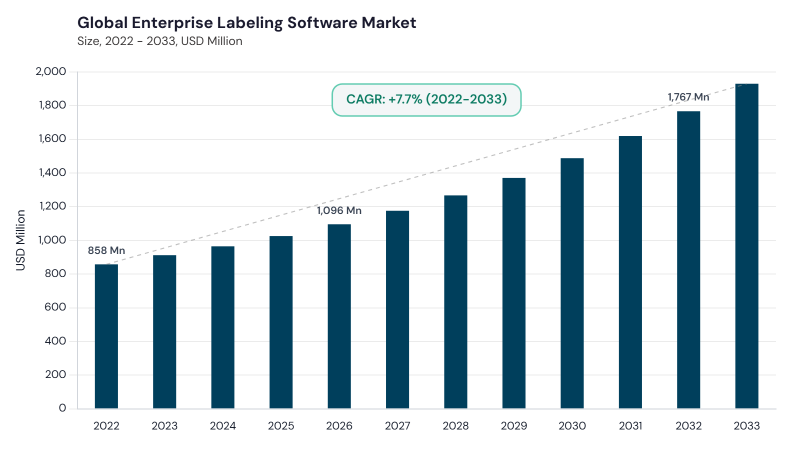
The Global Enterprise Labeling Software Market size is expected to reach USD 1,930.2 million by 2033, rising at a market growth of 8.4% CAGR during the forecast period.
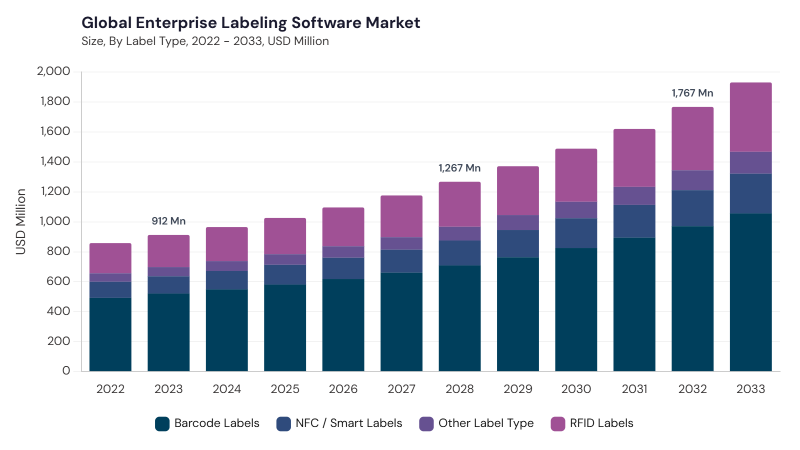
Growth in the market is driven by increasing regulatory compliance requirements, rising adoption of cloud-based enterprise software, and growing demand for supply chain traceability across industries such as manufacturing, retail, healthcare, logistics, and FMCG. Organizations are increasingly adopting enterprise labeling software to automate labeling workflows, reduce operational errors, improve inventory visibility, and ensure global compliance standards. Furthermore, the integration of AI, IoT, RFID, and cloud technologies into enterprise labeling ecosystems is accelerating digital transformation initiatives and improving operational efficiency across enterprise environments.
Today, technologies such as artificial intelligence, machine learning, cloud deployment, RFID integration, and IoT-enabled supply chains are at the core of market growth. Enterprises are increasingly deploying enterprise labeling solutions to improve operational visibility, reduce labeling errors, optimize inventory management, strengthen regulatory compliance, and support digital transformation initiatives.
The major strategies followed by market participants are Product Launches, Partnerships & Collaborations, Cloud Integration, and Geographic Expansion to strengthen their competitive positioning. For instance, in April 2023, SATO launched an NFC/HF RFID encoding solution integrated with NiceLabel software, enabling enterprises to design, encode, and print smart labels within a unified workflow. Additionally, in January 2023, Loftware expanded its SAP S/4HANA integration ecosystem through structured training programs to strengthen interoperability between enterprise systems and labeling platforms.
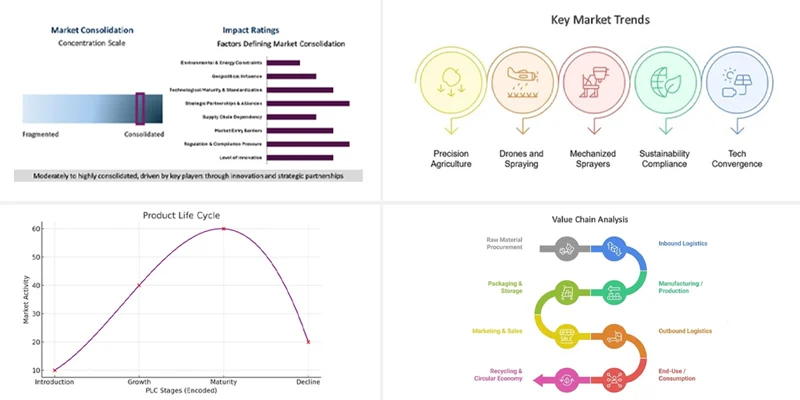

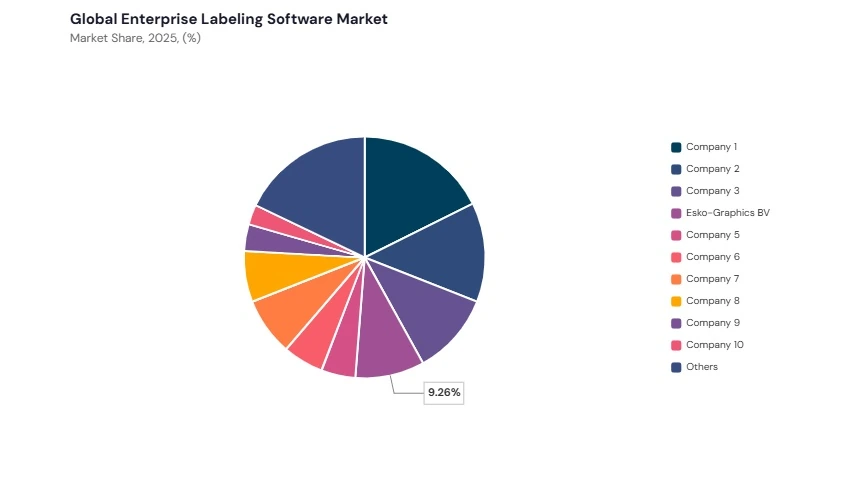
The Enterprise Labeling Software Market remains moderately consolidated with companies such as Loftware, Seagull Scientific, TEKLYNX, Zebra Technologies, and Honeywell International, Inc. maintaining strong market presence through cloud-native labeling platforms, AI-enabled automation, RFID integration, and enterprise compliance management solutions. Vendors are increasingly focusing on ERP interoperability, centralized label management, supply chain traceability, and strategic partnerships to strengthen competitive positioning globally.
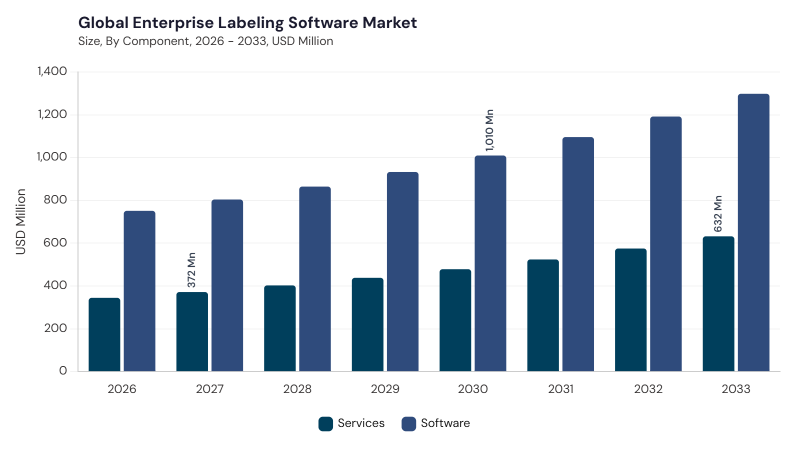
On the basis of component, the Enterprise Labeling Software Market is classified into Software and Services. The Software segment dominated the market in 2025 with a revenue share of 68.71%. The growth is driven by increasing demand for centralized label management, automated compliance systems, cloud-based deployments, and enterprise-wide integration capabilities. Organizations are increasingly implementing advanced software platforms to streamline label generation, inventory management, shipping operations, and regulatory compliance workflows.
Based on Label Type, the market is segmented into Barcode Labels, RFID Labels, NFC / Smart Labels, and Other Label Types. Barcode Labels dominated the market in 2025 owing to their widespread adoption across inventory management, warehousing, manufacturing, and logistics applications, accounting for a 56.64% revenue share. RFID Labels are also witnessing strong growth driven by increasing adoption of real-time asset tracking, IoT-enabled supply chains, and warehouse automation systems. NFC / Smart Labels are gaining traction across retail, healthcare, and premium consumer goods industries owing to growing demand for product authentication, consumer engagement, and connected packaging solutions.
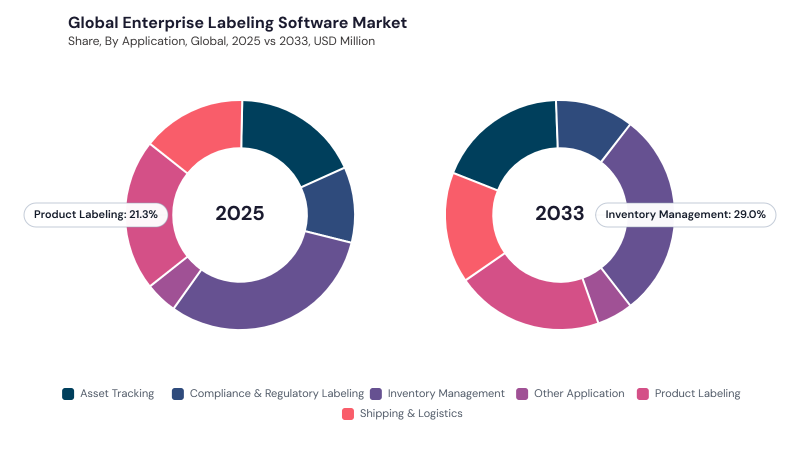
Based on Application, the market is segmented into Inventory Management, Product Labeling, Asset Tracking, Shipping & Logistics, Compliance & Regulatory Labeling, and Other Applications. Inventory Management dominated the market in 2025 driven by increasing enterprise focus on warehouse automation, inventory visibility, and supply chain optimization, accounting for a 30.94% revenue share. Asset Tracking and Shipping & Logistics applications are also witnessing substantial growth due to rising adoption of RFID technologies, cloud-enabled supply chain systems, and real-time product monitoring solutions. Compliance & Regulatory Labeling remains a critical application area, especially across healthcare, pharmaceuticals, food & beverage, and industrial manufacturing industries where strict regulatory requirements continue to drive software adoption.
By End-use, the market is divided into Manufacturing, Retail & E-commerce, FMCG, Healthcare, Logistics & Transportation, Automotive, and Other End-use. Manufacturing dominated the global market in 2025 owing to increasing automation initiatives, production traceability requirements, and growing adoption of Industry 4.0 technologies, accounting for a 27.44% market share globally. Retail & E-commerce and FMCG sectors are also major adopters of enterprise labeling software due to increasing demand for product identification, inventory visibility, order fulfillment optimization, and omnichannel retail operations. Meanwhile, healthcare organizations continue deploying advanced labeling platforms to ensure pharmaceutical traceability, medical device compliance, and patient safety.
Region-wise, the Enterprise Labeling Software Market is analyzed across North America, Europe, Asia Pacific, and LAMEA. North America dominated the market in 2025 accounting for a 37.72% revenue share. The region benefits from advanced enterprise IT infrastructure, strong regulatory compliance frameworks, high adoption of cloud technologies, and increasing investments in supply chain automation.
Europe also maintains a significant market presence supported by stringent labeling regulations, digital transformation initiatives, and increasing enterprise focus on sustainability and traceability. Asia Pacific is emerging as the fastest-growing region driven by rapid industrialization, manufacturing expansion, increasing cloud adoption, and rising digital supply chain investments across China, India, Japan, and Southeast Asia.
The Enterprise Labeling Software Market is moderately competitive and characterized by continuous innovation in AI-enabled automation, cloud-native deployments, compliance management, and ERP interoperability. Vendors differentiate themselves through advanced label management capabilities, RFID integration, predictive analytics, and centralized compliance automation systems. Strategic partnerships with ERP providers, industrial automation firms, cloud infrastructure companies, and supply chain solution providers significantly influence competitive positioning.
Enterprise Labeling Software Market Coverage:
| Report Attribute | Details |
|---|---|
| Market size value in 2026 | USD 1,095.8 Million |
| Market size forecast in 2033 | USD 1,930.2 Million |
| Base Year | 2024 |
| Historical period | 2022 to 2024 |
| Forecast Period | 2025 to 2033 |
| Revenue Growth Rate | CAGR of 8.4% from 2025 to 2033 |
| Number of Pages | 758 |
| Tables | 900 |
| Report Coverage | Market Trends, Revenue Estimation and Forecast, Segmentation Analysis, Regional and Country Breakdown, Competitive Landscape, Market Share Analysis, Porter’s 5 Forces Analysis, Company Profiling, Companies Strategic Developments, SWOT Analysis, Winning Imperatives |
| Segments Covered | Component, Label Type, Application, End-use, Region |
| Country Scope |
|
| Companies Included | Loftware, Seagull Scientific, TEKLYNX, Zebra Technologies, Honeywell International, Inc., SATO Holdings, Avery Dennison Corporation, Cognex Corporation, CYBRA Corporation, Esko |
By Component
By Label Type
By Application
By End-use
By Geography
Market value will reach USD 1,930.27 Million by 2033, growing at 8.4% CAGR during the forecast period.
Software dominates with 68.71% revenue share in 2025, fueled by centralized label management and cloud-based deployments.
Loftware, Seagull Scientific, TEKLYNX, Zebra Technologies, and Honeywell International hold the dominant positions in this space.
North America leads with 37.72% revenue share in 2025, backed by advanced enterprise IT infrastructure.
Regulatory compliance pressures, AI automation integration, and cloud-based scalable labeling solutions adoption are pushing expansion.
Barcode Labels command 56.64% revenue share in 2025, supported by widespread inventory and logistics applications.
Our team of dedicated experts can provide you with attractive expansion opportunities for your business.






 Unique Offerings