“Global Dock And Yard Management Systems Market to reach a market value of 8.85 Billion by 2032 growing at a CAGR of 11.5%”
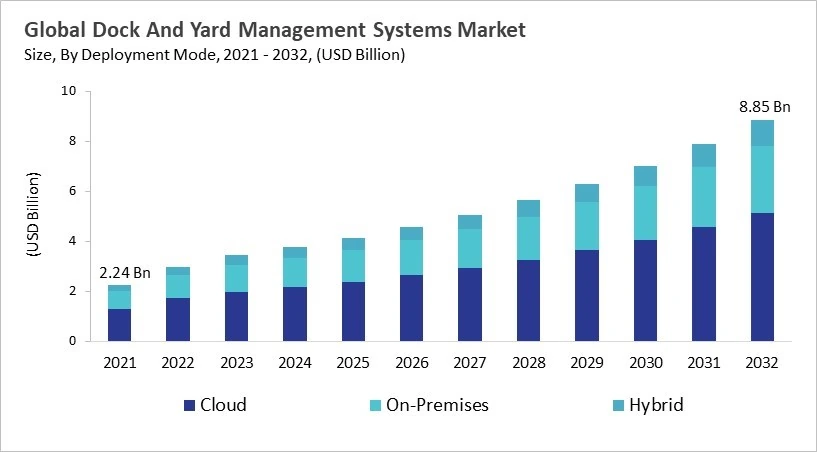
The Global Dock And Yard Management Systems Market size is estimated at $4.13 billion in 2025 and is expected to reach $8.85 billion by 2032, rising at a market growth of 11.5% CAGR during the forecast period (2025-2032). This growth is due to more automated warehouses, more complicated e-commerce logistics, and a need for real-time visibility in dock operations. Integration with AI, IoT, and cloud platforms makes things work better and speeds up the process, which makes people more likely to use it.
The dock and yard management systems market has evolved from the requirement to enhance efficiency in yard operations and warehouse docks, which initially were managed through paper-based processes and basic scheduling tools. These early methods resulted in congestion, delays, and poor utilization of resources. With the growth of digital technologies, the dock and yard management systems market has developed toward integrated and automated solutions, combining hardware like sensors with software platforms for real-time tracking. The transportation management systems (TMS) and integration of warehouse management systems (WMS) further surge this evolution, allowing more data-driven and advanced dock and yard operations. The market is shaped by AI-powered systems that support dynamic scheduling, predictive analytics, and improved operational visibility, addressing both compliance and efficiency needs in increasingly complex supply chains.
The dock and yard management systems market is shaped by factors including the adoption of machine learning and AI for predictive optimization, enabling companies to proactively reduce delays and manage demand fluctuations. The rising use of automation tools and dock scheduling has enhanced synchronization of freight movements, improving overall supply chain performance and minimizing bottlenecks. Moreover, the shift toward scalable, cloud-based platforms has allowed rapid deployment and flexibility across regional and global operations. Key market players focus on innovation through real-time analytics, AI-driven features, and automation, often supported by partnerships with WMS, ERP, and TMS providers.

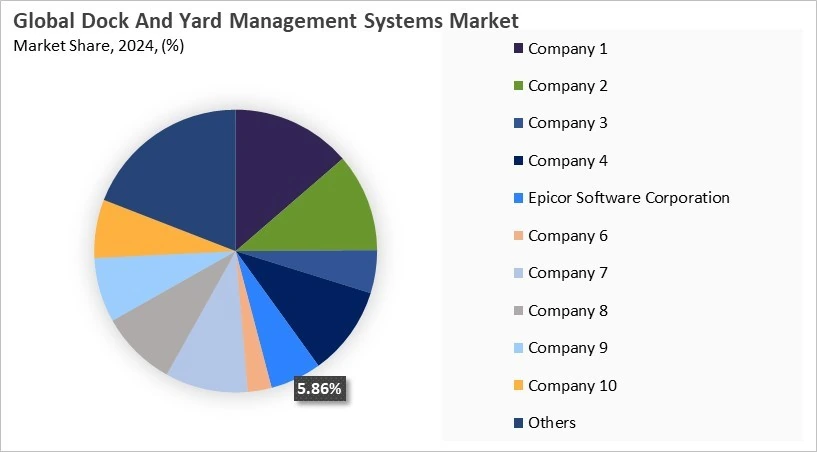
The leading players in the market are competing with diverse innovative offerings to remain competitive in the market. The above illustration shows the percentage of revenue shared by some of the leading companies in the market. The leading players of the market are adopting various strategies in order to cater demand coming from the different industries. The key developmental strategies in the market are Acquisitions, and Partnerships & Collaborations.
Before COVID-19, the market for dock and yard management systems grew steadily because trade volumes were rising and supply chains were getting more complicated. The pandemic changed this path by closing ports, causing labor shortages, and limiting transportation. This caused congestion, lower throughput, and less efficient operations. Demand was also affected by changing shipping patterns and a lack of available workers on-site. But the crisis sped up digital transformation by making more people use automation, cloud-based platforms, and real-time tracking solutions to keep operations running smoothly. It also led to new ideas in AI-powered analytics and predictive tools that help manage disruptions better. As recovery went on, the market bounced back with a stronger focus on resilience, agility, and advanced technological integration. This was a sign of an overall adverse impact that would have long-term, transformative benefits. Thus, the COVID-19 pandemic had a negative impact on the Dock and Yard Management Systems Market.
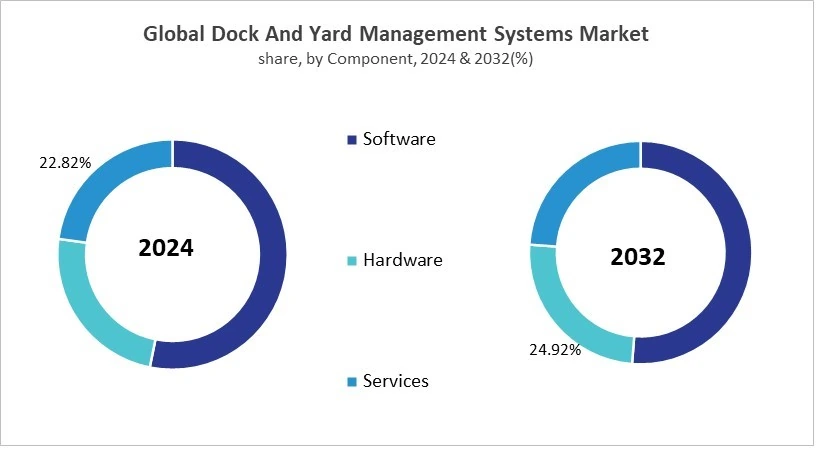
Based on Component, the market is segmented into Software, Hardware and Services. The Hardware segment accounted for 24.01% of the Dock and Yard Management Systems Market in 2024. The demand for hardware components such as sensors, RFID devices, and tracking systems supports yard automation and real-time monitoring. These technologies play a crucial role in improving operational accuracy and asset tracking.
Based on Deployment Mode, the market is segmented into Cloud, On-Premises and Hybrid. The On-Premises segment accounted for 31.15% of the Dock and Yard Management Systems Market in 2024. This deployment model is preferred by organizations requiring greater control over data security and system customization, particularly in regulated industries.
Free Valuable Insights: Dock And Yard Management Systems Market Size to reach $8.85 by 2032
Region-wise, the Dock and Yard Management Systems Market is analyzed across North America, Europe, Asia Pacific, and LAMEA. The North America segment held a 36.62% share in the Dock and Yard Management Systems Market in 2024. The dock and yard management systems market is anticipated to expand at a significant rate in the North America and Europe regions. The market growth is supported by large-scale distribution networks, highly developed logistics infrastructure, and strong e-commerce demand. Enterprises in Canada and the US are early adopters of IoT-enabled yard visibility, AI-driven scheduling, and automated gate systems to optimize labor utilization, reduce dwell times, and enhance throughput efficiency. High detention costs and labor shortages further spur the adoption of advanced solutions. Moreover, Europe dock and yard management systems market is predicted to grow at a steady pace. The market is driven by stringent regulatory frameworks, dense cross-border trade, and sustainability mandates. The region prioritizes emissions reduction, optimized scheduling, and multimodal logistics integration, with nations such as France, Germany, and the UK investing largely in digital freight ecosystems and smart logistics platforms.
In the Asia Pacific and LAMEA region, the dock and yard management systems market is estimated to experience noticeable growth. This is because of expanding e-commerce, rapid industrialization, and large-scale investments in port infrastructure and smart logistics ecosystems across nations like India, China, and Southeast Asia. The region’s expanding warehouse networks and high cargo volumes are accelerating the adoption of automation, digital yard visibility, and mobile-first solutions to manage high-throughput operations. Additionally, LAMEA’s dock and yard management systems market is offering lucrative opportunities, driven by logistics corridor development, port modernization, and rising investments in free trade zones, especially in nations such as Saudi Arabia, Brazil, and the UAE. The demand is increasing for scalable, cost-effective, and cloud-based solutions that can modernize yard operations without the need of extensive infrastructure upgrades.
| Report Attribute | Details |
|---|---|
| Market size value in 2025 | USD 4.13 Billion |
| Market size forecast in 2032 | USD 8.85 Billion |
| Base Year | 2024 |
| Historical period | 2021 to 2023 |
| Forecast Period | 2025 to 2032 |
| Revenue Growth Rate | CAGR of 11.5% from 2025 to 2032 |
| Number of Pages | 501 |
| Tables | 385 |
| Report Coverage | Market Trends, Revenue Estimation and Forecast, Segmentation Analysis, Regional and Country Breakdown, Market Share Analysis, Porter’s 5 Forces Analysis, Company Profiling, Companies Strategic Developments, SWOT Analysis, Winning Imperatives |
| Segments Covered | Component, Deployment Mode, Industry Vertical, Region |
| Country Scope |
|
| Companies Included | Zebra Technologies Corporation, Oracle Corporation, Informatica Inc., SAP SE, Epicor Software Corporation, Conduit, Inc., Manhattan Associates, Inc., Blue Yonder Group, Inc. (Panasonic Holdings Corporation), The Descartes Systems Group, Inc., and Kaleris |
By Component
By Deployment Mode
By Industry Vertical
By Geography
Valued at USD 4.13 billion in 2025, reaching USD 8.85 billion by 2032 at 11.5% CAGR during 2025-2032.
Cloud segment dominates, achieving a market value of $5.1 billion by 2032.
Zebra Technologies Corporation, Oracle Corporation, Informatica Inc., SAP SE, and Epicor Software Corporation hold dominant positions.
North America leads with $3.1 billion by 2032; Europe grows at 11.1% CAGR during 2025-2032.
Retail & E-commerce segment grows at 10.5% CAGR during the forecast period.
Software segment experiences 11% CAGR during the forecast period.
Our team of dedicated experts can provide you with attractive expansion opportunities for your business.








 Unique Offerings