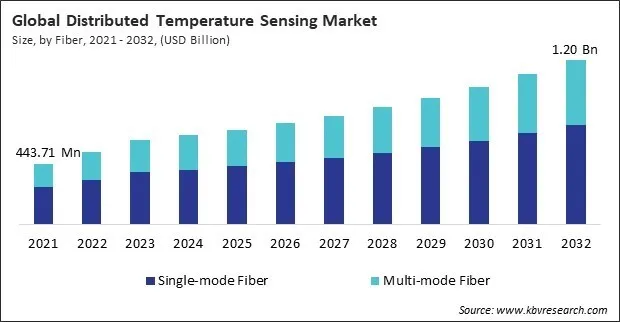
“Global Distributed Temperature Sensing Market to reach a market value of USD 1.20 Billion by 2032 growing at a CAGR of 8.2%”
The Global Distributed Temperature Sensing Market size is expected to reach $1.20 billion by 2032, rising at a market growth of 8.2% CAGR during the forecast period.
The growing demand for reliable power transmission and distribution has made Distributed Temperature Sensing (DTS) systems essential for power cable monitoring. These systems provide real-time, continuous temperature data along the entire length of underground, overhead, and submarine power cables. DTS systems utilize fiber optic cables integrated with the power infrastructure to detect abnormal temperature rises, predict overload conditions, and prevent potential cable failures. Power cables, especially in densely populated urban areas and remote renewable energy installations, are critical assets. Any failure or downtime can lead to costly outages, system inefficiencies, and regulatory penalties. DTS provides utilities and grid operators with a non-intrusive, maintenance-friendly solution to proactively monitor these assets, enhancing the overall reliability, safety, and operational efficiency of the power grid.
One of the most critical safety applications of DTS technology in the oil and gas industry is its use for leak detection. Pipelines, which transport oil, gas, and chemicals over vast distances, are prone to corrosion, mechanical damage, or operational failures that may lead to leaks. Leaks, if undetected, can cause catastrophic environmental disasters, jeopardize community safety, and result in hefty financial penalties. DTS systems address this challenge by continuously scanning the entire length of the pipeline for temperature changes that indicate the presence of a leak. By enabling early detection, DTS empowers operators to take swift corrective action, thereby minimizing environmental impact, mitigating safety risks, and preventing costly downtime.
Additionally, the integration of Distributed Temperature Sensing (DTS) technology into smart grid infrastructure is revolutionizing the way utilities monitor and manage power distribution networks. DTS systems utilize fiber optic cables to provide continuous, real-time temperature profiles along power lines, transformers, and substations. This capability is crucial for detecting thermal anomalies, preventing equipment failures, and enhancing the overall reliability and efficiency of the electrical grid. In conclusion, the integration of Distributed Temperature Sensing technology into smart grid infrastructure offers significant advantages in terms of reliability, efficiency, and sustainability. By providing continuous, real-time temperature monitoring, DTS systems empower utilities to proactively manage their networks, optimize asset utilization, and respond swiftly to emerging issues.
However, the global adoption of Distributed Temperature Sensing (DTS) technology faces significant restraint due to high initial investment and operational costs. DTS systems, which utilize fiber-optic cables to provide continuous temperature monitoring over extensive distances, are integral in industries such as oil and gas, power generation, and infrastructure. However, the substantial capital required for deployment and the ongoing expenses associated with operation and maintenance pose challenges to widespread implementation. In summary, while high initial investment and operational costs hinder the global proliferation of DTS technology, strategic planning and technological advancements hold the potential to overcome these financial obstacles, enabling broader adoption across various sectors.
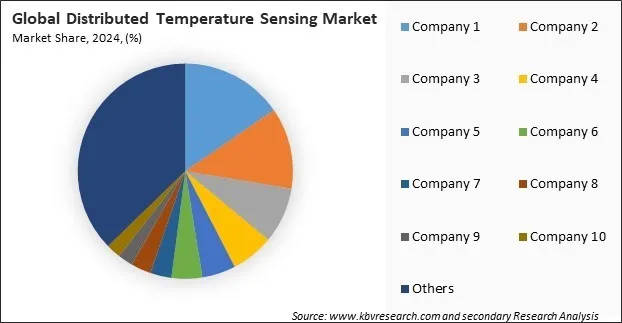
The leading players in the market are competing with diverse innovative offerings to remain competitive in the market. The above illustration shows the percentage of revenue shared by some of the leading companies in the market. The leading players of the market are adopting various strategies in order to cater demand coming from the different industries. The key developmental strategies in the market are Acquisitions, and Partnerships & Collaborations.

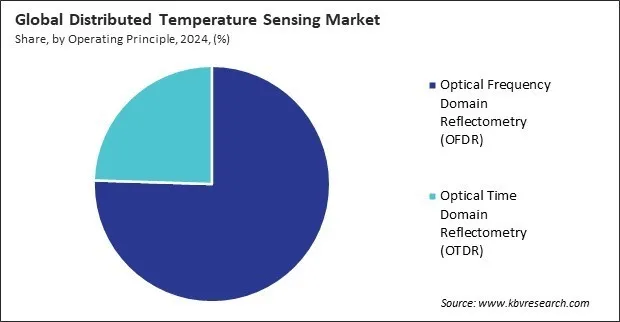
Based on Operating Principle, the market is segmented into Optical Frequency Domain Reflectometry (OFDR) and Optical Time Domain Reflectometry (OTDR). Optical Frequency Domain Reflectometry (OFDR) is an advanced distributed sensing technology that leverages the interference of light waves to measure backscattered signals within optical fibers. Unlike traditional point sensors, OFDR provides high-resolution, continuous temperature profiles along the length of the fiber, offering precise data over short to medium ranges. This operating principle uses tunable lasers to vary the frequency and accurately analyze Rayleigh backscatter, enabling the detection of even minor changes in temperature and strain.
Based on Fiber, the market is segmented into Single-mode Fiber and Multi-mode Fiber. Multi-mode fiber is another important segment within the distributed temperature sensing (DTS) market, particularly where short to medium distance monitoring is sufficient. With a larger core diameter, usually around 50 to 62.5 microns, multi-mode fiber supports multiple modes of light propagation, making it suitable for applications where lower range but higher power backscatter signals are advantageous.
Based on Application, the market is segmented into Oil & Gas, Power Cable Monitoring, Process & Pipeline Monitoring, Fire Detection, Environmental Monitoring, and Other Application. The oil & gas industry has been a pivotal adopter of Distributed Temperature Sensing (DTS) technology due to its unparalleled ability to provide continuous, real-time, and long-distance temperature monitoring.
Free Valuable Insights: Global Distributed Temperature Sensing Market size to reach USD 1.20 Billion by 2032
The geographies included in the report are North America, Europe, Asia Pacific, and Latin America, Middle East & Africa. The Asia-Pacific region is witnessing a significant expansion in its oil and gas sector, driven by increasing energy demands and the exploration of new reserves. Countries like China, India, and Australia are investing heavily in upstream and downstream activities, necessitating advanced monitoring solutions to ensure operational efficiency and safety.
| Report Attribute | Details |
|---|---|
| Market size value in 2024 | USD 651.40 Million |
| Market size forecast in 2032 | USD 1.20 Billion |
| Base Year | 2024 |
| Historical Period | 2021 to 2023 |
| Forecast Period | 2025 to 2032 |
| Revenue Growth Rate | CAGR of 8.2% from 2025 to 2032 |
| Number of Pages | 348 |
| Number of Tables | 362 |
| Report coverage | Market Trends, Revenue Estimation and Forecast, Segmentation Analysis, Regional and Country Breakdown, Market Share Analysis, Porter’s 5 Forces Analysis, Company Profiling, Companies Strategic Developments, SWOT Analysis, Winning Imperatives |
| Segments covered | Operating Principle, Fiber, Application, Region |
| Country scope |
|
| Companies Included | Schlumberger Limited, Halliburton Company, Yokogawa Electric Corporation, Weatherford International PLC, Sumitomo Electric Industries, Ltd., Prysmian Group, Bandweaver Technology Ltd., AP Sensing GmbH, Optromix, Inc., and Viavi Solutions, Inc. |
By Operating Principle
By Fiber
By Application
By Geography
This Market size is expected to reach $1.20 billion by 2032.
Enhanced Safety and Operational Efficiency in the Oil & Gas Industry are driving the Market in coming years, however, High Initial Investment and Operational Costs: restraints the growth of the Market.
Schlumberger Limited, Halliburton Company, Yokogawa Electric Corporation, Weatherford International PLC, Sumitomo Electric Industries, Ltd., Prysmian Group, Bandweaver Technology Ltd., AP Sensing GmbH, Optromix, Inc., and Viavi Solutions, Inc.
The expected CAGR of this Market is 8.2% from 2023 to 2032.
The Single-mode Fiber segment is leading the Market by Fiber in 2024; thereby, achieving a market value of $728.6 million by 2032.
The North America region dominated the Market by Region in 2024, and would continue to be a dominant market till 2032; thereby, achieving a market value of $389.1 million by 2032.
Our team of dedicated experts can provide you with attractive expansion opportunities for your business.








 Unique Offerings