“Global Direct-to-chip Liquid Cooling Market to reach a market value of 7.48 Billion by 2032 growing at a CAGR of 19.4%”
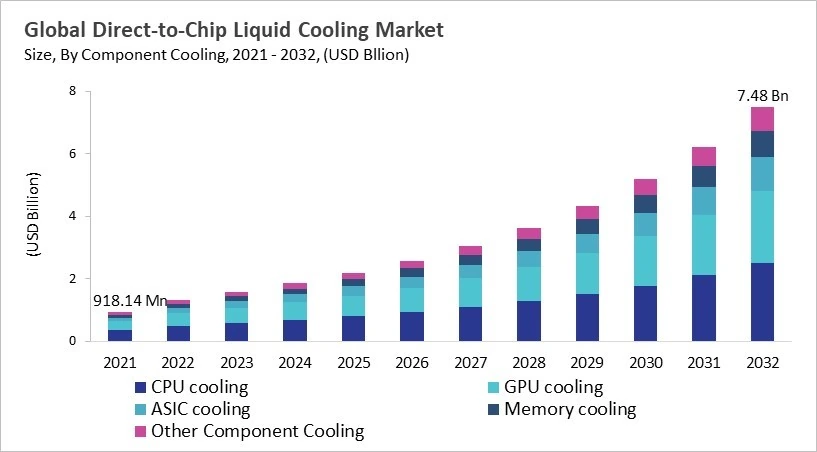
The Global Direct-to-Chip Liquid Cooling Market size is estimated at $2.16 billion in 2025 and is expected to reach $7.48 billion by 2032, rising at a market growth of 19.4% CAGR during the forecast period (2025-2032). The growth of the Direct-to-Chip Liquid Cooling Market is driven by the rapid expansion of high-performance computing, data centers, and AI workloads that generate significant heat. Increasing demand for energy-efficient cooling solutions, rising chip power densities, and sustainability goals are encouraging adoption of advanced liquid cooling technologies, supporting strong market expansion through 2032.
The direct-to-chip liquid cooling market is developed in response to the rising requirement to manage escalating heat levels in high-performance computing environments, especially as traditional air-cooling methods became incompatible for modern workloads like high-density data processing and AI. This technology has noticeably enhanced dissipation efficiency, developing from early cold plate systems into advanced two-phase and microchannel designs. Innovations in material science and fluid dynamics improved system reliability, enabled scalable deployments, and minimized leakage risks. With the increasing application of machine learning and AI, direct-to-chip liquid cooling shifted from a niche adoption to a critical solution, largely implemented in data centers to support high computational densities and assure operational stability.
The direct-to-chip liquid cooling market is driven by factors such as rising adoption of two-phase cooling systems to meet the demands of high-density chips, the integration of liquid cooling into AI-enabled infrastructure to prevent performance degradation, and overheating. Sustainability has further become a major focus, thereby promoting the development of closed-loop, energy-efficient, and recyclable cooling systems that reduce environmental impact. Key market players are investing in partnerships, innovations, and real-time monitoring technologies to improve system performance and scalability. The market’s intensive competitive landscape drives cost-optimization and continued advancements, with companies positioning themselves ahead through customization capabilities, proprietary technologies, and integrated solutions.
The major strategies followed by the market participants are Product Launches as the key developmental strategy to keep pace with the changing demands of end users. For instance, In March, 2025, Vertiv Group Corp. unveiled a new high-density heat rejection system designed to support liquid and air cooling, tailored for AI and high-performance computing environments. This flexible solution addresses evolving thermal demands in data centers, enabling efficient hybrid cooling to manage rising power densities and maintain optimal performance for advanced AI workloads. Additionally, In March, 2025, CoolIT Systems Inc. unveiled a groundbreaking 4000W direct liquid cooling (DLC) solution, setting a new benchmark for single-phase DLC in managing ultra-high-wattage AI processors. This innovation enhances thermal management efficiency, addressing the growing power demands of next-gen AI hardware while improving system performance, reliability, and energy savings in data centers.
Based on the Analysis presented in the KBV Cardinal matrix; Schneider Electric SE is the forerunner in the Direct-to-chip Liquid Cooling Market. Companies such as Advanced Micro Devices, Inc., Fujitsu Limited, and JETCOOL Technologies Inc. are some of the key innovators in Direct-to-chip Liquid Cooling Market. In May, 2025, JETCOOL Technologies Inc. unveiled advanced liquid cooling systems that cut IT power usage by 15% without requiring facility upgrades. These solutions enhance energy efficiency and thermal management in data centers, offering a cost-effective and sustainable alternative to traditional cooling methods while supporting growing computing demands.
Before the COVID-19 pandemic, the Direct-to-Chip Liquid Cooling Market was gradually expanding due to increasing data center demand and the need for efficient thermal management in high-performance computing environments. During the pandemic, supply chain disruptions and manufacturing constraints delayed equipment availability and project deployments. Remote work restrictions also limited on-site installation and maintenance activities, while economic uncertainty temporarily reduced capital investments. However, accelerated digital transformation, rising cloud computing, and increased AI workloads boosted demand for high-density and energy-efficient cooling solutions. As markets recovered, supply chains stabilized and adoption of liquid cooling strengthened. Post-pandemic, the market saw greater integration with AI-driven thermal management and broader acceptance in next-generation data centers. Thus, the COVID-19 pandemic had a negative impact on the Direct-to-chip Liquid Cooling Market, accelerating innovation while disrupting traditional operations.

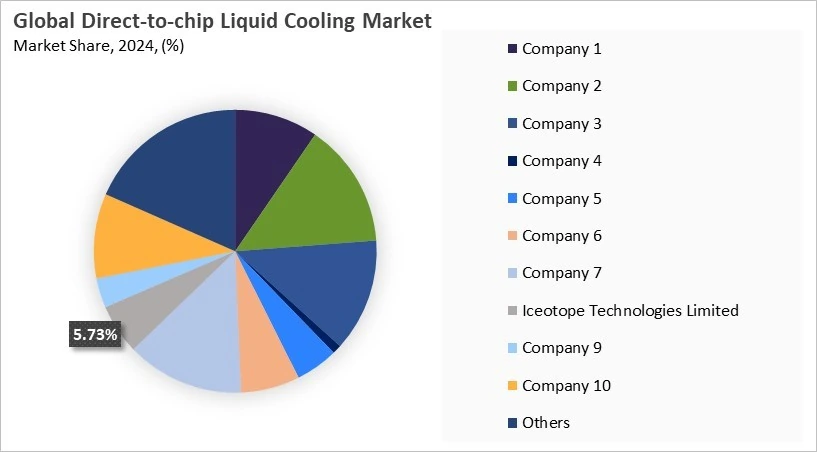
The leading players in the market are competing with diverse innovative offerings to remain competitive in the market. The above illustration shows the percentage of revenue shared by some of the leading companies in the market. The leading players of the market are adopting various strategies in order to cater demand coming from the different industries. The key developmental strategies in the market are Acquisitions, and Partnerships & Collaborations.
Based on component cooling, the direct-to-chip liquid cooling market is characterized into CPU cooling, GPU cooling, ASIC cooling, memory cooling and other component cooling. The GPU cooling segment attained 31% revenue share in the direct-to-chip liquid cooling market in 2024. The GPU cooling segment is a key area within the global direct-to-chip liquid cooling market, fueled by the growing demand for graphics processing in applications such as artificial intelligence, machine learning, and data analytics. GPUs generate significant heat due to their parallel processing capabilities, making advanced cooling solutions critical for optimal performance.
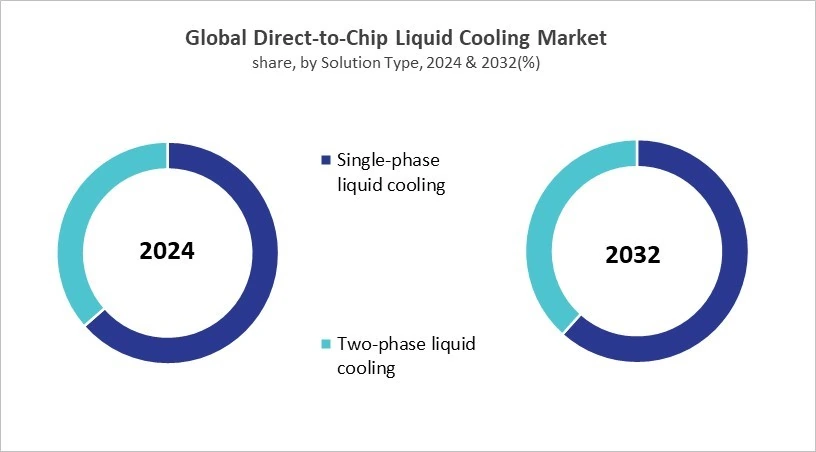
On the basis of solution type, the direct-to-chip liquid cooling market is classified into single-phase liquid cooling and two-phase liquid cooling. The two-phase liquid cooling segment recorded 36% revenue share in the direct-to-chip liquid cooling market in 2024. The two-phase liquid cooling segment is an advanced solution in the global direct-to-chip liquid cooling market, characterized by its ability to handle extremely high heat densities through phase change processes. In this approach, the coolant absorbs heat and transitions from liquid to vapor, enabling highly efficient thermal transfer.
Free Valuable Insights: Direct-to-Chip Liquid Cooling Market Size to reach $7.48 by 2032
Region-wise, the direct-to-chip liquid cooling market is analyzed across North America, Europe, Asia Pacific, and LAMEA. The North America segment recorded 39% revenue share in the direct-to-chip liquid cooling market in 2024. In North America, the direct-to-chip liquid cooling market is estimated to experience substantial expansion. This is because of the strong presence of hyperscale data centers, advanced AI infrastructure, and cloud providers. The region further benefits from noticeable investments by major tech giants and early adoption of high-performance computing technologies. Sustainability regulations, supportive government initiatives, and incentives for green data centers further surge adoption. Additionally, Europe direct-to-chip liquid cooling market is expected to grow at a significant rate, driven by carbon neutrality goals, strict environmental policies, and rising deployment of energy-efficient data centers. Nations like the UK, Germany, and France are prioritizing sustainable infrastructure, which supports the usage of advanced cooling technologies.
The direct-to-chip liquid cooling market is projected to capture prominent growth during the forecast period. The regional market is propelled by expending data centre capacity, rapid digital transformation, and rising adoption of could computing, AI, and high-performance computing across nations such as Japan, South Korea, China, and India. Further, the regional market is driven by increasing investment in IT and telecom infrastructure, government supported digital initiatives. Moreover, LAMEA's direct-to-chip liquid cooling market is anticipated to represent lucrative opportunities during the projection period. The statement is supported by surging data center ecosystems in Saudi Arabia and Brazil. Also, rising awareness of energy efficient technologies and sustainability priorities continues to result in accelerating demand across Latin America and the Middle East.
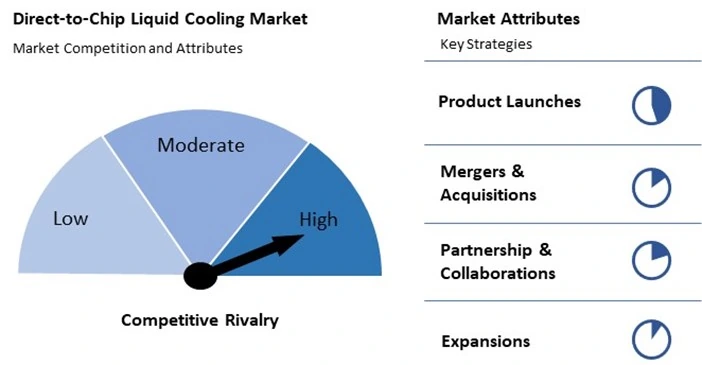
The Direct-to-Chip Liquid Cooling Market is characterized by intense competition driven by rapid technological innovation and the growing demand for efficient thermal management in high-performance computing and data centers. Market participants focus on enhancing cooling efficiency, scalability, and energy optimization to differentiate their solutions. Competitive dynamics are influenced by the increasing adoption of AI workloads, hyperscale data centers, and sustainable cooling practices. Providers compete through advanced engineering, improved system integration, and cost-effective deployment models while continuously investing in research and development to address evolving performance and energy efficiency requirements.
| Report Attribute | Details |
|---|---|
| Market size value in 2025 | USD 2.16 Billion |
| Market size forecast in 2032 | USD 7.48 Billion |
| Base Year | 2024 |
| Historical period | 2021 to 2023 |
| Forecast Period | 2025 to 2032 |
| Revenue Growth Rate | CAGR of 19.4% from 2025 to 2032 |
| Number of Pages | 723 |
| Tables | 619 |
| Report Coverage | Market Trends, Revenue Estimation and Forecast, Segmentation Analysis, Regional and Country Breakdown, Competitive Landscape, Market Share Analysis, Porter’s 5 Forces Analysis, Company Profiling, Companies Strategic Developments, SWOT Analysis, Winning Imperatives |
| Segments Covered | Component Cooling, Application, Solution Type, Liquid Coolant Type, End-Use Industry, Region |
| Country Scope |
|
| Companies Included | Asetek Inc. A/S, Vertiv Group Corp., Schneider Electric SE, Advanced Micro Devices, Inc., Chilldyne, Inc., Fujitsu Limited, CoolIT Systems Inc., Iceotope Technologies Limited, JETCOOL Technologies Inc. (FLEX LTD.) and LiquidStack Holding B.V. (Bitfury Group Limited) |
By Component Cooling
By Application
By Solution Type
By Liquid Coolant Type
By End-Use Industry
By Geography
Valued at USD 2.16 billion in 2025, reaching USD 7.48 billion by 2032, growing at 19.4% CAGR during 2025-2032.
Data centers segment leads the market, achieving a value of $3.14 billion by 2032.
Asetek Inc. A/S, Vertiv Group Corp., Schneider Electric SE, and Advanced Micro Devices, Inc. hold dominant positions.
North America leads at $2.74 billion by 2032; Europe grows at 18.9% CAGR during 2025-2032.
Rising AI and high-performance computing demand, plus efficiency-driven data center thermal management solutions fuel expansion.
Water-based coolants segment reaches $2.11 billion by 2032, leading due to high thermal conductivity and cost-effectiveness.
Our team of dedicated experts can provide you with attractive expansion opportunities for your business.








 Unique Offerings