
“Global Data Annotation Tools Market to reach a market value of USD 15867.99 Million by 2033 growing at a CAGR of 29.45%”
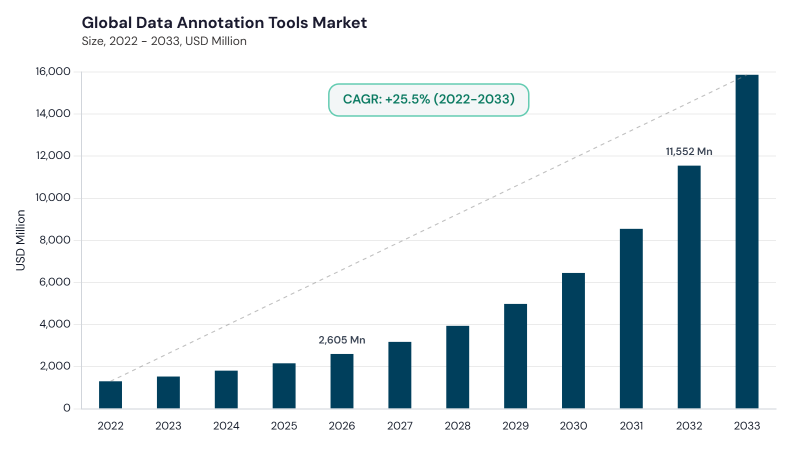
The Global Data Annotation Tools Market is expected to reach USD 15.9 billion by 2033, growing at a CAGR of 29.4% during 2026–2033. The report analyzes market size, growth trends, and opportunities across data types, annotation methods, deployment modes, components, industry verticals, and regions.

Data annotation tools are software platforms and associated services that label and organize text, images, video, audio, and sensor data for artificial intelligence and machine learning. Also described as data labeling tools, these solutions help teams build training datasets, validate model outputs, and manage human review. AI data annotation can involve text classification, named-entity tagging, image segmentation, speech transcription, and 3D object labeling. Consistent guidelines and quality checks make the resulting datasets more useful for AI training and model evaluation.
Organizations developing language models, recommendation systems, computer vision, and predictive analytics need curated datasets that reflect actual business conditions. Data annotation for AI training supports supervised learning, retrieval evaluation, safety testing, and comparisons of model responses. As projects move into production, demand extends beyond one-off labeling tasks to repeatable workflows that capture errors and feed corrected examples back into model development. This supports spending on annotation interfaces, dataset versioning, review operations, and integration with machine learning pipelines. Buyers increasingly assess these investments through label quality, reviewer consistency, and measurable improvements in model performance.
AI applications increasingly combine text, images, video, audio, and spatial information. Autonomous systems may need camera frames aligned with sensor data, while customer-service assistants may combine transcripts, intent labels, and response evaluations. These requirements create a role for multimodal data annotation tools with consistent labeling schemes and synchronized datasets. Temporal tracking, polygon segmentation, point-cloud labeling, and specialist review help address tasks beyond basic classification. Capturing edge cases and underrepresented conditions also makes reviewer calibration and annotation quality assurance central to dataset preparation.

Based on Data Type, the market is segmented into Text, Image, Video, Audio, 3D & Sensor Data, Others. Text dominated in 2025 and is projected to reach USD 5.0 billion by 2033, growing at a CAGR of 26.8%. 3D & Sensor Data is expected to record the highest CAGR of 39.7% during the forecast period.
Text annotation tools support tasks such as intent classification, entity recognition, and review of language-model responses. Image annotation tools create bounding boxes, polygons, keypoints, and segmentation masks for computer vision, while video annotation adds object tracking and event labeling over time. Audio annotation covers transcription, speaker identification, and sound classification. For 3D and sensor datasets, teams may need point-cloud labeling and alignment between multiple sensor streams. These differences make data compatibility and labeling precision important criteria when selecting a platform.
Based on Annotation Method, the market is segmented into Manual, Semi-Supervised, Automatic. Manual dominated in 2025 and is projected to reach USD 8.1 billion by 2033, growing at a CAGR of 26.6%. Automatic is expected to record the highest CAGR of 36.6% during the forecast period.
Manual data annotation relies on people to interpret content and apply labels, making it useful for ambiguous examples and tasks requiring domain expertise. Semi-Supervised workflows combine model suggestions with human validation, while Automatic annotation uses models to generate labels at scale. Model-assisted data labeling can reduce repetitive work, but teams still need to check errors, uncertain predictions, and consistency with project guidelines. Label Studio documents pre-annotation and interactive labeling workflows that connect machine learning models with human reviewers.
Based on Deployment Mode, the market is segmented into Cloud-Based, On-Premises. Cloud-Based dominated in 2025 and is projected to reach USD 10.8 billion by 2033, growing at a CAGR of 31.8%. Cloud-Based is expected to record the highest CAGR of 31.8% during the forecast period.
Cloud-based data annotation tools can support shared workspaces and distributed labeling teams without requiring buyers to manage every element of the application infrastructure. On-premises deployment gives organizations greater control over where sensitive datasets are processed and how systems connect to internal environments. Selection depends on security policies, data residency requirements, integration effort, and the scale of annotation activity. Procurement should also consider access controls, auditability, storage arrangements, and the practical cost of maintaining the chosen environment.
Based on Component, the market is segmented into Software Platforms, Services. Software Platforms dominated in 2025 and is projected to reach USD 7.8 billion by 2033, growing at a CAGR of 27.8%. Services is expected to record the highest CAGR of 31.3% during the forecast period.
Data annotation software platforms provide the interfaces and workflow controls used to create, review, and export labeled datasets. Data annotation services supply associated work such as labeling, specialist review, project coordination, and quality assurance. Buyers may operate software internally, use external annotation teams, or combine both approaches. Service requirements vary with language coverage, task complexity, and the need for domain expertise. The distinction matters because spending on annotation labor and managed delivery should not be confused with software licensing alone.
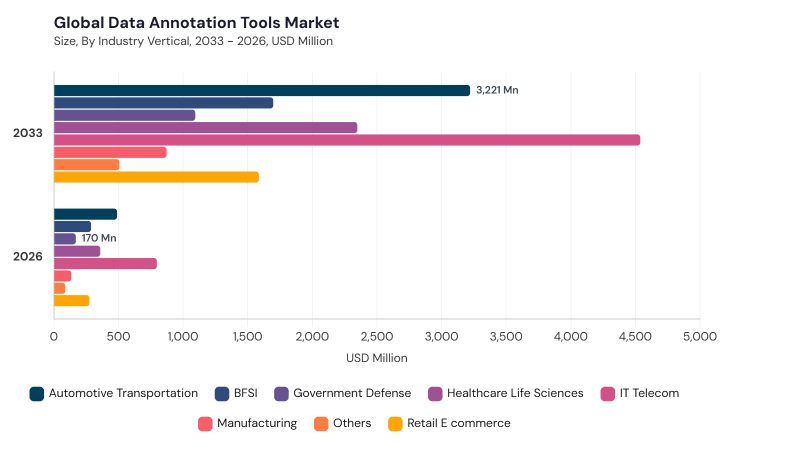
Based on Industry Vertical, the market is segmented into IT & Telecom, Automotive & Transportation, Healthcare & Life Sciences, BFSI, Retail & E-commerce, Government & Defense, Manufacturing, Others. IT & Telecom dominated in 2025 and is projected to reach USD 4.5 billion by 2033, growing at a CAGR of 28.2%. Automotive & Transportation is expected to record the highest CAGR of 30.9% during the forecast period.
IT and telecom applications include document classification, conversational AI, and customer-support automation. Automotive and transportation workflows use image, video, and sensor annotation for perception and mobility applications. Healthcare and life sciences can require specialist review of clinical text and medical images, while BFSI applications place emphasis on document understanding and controlled handling of sensitive information. Retail, manufacturing, government, and defense use cases create additional requirements around product recognition, visual inspection, and context-specific labeling. Each vertical places different demands on accuracy, security, and reviewer expertise.
Free Valuable Insights: Data Annotation Tools Market Size to reach $15.9 Billion by 2033
Region-wise, the Data Annotation Tools Market is analyzed across North America, Europe, Asia Pacific, LAMEA. North America led in 2025 and is projected to reach USD 5.9 billion by 2033, growing at a CAGR of 28.7%. Europe is projected to grow at a CAGR of 28.6%. Asia Pacific is projected to grow at a CAGR of 31.2%. LAMEA is projected to grow at a CAGR of 29.6%.
Regional purchasing decisions reflect differences in enterprise AI adoption, available annotation expertise, language requirements, and data governance. North American buyers may assess platforms for integration with established AI development workflows, while European deployments must account for applicable privacy and data-handling requirements. Asia Pacific presents varied requirements across languages, industry applications, and local deployment environments. In LAMEA, multilingual coverage, implementation support, and accessible delivery models are relevant considerations. Regional comparisons therefore require attention to both software deployment and the services needed to operate annotation projects.
By Data Type
By Annotation Method
By Deployment Mode
By Component
By Industry Vertical
By Geography
| Report Attribute | Details |
|---|---|
| Market size value in 2026 | USD 2.6 billion |
| Market size forecast in 2033 | USD 15.9 billion |
| Base Year | 2025 |
| Historical Period | 2022 to 2024 |
| Forecast Period | 2026 to 2033 |
| Revenue Growth Rate | CAGR of 29.4% from 2026 to 2033 |
| Number of Tables | 810 |
| Number of Figures | 135 |
| Report Coverage | Market Trends, Revenue Estimation and Forecast, Segmentation Analysis, Regional and Country Breakdown, Competitive Landscape |
| Segments Covered | Data Type, Annotation Method, Deployment Mode, Component, Industry Vertical and Geography |
| Country Scope |
|
By Geography
Valued at USD 2.6 billion in 2026, it's projected to reach USD 15.9 billion by 2033, growing at 29.4% CAGR during 2026-2033.
Text annotation leads, expected to reach USD 5.0 billion by 2033.
Top companies include Cisco, IBM, Microsoft, and Google.
North America leads, projected to reach USD 5.9 billion by 2033.
Expansion of Enterprise AI and Generative Model Development are key growth drivers.
Cloud-Based deployment leads, expected to reach USD 10.8 billion by 2033.
Our team of dedicated experts can provide you with attractive expansion opportunities for your business.




