“Global Coconut Derivatives Market to reach a market value of USD 54.08 Billion by 2032 growing at a CAGR of 9.5%”
The Global Coconut Derivatives Market size is expected to reach $54.08 billion by 2032, rising at a market growth of 9.5% CAGR during the forecast period.
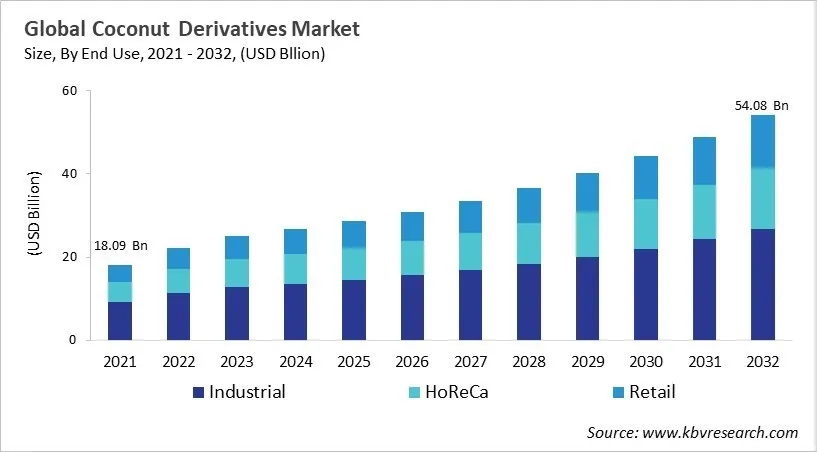
The coconut derivatives market has recently developed into a diverse industry covering cosmetics, food & beverages, and industrial applications. The market for coconut derivatives has witnessed a noticeable shift with the rising popularity of coconut derivatives such as coconut milk and cream in plant-based diets, coconut water as a hydration drink, and coconut oil for personal care and wellness. Further, the market revenue is also anticipated to expand due to growing usage in the industrial sector as coir and activated carbon. Producer nations like Sri Lanka, India, Indonesia, Philippines stand as global suppliers, supporting expansion in the regional markets.
The consumer demand for coconut derivatives is surging as a result of the shift towards health-driven, sustainable, and premium coconut products. Key players in personal care, food & beverages companies are embedding ethical provenance and sourcing into their branding. Furthermore, coconut producing nations are widely upgrading their supply chains, focusing towards branded and processed goods like coconut water, coir products, and virgin coconut oil. Personal care and cosmetic companies are harnessing clean-label positioning to gain market position. Traceability, sustainability, and compliance with global standards have developed as a competitive factor across all segments.

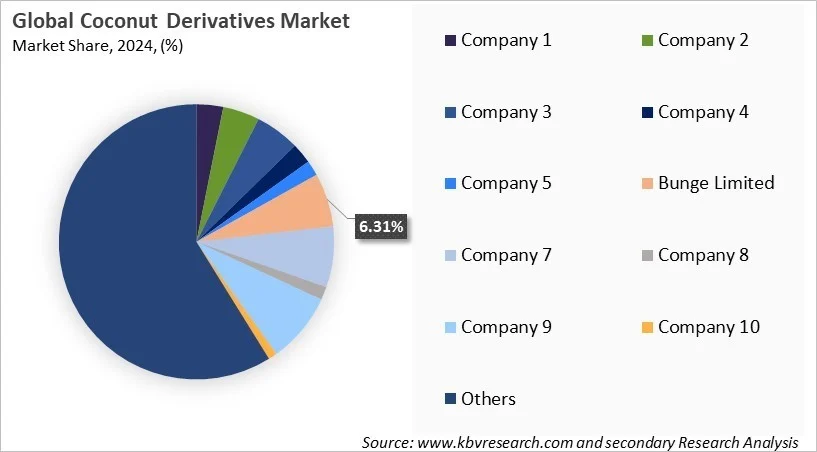
The leading players in the market are competing with diverse innovative offerings to remain competitive in the market. The above illustration shows the percentage of revenue shared by some of the leading companies in the market. The leading players of the market are adopting various strategies in order to cater demand coming from the different industries. The key developmental strategies in the market are Acquisitions, and Partnerships & Collaborations.
Lockdowns in important coconut-producing countries like the Philippines, Indonesia, and India made it hard to harvest, process, and move coconut derivatives during the COVID-19 pandemic. Supply chain problems, port restrictions, rising shipping costs, and a lack of workers all caused prices and supply to be unstable. At the same time, industrial demand fell because of economic uncertainty. But as people became more health-conscious and started buying more natural and plant-based products, the demand for coconut water, milk, and virgin coconut oil grew. The rise in home cooking, the growth of e-commerce, and the stronger sustainability stories from big companies all helped the market stay strong. This set the stage for long-term recovery, even though there were short-term problems. Thus, the COVID-19 pandemic had a negative impact on the market.
Based on End User, the market is segmented into Industrial, HoReCa, and Retail. The HoReCa segment procured 26.5% revenue share in the market in 2024. Its growth is fueled by the increasing demand for coconut derivatives in foodservice outlets for preparing beverages, desserts, and international cuisines. Coconut milk, cream, and oil are widely used in hotels and restaurants for their flavor, texture, and nutritional value. The rising popularity of plant-based diets has also prompted chefs to incorporate coconut-based ingredients into mainstream menus.
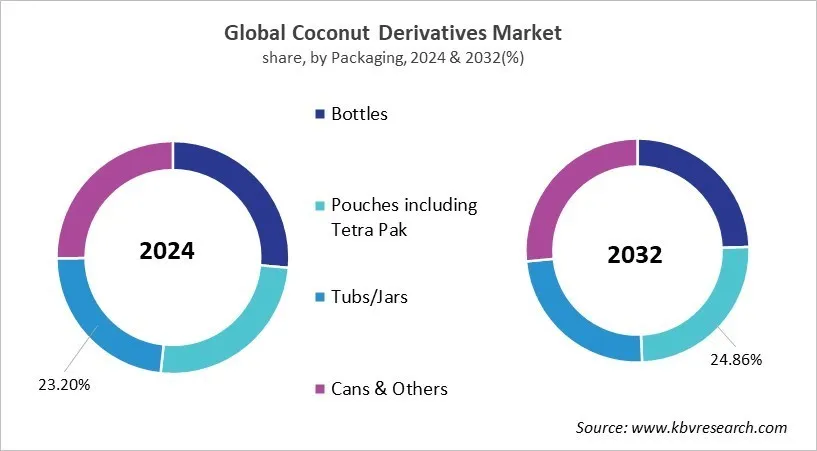
Based on Packaging, the market is segmented into Bottles, Pouches including Tetra Pak, Tubs/Jars, and Cans & Others. The Pouches including Tetra Pak segment recorded 25.3% revenue share in the market in 2024. These packaging solutions are valued for being lightweight, eco-friendly, and cost-effective compared to rigid alternatives. Tetra Pak and similar formats provide excellent protection against light, air, and contaminants, thereby ensuring longer shelf life. Their compact design makes storage and transportation more efficient, appealing to both retailers and consumers.
Free Valuable Insights: Global Coconut Derivatives Market size to reach USD 54.08 Billion by 2032
Region-wise, the market is analyzed across North America, Europe, Asia Pacific, and LAMEA. The Asia Pacific segment procured 48.4% revenue share in the market in 2024. The coconut derivatives market is anticipated to expand in the North America and Europe regions. This is supported by rising consumer demand for plant-based, clean-label, and natural products. The demand for coconut water has widened as a hydrating drink, driven by beverage brands. Virgin coconut oil, coconut milk, and dream are also gaining traction into gluten-free, dairy-alternative, and vegan diets. In Europe, the coconut derivatives market is driven by traceability and sustainability are key themes supporting expansion. Brand differentiation, premium positioning, and innovation in packaging and flavor are elements intensifying the competition among global and regional positioning.
The coconut derivatives market in the Asia Pacific and LAMEA region is predicted to experience growth. This is due to the diverse consumption patterns and supply strength of the regions. The market growth in Asia Pacific is supported by the processing capacities of regional nations such as Sri Lanka, India, Indonesia and Philippines, leading to high availability of branded virgin oils, activated carbon, and coconut water. Key players in the region hold a strong position in hair and edible oil categories, backed by well-established supply chains. Moreover, the LAMEA coconut derivatives market is experiencing positive opportunities. Government initiatives in farmer training and replanting in order to stabilize supply, along with allowing producers to gain market positioning.
| Report Attribute | Details |
|---|---|
| Market size value in 2025 | USD 28.66 Billion |
| Market size forecast in 2032 | USD 54.08 Billion |
| Base Year | 2024 |
| Historical Period | 2021 to 2023 |
| Forecast Period | 2025 to 2032 |
| Revenue Growth Rate | CAGR of 9.5% from 2025 to 2032 |
| Number of Pages | 516 |
| Number of Tables | 509 |
| Report coverage | Market Trends, Revenue Estimation and Forecast, Segmentation Analysis, Regional and Country Breakdown, Market Share Analysis, Porter’s 5 Forces Analysis, Company Profiling, Companies Strategic Developments, SWOT Analysis, Winning Imperatives |
| Segments covered | End User, Retail Type, Packaging, Product Type, Region |
| Country scope |
|
| Companies Included | Axelum Resources Corp., The Vita Coco Company, Inc., Marico Limited, Thai Coconut Public Co., Ltd., Sambu Group, Bunge Limited, Cargill, Incorporated, Nutiva, Inc., Wilmar International Ltd, and Greenville Agro Corporation |
By End User
By Retail Type
By Packaging
By Product Type
By Geography
The market size is projected to reach USD 54.08 Billion billion by 2032.
The coconut derivatives market is projected to grow at a CAGR of 9.5% between 2025 and 2032.
Rising global demand for plant-based and natural products alongside expanding applications across food, beverage, and personal care industries.
Axelum Resources Corp., The Vita Coco Company, Inc., Marico Limited, Thai Coconut Public Co., Ltd., Sambu Group, Bunge Limited, Cargill, Incorporated, Nutiva, Inc., Wilmar International Ltd, and Greenville Agro Corporation
The Bottles segment led the maximum revenue in the Global Coconut Derivatives Market by Packaging in 2024, thereby, achieving a market value of $13.2 billion by 2032.
The Asia Pacific region dominated the Global Coconut Derivatives Market by Region in 2024, and would continue to be a dominant market till 2032; thereby, achieving a market value of $24.1 billion by 2032.
Our team of dedicated experts can provide you with attractive expansion opportunities for your business.







 Unique Offerings