“Global Co-Packaged Optics Testing Equipment Market to reach a market value of USD 355.81 Million by 2033 growing at a CAGR of %”
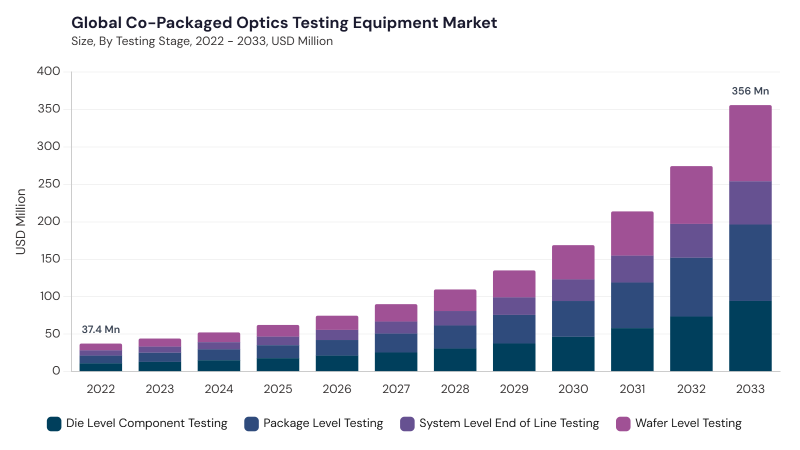
The Global Co-Packaged Optics Testing Equipment Market is expected to reach USD 355.8 million by 2033, growing at a CAGR of 25.0 % during (2026 - 2033).
Co-packaged optics (CPO) testing equipment refers to instruments and integrated systems used to evaluate photonic components and optical engines packaged alongside high-performance electronic chips. Core functions include optical characterization, high-speed electrical measurement, wafer probing, optical alignment, package validation, and thermal and reliability assessment. Unlike conventional optical transceiver testing, CPO testing must address closely integrated optical and electronic functions across several manufacturing stages. Its scope extends from evaluating individual photonic devices to verifying the performance of completed packages and systems.
Large AI clusters require communication fabrics that move substantial data between computing resources. As electrical transmission paths become harder to manage at higher speeds, CPO offers a route to placing optical conversion nearer the processing or switching device. Every new design must establish that its optical engines, electronic interfaces and assembled links meet performance targets. This creates demand for characterization and validation before production capacity is committed. Commercially, equipment purchases follow design qualification milestones and manufacturing ramps rather than AI spending in general. Suppliers therefore benefit most when their platforms support the specific interface speeds, lane counts and operating conditions of customer programs.
Integrating multiple photonic and electronic components increases the financial consequence of discovering a defective part late in assembly. Screening wafers, dies and optical engines before integration can reduce avoidable packaging expenditure and improve failure diagnosis. This supports demand for equipment that produces credible known-good-die and known-good-engine information. The business case depends on the balance between screening cost and the downstream loss it prevents. Buyers are likely to favor systems that detect consequential defects while avoiding excessive retest or false rejection. Early screening is especially valuable when it connects measurable device characteristics to subsequent package performance, rather than simply adding another inspection step.
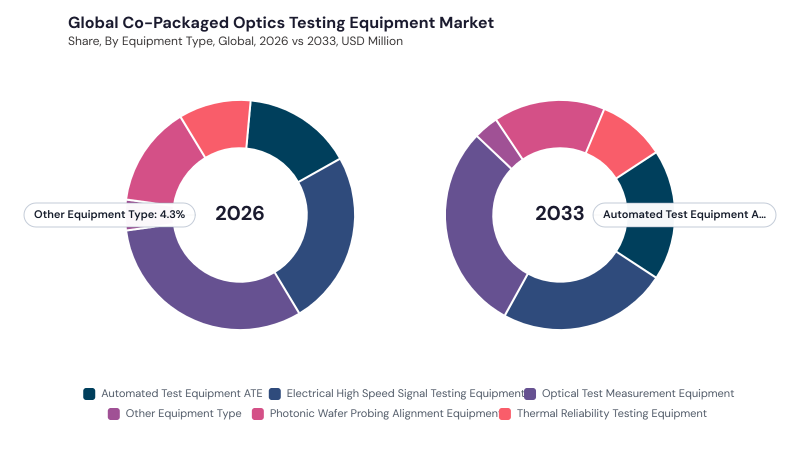
Based on Equipment Type, the market is segmented into Optical Test & Measurement Equipment, Electrical & High-Speed Signal Testing Equipment, Automated Test Equipment (ATE), Photonic Wafer Probing & Alignment Equipment, Thermal & Reliability Testing Equipment, Other Equipment Type. Optical Test & Measurement Equipment dominated in 2025 and is projected to reach USD 103.5 million by 2033, growing at a CAGR of 23.6%. Automated Test Equipment (ATE) is expected to record the highest CAGR of 28.3% during the forecast period.
The market is segmented into Optical Test & Measurement Equipment, Electrical & High-Speed Signal Testing Equipment, Automated Test Equipment (ATE), Photonic Wafer Probing & Alignment Equipment, Thermal & Reliability Testing Equipment, and Others. Optical instruments characterize light generation, transmission and reception, while electrical equipment evaluates the electronic interfaces and signal behavior. ATE coordinates repeatable device stimulation and production measurements. Wafer probing and alignment systems establish physical optical and electrical access; thermal and reliability equipment applies controlled conditions for performance and stress evaluation. Others covers ancillary test-specific equipment that does not fit these primary categories. Because a turnkey cell may contain several equipment classes, revenue allocation should count each sale once under a consistent primary-function rule.
Based on Testing Stage, the market is segmented into Wafer-Level Testing, Die-Level & Component Testing, Package-Level Testing, System-Level & End-of-Line Testing. Die-Level & Component Testing dominated in 2025 and is projected to reach USD 94.3 million by 2033, growing at a CAGR of 23.6%. Wafer-Level Testing is expected to record the highest CAGR of 27.1% during the forecast period.
Based on Test Parameter, the market is segmented into Optical Performance Testing, Electrical & Signal Integrity Testing, Optical Alignment & Coupling Testing, Thermal & Reliability Testing. Optical Performance Testing dominated in 2025 and is projected to reach USD 124.9 million by 2033, growing at a CAGR of 23.8%. Optical Alignment & Coupling Testing is expected to record the highest CAGR of 27.1% during the forecast period.
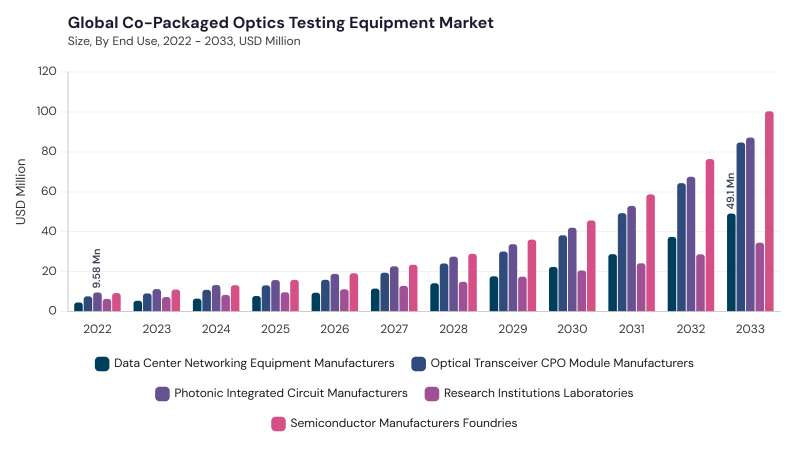
Based on End Use, the market is segmented into Semiconductor Manufacturers & Foundries, Photonic Integrated Circuit Manufacturers, Optical Transceiver & CPO Module Manufacturers, Data Center & Networking Equipment Manufacturers, Research Institutions & Laboratories. Semiconductor Manufacturers & Foundries dominated in 2025 and is projected to reach USD 100.3 million by 2033, growing at a CAGR of 26.6%. Optical Transceiver & CPO Module Manufacturers is expected to record the highest CAGR of 27.0% during the forecast period.
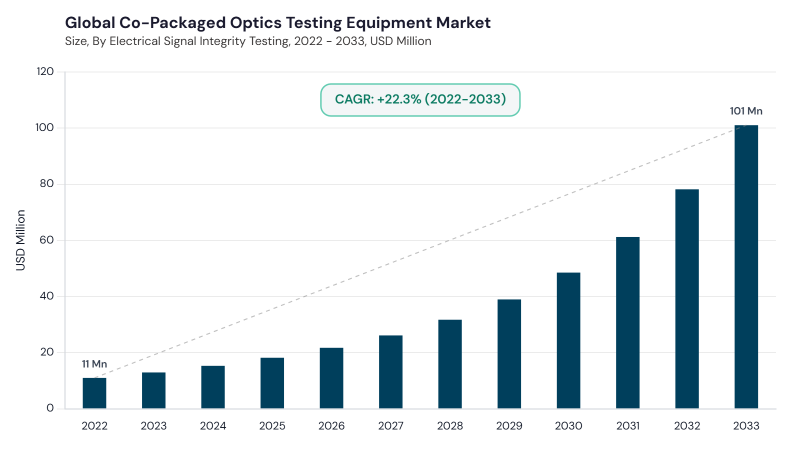
Region-wise, the Co-Packaged Optics Testing Equipment Market is analyzed across North America, Europe, Asia Pacific, LAMEA. North America led in 2025 and is projected to reach USD 124.5 million by 2033, growing at a CAGR of 23.9%. Europe is projected to grow at a CAGR of 23.4%. Asia Pacific is projected to grow at a CAGR of 26.8%. LAMEA is projected to grow at a CAGR of 28.2%.
By Equipment Type
By Testing Stage
By Test Parameter
By End Use
| Report Attribute | Details |
|---|---|
| Market size value in 2026 | USD 74.6 million |
| Market size forecast in 2033 | USD 355.8 million |
| Base Year | 2025 |
| Historical Period | 2022 to 2024 |
| Forecast Period | 2026 to 2033 |
| Revenue Growth Rate | CAGR of 25.0% from 2026 to 2033 |
| Number of Tables | 720 |
| Number of Figures | 120 |
| Report Coverage | Market Trends, Revenue Estimation and Forecast, Segmentation Analysis, Regional and Country Breakdown, Competitive Landscape |
| Segments Covered | Equipment Type, Testing Stage, Test Parameter, End Use and Geography |
| Country Scope |
|
By Geography
The Global Co-Packaged Optics Testing Equipment Market is projected to reach USD 355.8 million by 2033, growing at a CAGR of 25.0% during 2026–2033, from USD 74.6 million in 2026.
Market growth is driven by increasing bandwidth requirements in AI data centers, demand for energy-efficient optical interconnects, adoption of advanced semiconductor packaging, and the need for precise ptical and electrical testing of co-packaged optics components.
Automated Test Equipment (ATE) is projected to register the fastest growth, with a 28.3% CAGR during 2026–2033. Optical Test & Measurement Equipment dominated in 2025 and is projected to reach USD 103.5 million by 2033.
Wafer-Level Testing is projected to register the highest growth among testing stages, with a 27.1% CAGR, while Optical Alignment & Coupling Testing is expected to lead test parameter growth, also registering a 27.1% CAGR during 2026–2033.
Optical Transceiver & CPO Module Manufacturers is expected to register the fastest growth, with a 27.0% CAGR during 2026–2033. Semiconductor Manufacturers & Foundries dominated in 2025 and are projected to reach USD 100.3 million by 2033.
North America dominated the market in 2025 and is projected to reach USD 124.5 million by 2033, growing at a CAGR of 23.9% during 2026–2033. LAMEA is expected to register the fastest regional growth, with a CAGR of 28.2%.
Our team of dedicated experts can provide you with attractive expansion opportunities for your business.