The sample copy of this report is available for access.
“Global Cloud-Based Workload Scheduling Automation Market to reach a market value of USD 4733.65 Million by 2033 growing at a CAGR of %”
The Global Cloud-Based Workload Scheduling Automation Market is expected to reach USD 4.7 billion by 2033, growing at a CAGR of 11.0% during (2026 - 2033).
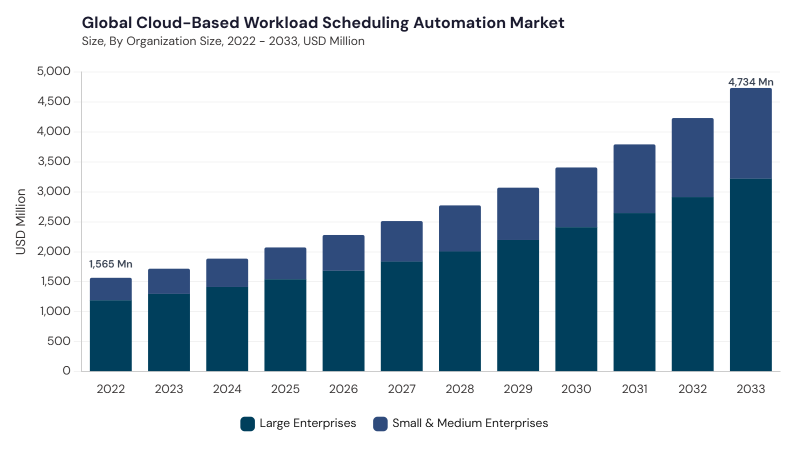
Cloud-based workload scheduling automation uses cloud-hosted or cloud-deployed software to coordinate when jobs run, which conditions must be satisfied, and how related tasks proceed across applications and infrastructure. The market covers eligible scheduling platforms and associated services for business processes, data pipelines, and IT operations. Its value comes from completing dependable workflows across systems, rather than simply launching tasks at a specified time. Buyers evaluate dependency management, failure handling, operational visibility, integration coverage, and the effort needed to administer the platform.
A business process may require several systems to complete tasks in the correct sequence, even when each system has its own scheduler. Central orchestration can make those relationships explicit and give operators a shared view of execution. This creates demand where disconnected scripts or local schedules make failures difficult to trace. The value is strongest when the platform can coordinate actual prerequisites and business conditions, rather than merely consolidating a list of launch times. Integration depth and reliable dependency handling are therefore central purchasing considerations.
Operational deadlines can depend on several upstream jobs finishing successfully. Delayed data preparation, file movement, or application processing may prevent a downstream service from completing on time. Workload automation provides a framework for representing those dependencies and managing the resulting sequence. BMC documentation describes scheduling criteria, job dependencies, and resource controls within Control-M SaaS. For buyers, the commercial objective is dependable business completion and faster diagnosis when progress is interrupted, rather than the number of scheduled jobs alone.
Based on Component, the market is segmented into Software, Services. Software dominated in 2025 and is projected to reach USD 3.2 billion by 2033, growing at a CAGR of 10.0%. Services is expected to record the highest CAGR of 13.3% during the forecast period.
By Component, Software accounted for 71.20% in 2025 and Services represented 28.80%. Software covers eligible scheduling engines, workflow design, dependencies, integrations, monitoring, and administration. Services cover defined implementation, migration, training, support, and operational assistance. Customers can require both to establish dependable automation. Subscription bundles need consistent allocation so included maintenance or support is not counted twice. Underlying hardware and cloud-compute spending should not automatically enter scheduling-software revenue.
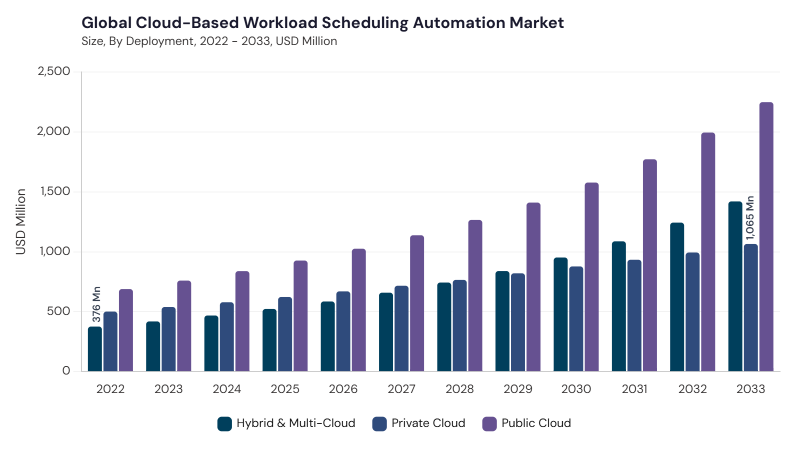
Based on Deployment, the market is segmented into Public Cloud, Private Cloud, Hybrid & Multi-Cloud. Public Cloud dominated in 2025 and is projected to reach USD 2.2 billion by 2033, growing at a CAGR of 11.9%. Hybrid & Multi-Cloud is expected to record the highest CAGR of 13.5% during the forecast period.
By Component, Software accounted for 71.20% in 2025 and Services represented 28.80%. Software covers eligible scheduling engines, workflow design, dependencies, integrations, monitoring, and administration. Services cover defined implementation, migration, training, support, and operational assistance. Customers can require both to establish dependable automation. Subscription bundles need consistent allocation so included maintenance or support is not counted twice. Underlying hardware and cloud-compute spending should not automatically enter scheduling-software revenue.
Based on Organization Size, the market is segmented into Large Enterprises, Small & Medium Enterprises. Large Enterprises dominated in 2025 and is projected to reach USD 3.2 billion by 2033, growing at a CAGR of 9.7%. Small & Medium Enterprises is expected to record the highest CAGR of 14.2% during the forecast period.
By Component, Software accounted for 71.20% in 2025 and Services represented 28.80%. Software covers eligible scheduling engines, workflow design, dependencies, integrations, monitoring, and administration. Services cover defined implementation, migration, training, support, and operational assistance. Customers can require both to establish dependable automation. Subscription bundles need consistent allocation so included maintenance or support is not counted twice. Underlying hardware and cloud-compute spending should not automatically enter scheduling-software revenue.
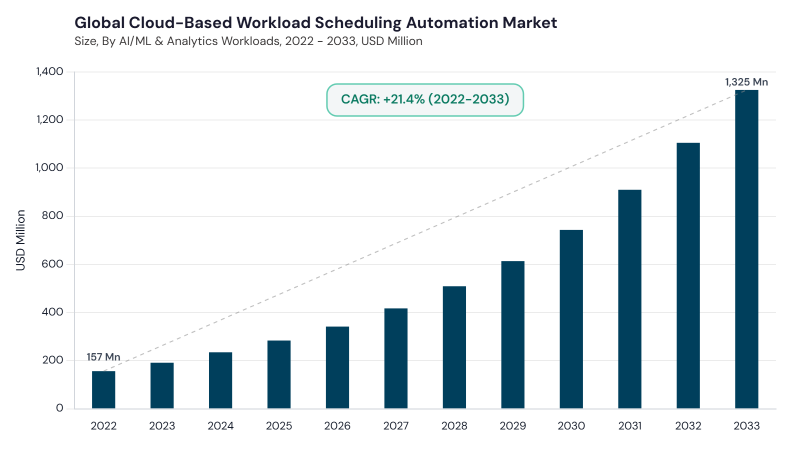
Based on Workload Type, the market is segmented into Data Processing & ETL, Application & Business Process Workloads, Infrastructure & IT Operations, AI/ML & Analytics Workloads. Application & Business Process Workloads dominated in 2025 and is projected to reach USD 1.2 billion by 2033, growing at a CAGR of 8.1%. AI/ML & Analytics Workloads is expected to record the highest CAGR of 21.4% during the forecast period.
By Component, Software accounted for 71.20% in 2025 and Services represented 28.80%. Software covers eligible scheduling engines, workflow design, dependencies, integrations, monitoring, and administration. Services cover defined implementation, migration, training, support, and operational assistance. Customers can require both to establish dependable automation. Subscription bundles need consistent allocation so included maintenance or support is not counted twice. Underlying hardware and cloud-compute spending should not automatically enter scheduling-software revenue.
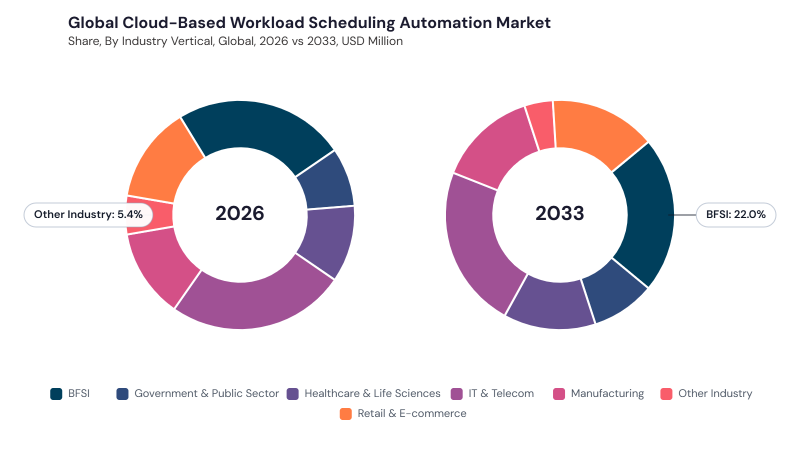
Based on Industry Vertical, the market is segmented into BFSI, IT & Telecom, Retail & E-commerce, Healthcare & Life Sciences, Manufacturing, Government & Public Sector, Other Industry. IT & Telecom dominated in 2025 and is projected to reach USD 1.1 billion by 2033, growing at a CAGR of 9.6%. Healthcare & Life Sciences is expected to record the highest CAGR of 13.9% during the forecast period.
By Component, Software accounted for 71.20% in 2025 and Services represented 28.80%. Software covers eligible scheduling engines, workflow design, dependencies, integrations, monitoring, and administration. Services cover defined implementation, migration, training, support, and operational assistance. Customers can require both to establish dependable automation. Subscription bundles need consistent allocation so included maintenance or support is not counted twice. Underlying hardware and cloud-compute spending should not automatically enter scheduling-software revenue.
Region-wise, the Cloud-Based Workload Scheduling Automation Market is analyzed across North America, Europe, Asia Pacific, LAMEA. North America led in 2025 and is projected to reach USD 1.6 billion by 2033, growing at a CAGR of 8.8%. Europe is projected to grow at a CAGR of 9.2%. Asia Pacific is projected to grow at a CAGR of 14.3%. LAMEA is projected to grow at a CAGR of 14.5%.
| Report Attribute | Details |
|---|---|
| Market size value in 2026 | USD 2.3 billion |
| Market size forecast in 2033 | USD 4.7 billion |
| Base Year | 2025 |
| Historical Period | 2022 to 2024 |
| Forecast Period | 2026 to 2033 |
| Revenue Growth Rate | CAGR of 11.0% from 2026 to 2033 |
| Number of Tables | 720 |
| Number of Figures | 120 |
| Report Coverage | Market Trends, Revenue Estimation and Forecast, Segmentation Analysis, Regional and Country Breakdown, Competitive Landscape |
| Segments Covered | Component, Deployment, Organization Size, Workload Type, Industry Vertical and Geography |
| Country Scope | North America: United States, Canada, Mexico, Rest of North America; Europe: Germany, United Kingdom, France, Russia, Spain, Italy, Rest of Europe; Asia Pacific: China, Japan, India, South Korea, Singapore, Malaysia, Rest of Asia Pacific; LAMEA: Brazil, Argentina, United Arab Emirates, Saudi Arabia, South Africa, Nigeria, Rest of LAMEA |
By Component
By Deployment
By Organization Size
By Workload Type
By Industry Vertical
By Geography
Expected to reach USD 4733.6 million by 2033, with an 11.0% CAGR during 2026–2033.
Hybrid & Multi-Cloud deployment is among the fastest-growing segments, driven by increasing demand for workload orchestration across multiple cloud environments.
BMC Software, Redwood Software, Broadcom, Stonebranch, HCLSoftware, and Amazon Web Services
North America is expected to maintain a leading position by 2033.
Growing demand for workload coordination across applications and infrastructure, and the need for reliable automation of complex business processes.
The market size is projected to reach USD 4733.6 million by 2033.
Our team of dedicated experts can provide you with attractive expansion opportunities for your business.






 Unique Offerings
