The sample copy of this report is available for access.
“Global Clinical Data Analytics Market to reach a market value of USD 6,89,114.5 Million by 2033 growing at a CAGR of 27.2%”
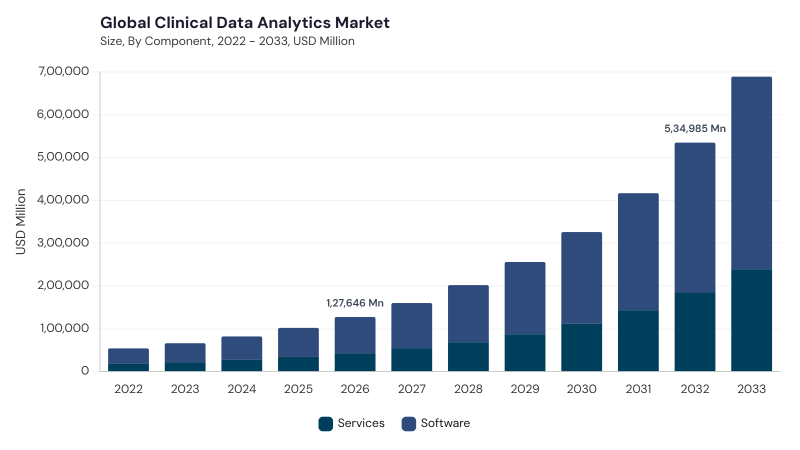
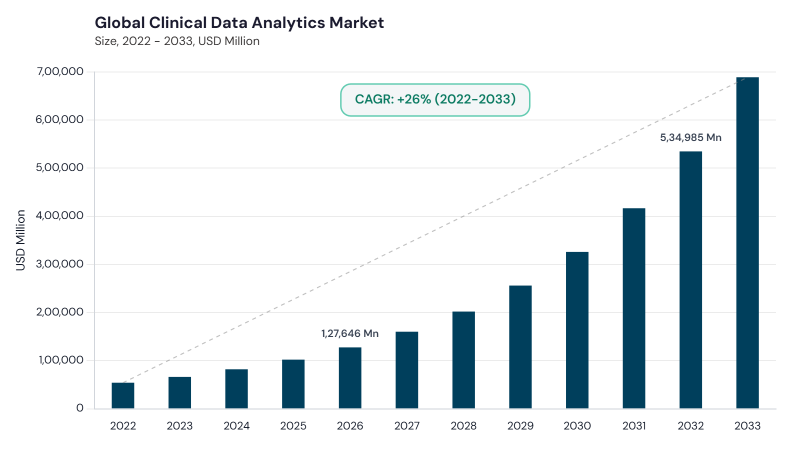
The Global Clinical Data Analytics Market is expected to reach USD 689114.5 million by 2033, growing at a CAGR of 27.2% during 2026 - 2033.
The Global Clinical Data Analytics Market has become an essential component of modern healthcare systems as organizations increasingly leverage data-driven insights to improve patient outcomes, optimize healthcare operations, and support evidence-based decision-making. Clinical data analytics involves the collection, integration, management, and analysis of healthcare information generated from electronic health records, clinical trials, laboratory systems, diagnostic platforms, medical devices, and patient monitoring technologies. Growing healthcare digitalization, increasing adoption of electronic health records, and rising demand for value-based care models have significantly accelerated the adoption of advanced clinical analytics solutions across healthcare ecosystems.
Expansion of healthcare interoperability frameworks and standardized data exchange initiatives. The market continues to evolve with advancements in artificial intelligence, machine learning, predictive analytics, cloud computing, and interoperability technologies. Healthcare providers, payers, pharmaceutical companies, and research organizations are increasingly investing in analytics platforms to enhance clinical decision-making, improve operational efficiency, support population health management, and advance precision medicine initiatives.
The increasing volume of healthcare data generated through connected healthcare systems, telemedicine platforms, wearable devices, and genomics research is further strengthening demand for sophisticated analytics solutions capable of transforming complex healthcare information into actionable insights.
The Clinical Data Analytics Market is characterized by a competitive landscape comprising healthcare technology providers, healthcare software vendors, cloud service providers, analytics platform developers, and life sciences technology companies. Competition is driven by artificial intelligence capabilities, predictive analytics performance, interoperability features, scalability, cybersecurity, cloud integration, and healthcare domain expertise. Market participants continue to strengthen their positions through technological innovation, strategic partnerships, acquisitions, cloud platform expansion, and integration of advanced analytics capabilities across healthcare ecosystems.
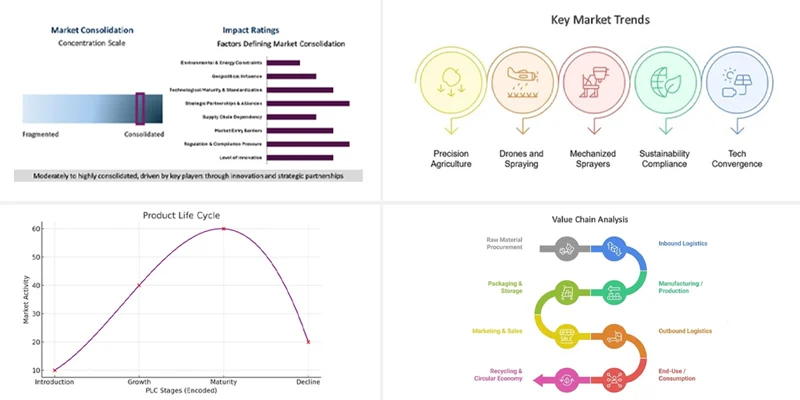

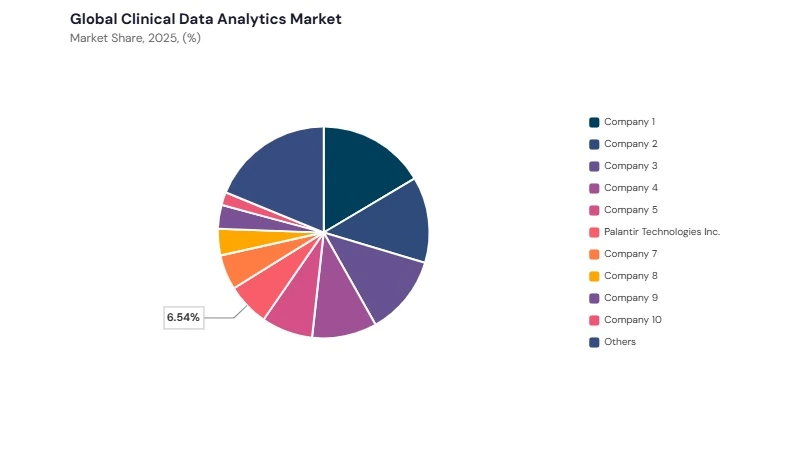
The Clinical Data Analytics Market demonstrates moderate consolidation with leading healthcare technology providers, healthcare analytics vendors, cloud infrastructure companies, and life sciences analytics firms competing through innovation and platform integration capabilities. Market participants continue investing in artificial intelligence, predictive analytics, cloud-based healthcare platforms, interoperability frameworks, and real-time clinical intelligence solutions. Competition increasingly focuses on healthcare data integration, clinical decision support, population health management, precision medicine enablement, and regulatory compliance capabilities.
Based on Component, the market is segmented into Software and Services. The Software market dominated the Global Clinical Data Analytics Market by Component in 2025, and would continue to be a dominant market till 2033; thereby, achieving a market value of USD 450156.5 million by 2033, growing at a CAGR of 27 % during the forecast period. The Services market is expected to witness a CAGR of 27.8% during (2026 - 2033).
Software solutions represent a significant segment driven by increasing demand for advanced analytics platforms capable of processing large volumes of clinical and healthcare data to support patient care, operational optimization, predictive analytics, and healthcare intelligence. Services continue to witness strong demand due to increasing requirements for implementation, consulting, integration, maintenance, support, training, and managed analytics services. Growing complexity of healthcare data environments and increasing adoption of advanced analytics technologies continue supporting demand across both segments.
Based on Deployment Model, the market is segmented into Cloud-Based and On-Premise. Cloud-Based deployment continues to gain traction due to scalability, flexibility, cost efficiency, centralized data management, and improved accessibility to healthcare insights across distributed healthcare environments. Healthcare organizations increasingly adopt cloud-based platforms to support real-time analytics and interoperability initiatives. On-Premise deployment remains relevant among organizations prioritizing direct control over sensitive healthcare data, cybersecurity management, regulatory compliance, and customized healthcare IT environments.
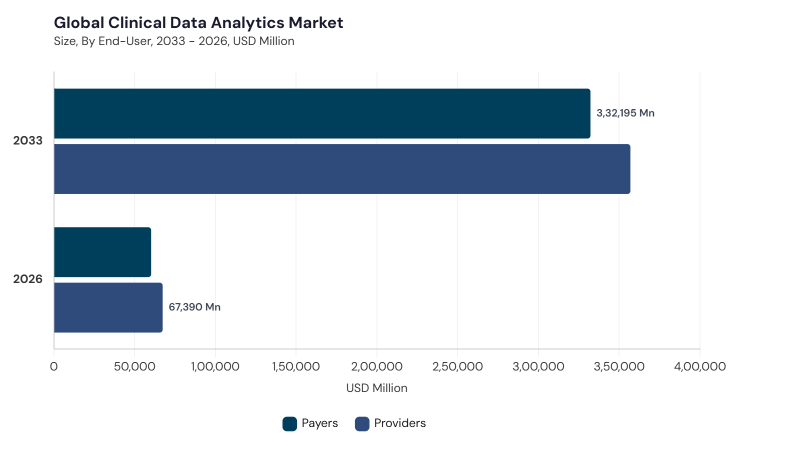
Based on End User, the market is segmented into Providers and Payers. The Providers market dominated the Global Clinical Data Analytics Market by End-User in 2025, and would continue to be a dominant market till 2033; thereby, achieving a market value of USD 356919.3 million by 2033, growing at a CAGR of 26.9 % during the forecast period. The Payers market is expected to witness a CAGR of 27.6% during (2026 - 2033).
Providers continue to adopt clinical analytics solutions to improve patient care, optimize workflows, enhance treatment outcomes, support clinical decision-making, and strengthen population health initiatives. Payers increasingly utilize analytics platforms for claims management, fraud detection, risk assessment, healthcare cost optimization, and value-based reimbursement strategies. Growing emphasis on data-driven healthcare management continues supporting adoption across both end-user segments.
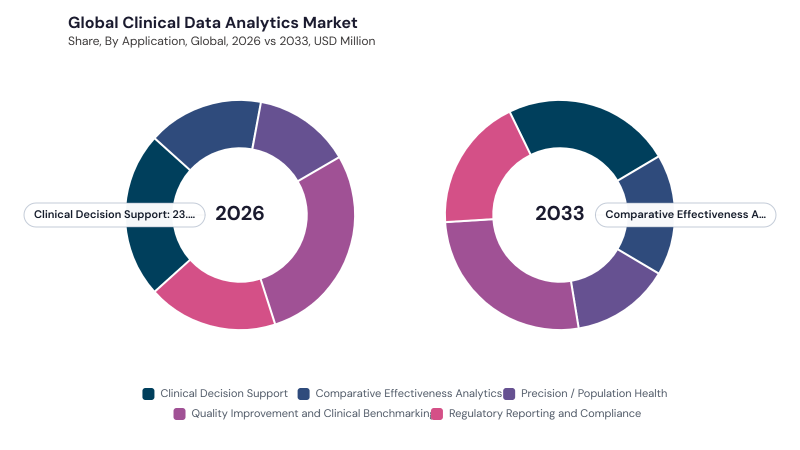
Based on Application, the market is segmented into Quality Improvement and Clinical Benchmarking, Clinical Decision Support, Regulatory Reporting and Compliance, Comparative Effectiveness Analytics, and Precision / Population Health. Healthcare organizations increasingly utilize these analytics applications to improve care quality, support evidence-based medicine, optimize healthcare operations, ensure regulatory compliance, evaluate treatment effectiveness, and advance personalized healthcare strategies. Growing healthcare complexity and increasing focus on outcome-based care continue driving adoption across all application segments.
Free Valuable Insights: Clinical Data Analytics Market Size to reach $6,89,114.5 Million by 2033
Region-wise, the Clinical Data Analytics Market is analyzed across North America, Europe, Asia Pacific, and LAMEA. The North America market dominated the Global Clinical Data Analytics Market by Region in 2025, and would continue to be a dominant market till 2033; thereby, achieving a market value of USD 306380.3 million by 2033, growing at a CAGR of 26.7 % during the forecast period.The Asia Pacific market is expected to witness a CAGR of 28.1% during (2026 - 2033). Additionally, The Europe market is expected to witness a CAGR of 27% during (2026 - 2033).
North America continues to maintain a strong market position due to advanced healthcare IT infrastructure, widespread electronic health record adoption, and significant investments in healthcare analytics. Europe benefits from growing healthcare digitalization initiatives and increasing focus on healthcare quality improvement. Asia Pacific is witnessing rapid expansion driven by healthcare infrastructure modernization, digital transformation programs, and increasing healthcare analytics adoption. LAMEA continues to emerge as a promising market supported by healthcare modernization initiatives and growing investments in digital healthcare infrastructure.
Clinical Data Analytics Market Coverage
| Report Attribute | Details |
|---|---|
| Market size value in 2026 | USD 1,27,645.5 Million |
| Market size forecast in 2033 | USD 6,89,114.5 Million |
| Base Year | 2025 |
| Historical Period | 2022 to 2024 |
| Forecast Period | 2026 to 2033 |
| Revenue Growth Rate | CAGR of 27.2% from 2026 to 2033 |
| Number of Pages | 622 |
| Tables | 690 |
| Report Coverage | Market Trends, Revenue Estimation and Forecast, Segmentation Analysis, Regional and Country Breakdown, Competitive Landscape, Market Share Analysis, Company Profiling, Strategic Developments, SWOT Analysis, Product Life Cycle Analysis, Value Chain Analysis, Market Consolidation Analysis, Key Customer Criteria, and Winning Imperatives |
| Segments Covered | Component, Deployment Model, End User, Application, Region |
| Country Scope |
|
| Companies Included | UnitedHealth Group (Optum), Oracle Corporation, IQVIA Holdings Inc., Epic Systems Corporation, SAS Institute Inc., Dassault Systèmes SE (Medidata), Cognizant Technology Solutions Corporation, Health Catalyst, Inc., eClinical Solutions LLC, OSP Labs |
By Component
By Deployment Model
By End User
By Application
By Geography
Expected to reach USD 689,114.5 million by 2033, with a 27.2% CAGR during 2026-2033.
Providers segment leads, growing at a 26.9% CAGR during 2026-2033.
UnitedHealth Group, Oracle Corporation, IQVIA Holdings, Epic Systems, and SAS Institute are key players.
North America dominates, reaching USD 306,380.3 million by 2033.
Adoption of EHRs and AI integration in healthcare drive market growth.
Asia Pacific is expected to witness a 28.1% CAGR during 2026-2033.
Our team of dedicated experts can provide you with attractive expansion opportunities for your business.








 Unique Offerings