
“Global Botanical Fermented Beverages Market to reach a market value of USD 8943.78 Million by 2033 growing at a CAGR of %”
The Global Botanical Fermented Beverages Market is expected to reach USD 8.9 billion by 2033, growing at a CAGR of 12.6% during (2026 - 2033).
Botanical fermented beverages are drinks produced through fermentation and characterized by plant-derived ingredients such as tea, herbs, flowers, roots, or spices. As a beverage category within the broader field of fermented foods, these products are made through microbial fermentation, but their defining feature is a drinkable format with a clear botanical identity. The category includes botanical kombucha, herbal and floral ferments, water kefir with botanical ingredients, and qualifying root- or spice-based beverages. Botanicals can form the fermentation substrate or be added for flavor during or after fermentation. A plant-flavored soft drink is not automatically a fermented beverage, so product composition and production method are central to the market definition.
Botanical ingredients give fermented beverages a broad sensory vocabulary, from floral aromas to herbal notes and warming spice. Fermentation adds another dimension through the product’s acidity and overall drinking profile. GT’s Living Foods lists elderflower, jasmine, and violet in its Bloom kombucha, while Brew Dr. describes a jasmine-tea blend with chamomile, lavender, and rose. These examples show how producers can differentiate beyond familiar fruit flavors. Demand depends on a balanced finished drink, with approachable descriptions helping consumers understand an unfamiliar combination before deciding to try it.
A botanical fermented drink can serve occasions that would otherwise involve another soft drink or a more elaborate beverage. Suppliers can emphasize flavor complexity, serving rituals, and compatibility with meals without depending exclusively on wellness messaging. The commercial driver is a recognizable role in the consumer’s routine, supported by appropriate pack sizes and availability. Brands need to be precise about alcohol content and local product classification when positioning drinks for particular occasions. A sophisticated flavor can support trial, but sustainable demand requires a price and experience consumers are willing to choose repeatedly.
Based on Beverage Type, the market is segmented into Botanical Kombucha, Fermented Herbal & Floral Beverages, Botanical Water Kefir, Fermented Root & Spice Beverages, Other Botanical Fermented Beverages. Botanical Kombucha dominated in 2025 and is projected to reach USD 5.9 billion by 2033, growing at a CAGR of 11.6%. Fermented Herbal & Floral Beverages is expected to record the highest CAGR of 15.7% during the forecast period.
By Beverage Type, the market comprises Botanical Kombucha, Fermented Herbal & Floral Beverages, Botanical Water Kefir, Fermented Root & Spice Beverages, and Other Botanical Fermented Beverages. Botanical kombucha follows a kombucha fermentation platform with an eligible botanical identity, while herbal and floral beverages cover qualifying ferments outside the separately identified kombucha and water-kefir groups. Botanical water kefir uses the relevant water-kefir fermentation system with included botanical ingredients. Root and spice beverages capture qualifying products characterized by those bases, while others includes remaining eligible drinks. Classification should follow fermentation platform before flavor so that a ginger kombucha is not also counted as a separate root ferment.
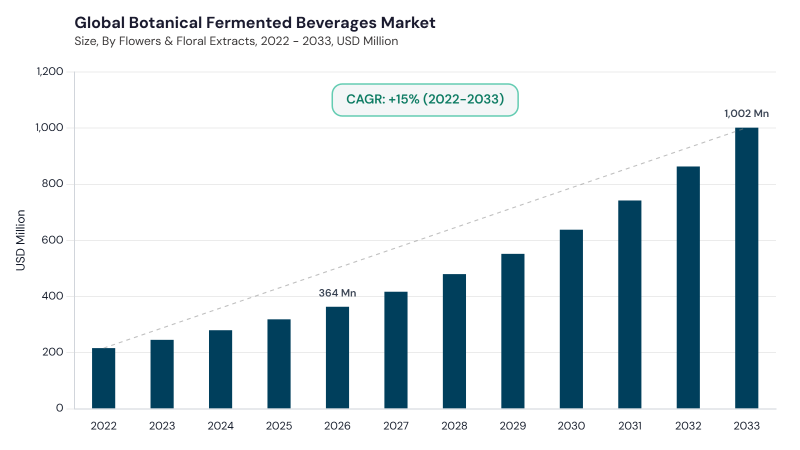
Based on Botanical Ingredient, the market is segmented into Tea Leaves, Herbs & Spices, Flowers & Floral Extracts, Roots & Rhizomes, Other Botanical Ingredients. Tea Leaves dominated in 2025 and is projected to reach USD 5.2 billion by 2033, growing at a CAGR of 11.3%. Flowers & Floral Extracts is expected to record the highest CAGR of 15.6% during the forecast period.
Based on Nature, the market is segmented into Organic, Conventional. Conventional dominated in 2025 and is projected to reach USD 5.1 billion by 2033, growing at a CAGR of 11.5%. Organic is expected to record the highest CAGR of 14.3% during the forecast period.
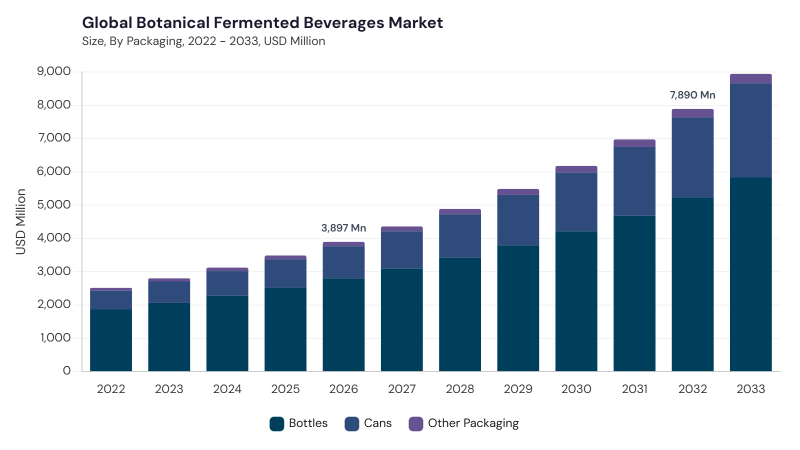
Based on Packaging, the market is segmented into Bottles, Cans, Other Packaging. Bottles dominated in 2025 and is projected to reach USD 5.8 billion by 2033, growing at a CAGR of 11.1%. Cans is expected to record the highest CAGR of 16.4% during the forecast period.
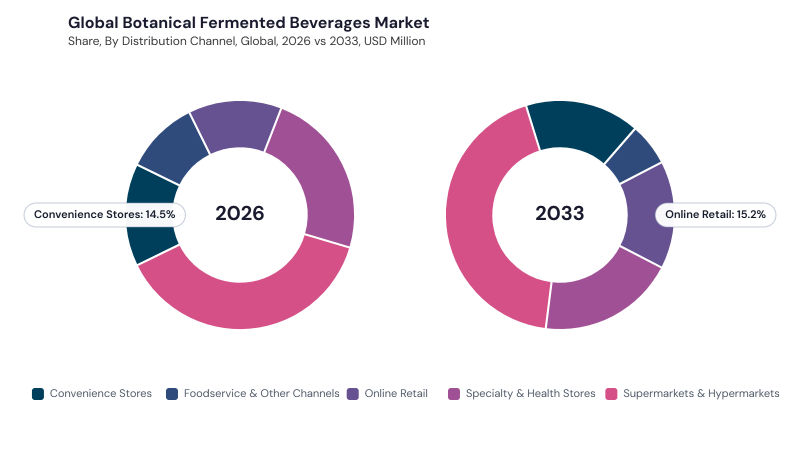
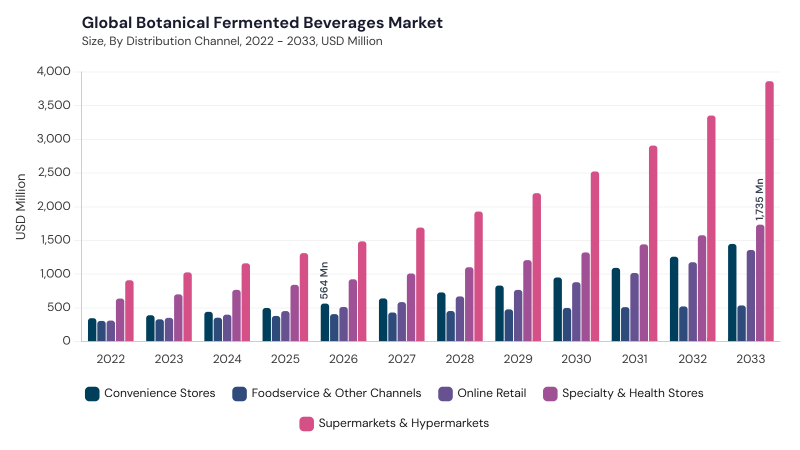
Based on Distribution Channel, the market is segmented into Supermarkets & Hypermarkets, Convenience Stores, Specialty & Health Stores, Online Retail, Foodservice & Other Channels. Supermarkets & Hypermarkets dominated in 2025 and is projected to reach USD 3.9 billion by 2033, growing at a CAGR of 14.6%. Online Retail is expected to record the highest CAGR of 14.9% during the forecast period.
Region-wise, the Botanical Fermented Beverages Market is analyzed across North America, Europe, Asia Pacific, LAMEA. North America led in 2025 and is projected to reach USD 3.5 billion by 2033, growing at a CAGR of 11.6%. Europe is projected to grow at a CAGR of 11.3%. Asia Pacific is projected to grow at a CAGR of 15.1%. LAMEA is projected to grow at a CAGR of 15.8%.
By Beverage Type
By Botanical Ingredient
By Nature
By Packaging
By Distribution Channel
| Report Attribute | Details |
|---|---|
| Market size value in 2026 | USD 3.9 billion |
| Market size forecast in 2033 | USD 8.9 billion |
| Base Year | 2025 |
| Historical Period | 2022 to 2024 |
| Forecast Period | 2026 to 2033 |
| Revenue Growth Rate | CAGR of 12.6% from 2026 to 2033 |
| Number of Tables | 780 |
| Number of Figures | 130 |
| Report Coverage | Market Trends, Revenue Estimation and Forecast, Segmentation Analysis, Regional and Country Breakdown, Competitive Landscape |
| Segments Covered | Beverage Type, Botanical Ingredient, Nature, Packaging, Distribution Channel and Geography |
| Country Scope |
|
By Geography
The market is projected to reach USD 8.9 billion by 2033, growing at a CAGR of 12.6% during 2026–2033, from USD 3.9 billion in 2026.
Growth is driven by increasing interest in distinctive botanical flavors, fermented beverage varieties, premium refreshment options, and expanding availability through retail and online distribution channels.
Fermented Herbal & Floral Beverages is projected to register the highest growth, with a 15.7% CAGR during 2026–2033, supported by product innovation using herbs, flowers, and distinctive botanical flavor combinations.
Flowers & Floral Extracts is expected to record the fastest growth, registering a 15.6% CAGR during 2026–2033, driven by increasing product differentiation through floral ingredients such as jasmine, elderflower, lavender, and rose.
Online Retail is projected to grow at the fastest rate, with a 14.9% CAGR during 2026–2033. Supermarkets & Hypermarkets remained the leading distribution channel in 2025 and are projected to reach USD 3.9 billion by 2033.
North America dominated the market in 2025 and is projected to reach USD 3.5 billion by 2033, growing at a CAGR of 11.6% during 2026–2033. LAMEA is expected to register the fastest regional growth, with a CAGR of 15.8%.
Our team of dedicated experts can provide you with attractive expansion opportunities for your business.




